Choosing the right social-impact approach is essential for modern organizations — and understanding the Difference Between CSI and CSR helps companies align their strategies with long-term sustainability. Many people use CSI (Corporate Social Investment) and CSR (Corporate Social Responsibility) interchangeably, but they are not the same. While CSI focuses on specific social or community investments, CSR refers to a company’s overall ethical, environmental, and social responsibility framework.
This guide explains the Difference Between CSI and CSR, with examples, comparisons, similarities, FAQs, and a clear conclusion.
Overview and Key Difference
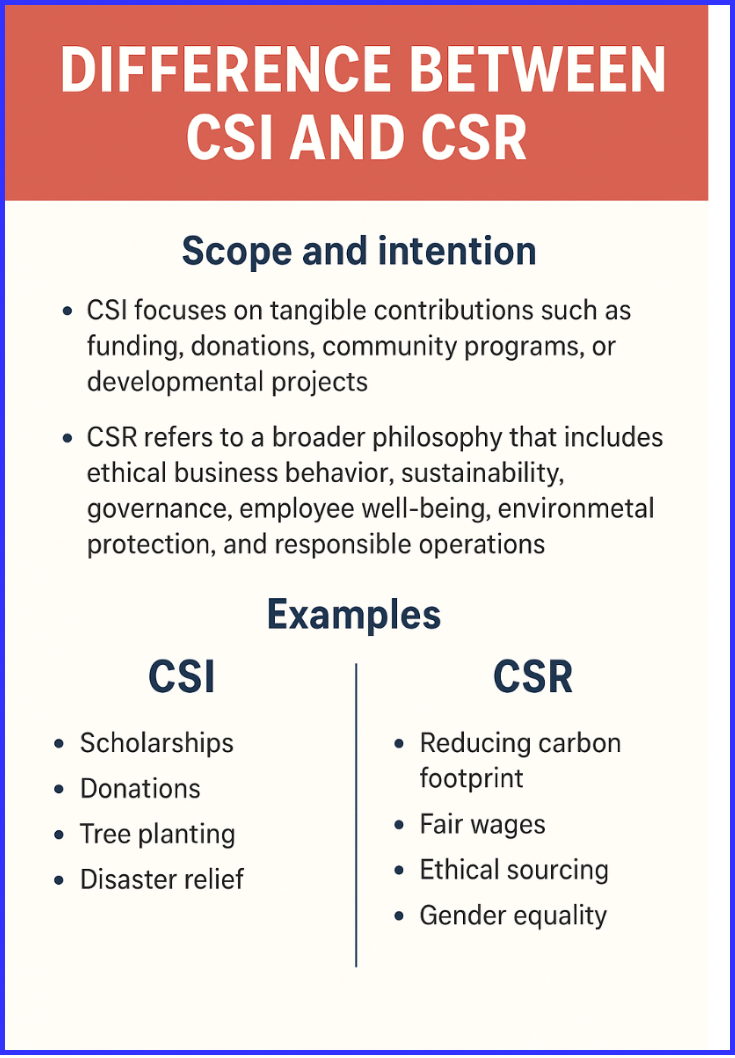
The primary Difference Between CSI and CSR lies in scope and intention:
- CSI (Corporate Social Investment) focuses on tangible contributions such as funding, donations, community programs, or developmental projects.
- CSR (Corporate Social Responsibility) is a broader philosophy that includes ethical business behavior, sustainability, governance, employee well-being, environmental protection, and responsible operations.
In short, CSI is a subset of CSR, but CSR covers the entire business ecosystem.
What is CSI (Corporate Social Investment)?
Corporate Social Investment (CSI) refers to intentional, measurable investments made by a company to uplift communities, improve quality of life, and support social development.
CSI projects are usually planned, financed, and executed separately from profit-generating operations.
Key Features of CSI
- Involves financial contributions, grants, or sponsorships
- Focuses on external social upliftment
- Aims for long-term community development
- Usually documented and measurable
Common Examples of CSI
- Educational investments:
- Funding scholarships for underprivileged students
- Setting up digital learning centers in rural areas
- Community healthcare:
- Donating medical equipment to public hospitals
- Sponsoring health awareness campaigns
- Environmental projects:
- River-cleaning drives
- Mangrove restoration projects
- Vocational skill development:
- Training unemployed youth in technical trades
- Supporting women’s self-help groups
- Disaster relief:
- Providing emergency funds, food kits, shelter materials
Why CSI Matters
Companies invest in CSI to build stronger communities, which eventually results in:
- A healthier consumer base
- Better employability within communities
- Long-term brand trust
- Positive social change aligned with national development goals
CSI creates direct social impact, even if it does not deliver immediate financial returns.
What is CSR (Corporate Social Responsibility)?
Corporate Social Responsibility is a broad business-level strategy where companies operate ethically, sustainably, and responsibly toward society, the environment, and all stakeholders.
CSR ensures that every aspect of business behavior — from sourcing materials to treating employees — aligns with global sustainability and governance standards.
Core Pillars of CSR
- Environmental Responsibility
- Reducing emissions
- Waste management
- Switching to renewable energy
- Sustainable supply chains
- Ethical Responsibility
- Fair business practices
- Anti-corruption policies
- Transparent governance
- Social Responsibility
- Employee welfare
- Diversity and inclusion
- Community support programs
- Economic Responsibility
- Supporting local economies
- Fair taxation
- Creating jobs
Examples of CSR
- Using eco-friendly packaging
- Ensuring zero child labor in the supply chain
- Offering fair wages and safe working conditions
- Implementing diversity and inclusion policies
- Publishing transparent ESG (Environmental, Social, Governance) reports
- Adopting green manufacturing processes
CSR is not a one-time activity — it is a company-wide culture that influences decisions, policies, operations, and leadership.
Similarities Between CSI and CSR
Both CSI and CSR:
- Aim to improve society and promote sustainable development
- Are often voluntary efforts beyond legal compliance
- Enhance brand reputation and stakeholder trust
- Strengthen community relationships
- Align with global frameworks like UN SDGs (Sustainable Development Goals)
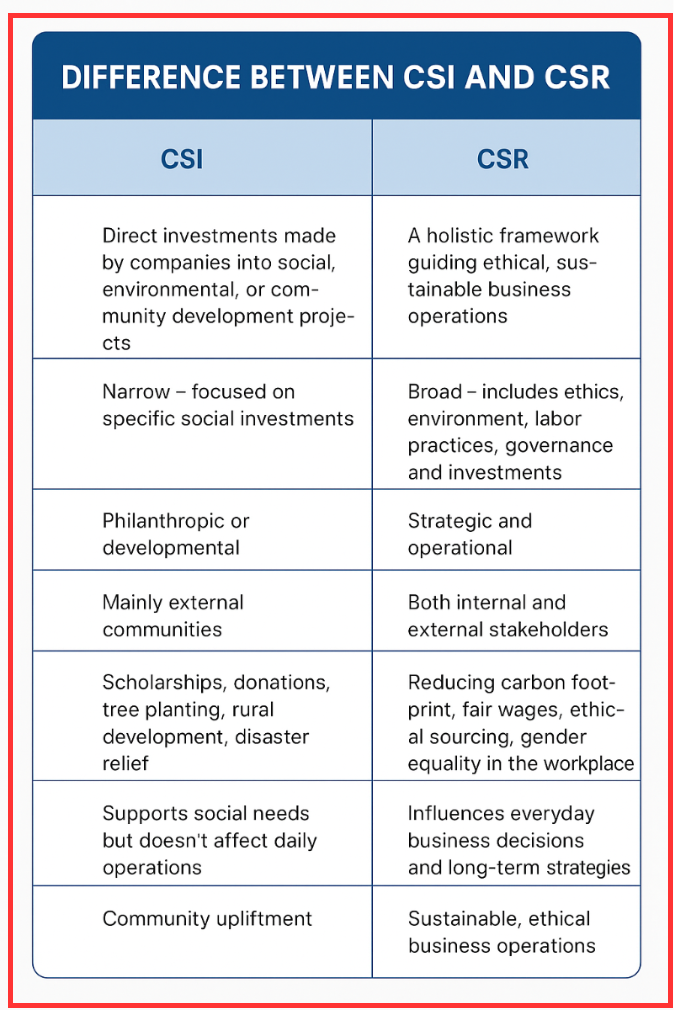
CSI vs CSR – Comparison Table
| Aspect | CSI (Corporate Social Investment) | CSR (Corporate Social Responsibility) |
| Definition | Direct investments made by companies into social, environmental, or community development projects. | A holistic framework guiding ethical, sustainable business operations. |
| Scope | Narrow – focused on specific social investments. | Broad – includes ethics, environment, labor practices, governance, and investments. |
| Nature | Philanthropic or developmental. | Strategic and operational. |
| Impact Area | Mainly external communities. | Both internal and external stakeholders. |
| Examples | Scholarships, donations, tree planting, rural development, disaster relief. | Reducing carbon footprint, fair wages, ethical sourcing, gender equality in the workplace. |
| Role in Business | Supports social needs but doesn’t affect daily operations. | Influences everyday business decisions and long-term strategies. |
| Primary Intent | Community upliftment. | Sustainable, ethical business operations. |
Summary – CSI vs CSR
The Difference Between CSI and CSR is simple yet fundamental: CSI is about investment, while CSR is about responsibility.
CSI focuses on monetary, measurable contributions, whereas CSR governs a company’s entire ethical, environmental, and social conduct. In essence, CSI is one of the many components that fall under CSR.
Conclusion
Understanding the Difference Between CSI and CSR is crucial for businesses that want to create meaningful social impact while maintaining responsible operations. CSI focuses on direct community investments, whereas CSR shapes the overall ethical and sustainable direction of a company. Businesses that strategically combine both can build trust, strengthen communities, and achieve long-term sustainability.
FAQ: CSI and CSR
Corporate Environmental Responsibility focuses only on environmental protection, while CSR covers a broader range, including ethics, employee welfare, and community development.
CSR: Ensures ethical and sustainable business behavior.
CSE (Corporate Social Entrepreneurship): Uses business innovation to solve social problems and generate social value.
Environmental responsibility
Ethical responsibility
Philanthropic responsibility
Economic responsibility
CSR = Company’s external social and environmental impact
Business ethics = Internal principles that guide behavior and decision-making
Social responsibility = General obligation to society
CSR = Specific corporate strategy and policies related to ethics and sustainability
Reference:
1. “Cooperate Social Investment.” Trialogue Knowledge Hub.
Read Next: