The difference between then and than is that then refers to time (meaning “at that time,” “next,” or “afterward”), while than is used for comparisons (such as “taller than” or “more important than”).
In simple words: then = time, and than = comparison.
Meaning of Then
Then is used to indicate time or a sequence of events.
It refers to something happening at a particular moment, or after another action.
You use then when describing what happened next, what happened afterward, or what existed at a specific time in the past.
Then – Etymology
The word then originated from:
- Old English: þanne, þænne
- Meaning: “at that time,” “soon after,” or “next in order”
- Evolution: Over centuries, it retained its meaning of referring to time or sequence.
So, then literally relates to time or progression.
Sentence Examples of Then
- I finished my homework, then went to play.
- Back then, we did not have smartphones.
- If you are free, then join us for dinner.
- She looked at the sky, then smiled softly.
- First mix the ingredients, then bake for 20 minutes.
Uses and Attributes of Then
People often use then when they want their speech or writing to flow logically.
Here’s how then functions:
1. Shows Time
Indicating when something happened.
Example: I was in college back then.
2. Shows Sequence
One step after another.
Example: He washed his hands, then cooked dinner.
3. Shows Result or Condition
Often paired with “if.”
Example: If you agree, then we can begin.
4. Adds Information
Sometimes used like “also.”
Example: And then, there is another point.
Attributes of “then”:
- Sequential
- Time-related
- Logical
- Smooth flow of ideas
Meaning of Than
Than is used to make comparisons between two things, people, actions, or qualities.
When you compare differences in height, age, quantity, preference, or choice, you use than.
Than – Etymology
The word than comes from:
- Old English: þanne, þan
- Meaning: “then, when, after”
- Later evolved into a comparative conjunction during Middle English
- Modern use: strictly used for comparisons
So, than is deeply rooted in showing differences between two things.
Sentence Examples of Than
- She is taller than her brother.
- I would rather stay home than go out.
- This book is more interesting than the movie.
- He is wiser than people realize.
- They have fewer challenges than before.
Uses and Attributes of Than
Here’s how than works in English:
1. Comparative Conjunction
Used with adjectives or adverbs.
Example: faster than, older than, happier than
2. Shows Preference
Example: I would rather walk than drive.
3. Shows Exception (rare usage)
Example: No sooner had we reached than it started raining.
4. Creates Contrast
Example: She is more cautious than confident.
Attributes of “than”:
- Comparative
- Differentiating
- Contrast-making
- Precise and clear
Key Differences Between Then and Than
| Feature | Then | Than |
| Meaning | Time / sequence | Comparison |
| Part of Speech | Adverb (mostly) | Conjunction / preposition |
| Use | “What happened next?” | “How two things differ” |
| Example | “We ate, then left.” | “She is taller than me.” |
| Memory Trick | E = event/time | A = comparison (as in compare) |
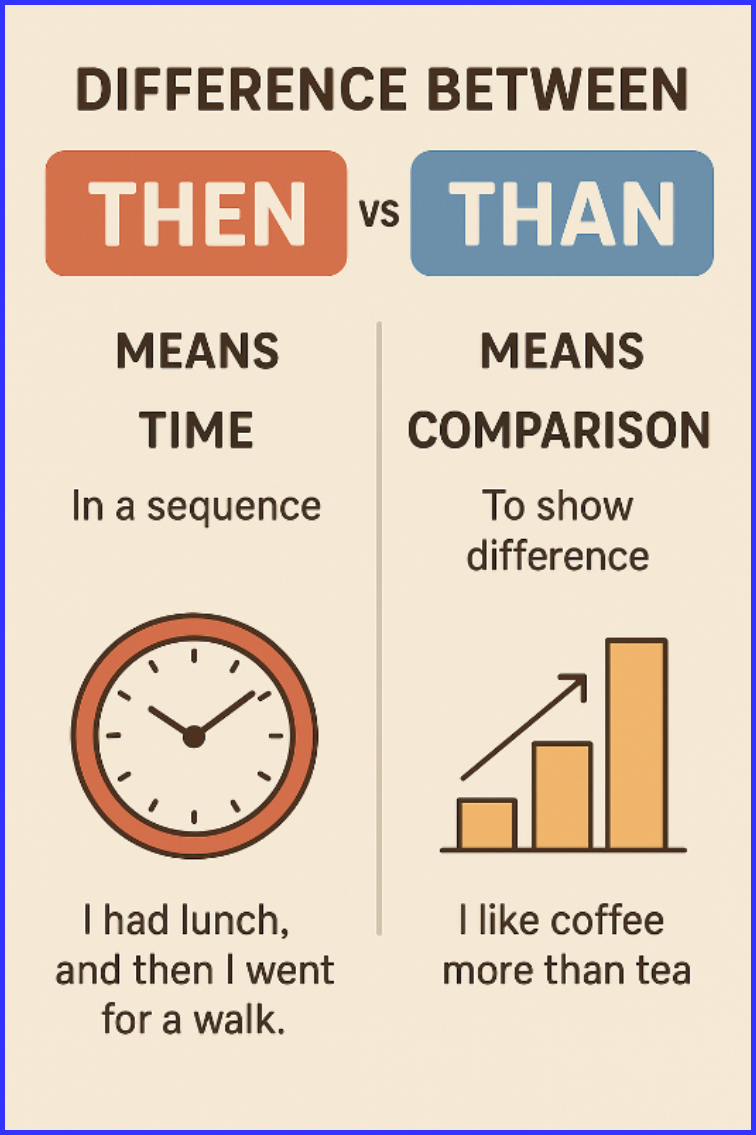
Easy Illustration to Understand the Difference
You wake up → eat breakfast → then go to work.
(Sequence of actions)
Than:
Tea is stronger than coffee.
(Comparison)
Story: Arya and Rohan — Then vs Than
“First, let’s understand the words, then we will practice.”
Rohan replied, “I think English is harder than science.”
Arya laughed and said,
“Yes, but if we study well, then we will score higher than everyone else!”
By the end of the day, they practiced, reviewed, then took the quiz together.
Arya scored slightly higher than Rohan—but both understood the grammar perfectly.
Conclusion
Understanding the difference between then and than helps you write clearly and confidently.
Remember: then relates to time and sequence, while than is all about comparison.
Once you know this simple rule, you will make fewer errors and build stronger writing skills.
Read Next: