The difference between Baptist and Presbyterian lies mainly in their beliefs about baptism, salvation, church governance, and scriptural authority. Baptists emphasize believer’s baptism and salvation through personal faith in Christ, while Presbyterians accept both infant and believer’s baptism and strongly uphold the doctrine of predestination. This article explains all key differences in detail with clear examples.
The difference between Baptist and Presbyterian churches begins with how each group interprets baptism, salvation, church structure, and the role of scripture. Baptists believe baptism is only for individuals who consciously profess faith in Jesus, while Presbyterians allow both infants and adults to be baptized as a sign of God’s covenant. Let’s explore their beliefs deeply.
Who Is a Baptist?
Baptists are Christians who prioritize personal faith and the authority of the Bible. They believe in a direct relationship between the individual and God.
Key Beliefs of Baptists
1. Believer’s Baptism Only
Baptists baptize only individuals who personally confess faith in Christ.
Example: A 20-year-old who accepts Christ can be baptized. A newborn cannot.
2. Salvation Through Faith Alone
Baptists teach that salvation is received only by faith in God, not through rituals or predetermined destiny.
3. No Baptism for Infants
Since infants cannot express faith, Baptists do not practice infant baptism.
4. No Prayer to Saints or Mary
Prayers are directed only to Jesus Christ. Baptist worship focuses on direct communication with God, without intermediaries.
5. View on Soul and Afterlife
Baptists do not accept the idea of purgatory. They believe the soul’s destiny is directly connected to one’s faith.
6. Limited Emphasis on Sacraments
Baptists observe the Lord’s Supper and Baptism as symbolic acts rather than channels of grace.
Who Is a Presbyterian?
Presbyterians follow the Reformed tradition and hold strong theological views shaped by John Calvin.
Key Beliefs of Presbyterians
1. Infant and Believer’s Baptism
Presbyterians baptize:
- Adults who profess faith
- Infants born into Christian families
This is based on the belief that baptism is a covenant sign.
2. Belief in Predestination
Presbyterians strongly believe that God has already chosen who will be saved.
Example: Salvation is predetermined, not earned by actions.
3. Sacraments as Symbols
Presbyterians believe that Baptism and the Lord’s Supper are symbols of God’s grace, not literal means of grace.
4. Importance of Human Reason
Unlike Baptists, Presbyterians hold that:
- Scriptures are central, but
- Human reasoning also helps understand God’s teachings.
5. Communion Is Symbolic
Presbyterians teach that communion represents Christ’s body and blood, but is not literally transformed.
6. Structured Church Governance
Presbyterian churches are governed by elders (presbyters), forming a hierarchical organizational structure.
Baptist vs Presbyterian: Detailed Differences
Below is a clear comparison of the main differences between Baptist and Presbyterian beliefs.
1. Baptism Practices
Baptists
- Only baptize those who personally accept Christ
- Avoid infant baptism
- Practice immersion as the preferred mode
Presbyterians
- Baptize infants and adults
- View baptism as a covenant sign
- May use sprinkling or pouring
2. Belief About Salvation
Baptists
- Salvation comes solely through personal faith
- Reject predestination (though some Baptist groups accept it)
Presbyterians
- Strongly teach predestination
- God chooses who is saved
3. Scriptures and Interpretation
Baptists
- Bible alone is the final authority
- Do not elevate human reasoning or traditions
Presbyterians
- Bible is primary but human reasoning is essential
- Encourage theological study and intellectual interpretation
4. Worship and Church Service
Baptists
- Worship is simple and spontaneous
- Congregations generally do not recite prayers aloud together
Presbyterians
- Structured worship
- Congregations recite prayers, liturgy, and creeds together
Difference Between Baptist and Presbyterian (Comparison Table)
| Feature | Baptist | Presbyterian |
| Baptism | Only believers’ baptism | Infant + believer’s baptism |
| Mode of Baptism | Immersion | Sprinkling / pouring / immersion |
| Salvation Belief | Faith alone | Predestination |
| Authority | Bible alone | Bible + human reason |
| Church Governance | Congregational | Elders (Presbytery) |
| Communion Belief | Symbolic memorial | Symbolic representation |
| Prayers to Saints/Mary | Not practiced | Not practiced |
| Worship Style | Non-liturgical | Liturgical |
| View on Sacraments | Symbolic | Symbolic signs of grace |
| Infant Baptism | Not allowed | Allowed |
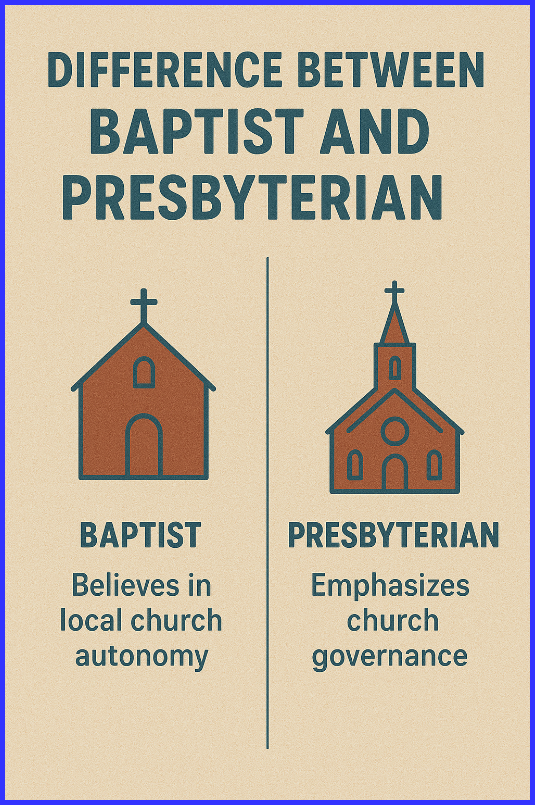
Conclusion: Between Baptist vs Presbyterian
The difference between Baptist and Presbyterian revolves around their views on baptism, salvation, church governance, and scriptural interpretation. Baptists emphasize personal faith and believer’s baptism, while Presbyterians uphold covenant theology, infant baptism, and predestination.
Understanding these distinctions helps individuals choose a tradition aligned with their spiritual beliefs and values. This comparison highlights the essential difference between Baptist and Presbyterian teachings for better clarity.
Read Next: