The key difference between paraben and paraffin is that parabens act as preservatives in cosmetics and pharmaceuticals, while paraffin is used to add gloss, smoothness, and lubrication to products. This simple distinction forms the foundation of the Difference Between Paraben and Paraffin, which is essential for consumers analyzing ingredient labels.
What Are Paraben?
Parabens are organic compounds made of a benzene ring, an ester group, and a hydroxyl group. They are widely used as preservatives because of their antibacterial and antifungal properties.
How Parabens Are Made
Parabens are produced by esterifying para-hydroxybenzoic acid with alcohols such as:
- Methanol
- Ethanol
- Propanol
These give rise to common parabens such as:
- Methylparaben
- Ethylparaben
- Propylparaben
- Butylparaben
Uses of Parabens (With Examples)
Parabens help extend shelf life. They are commonly found in:
- Shampoos
- Moisturizers
- Toothpaste
- Makeup products
- Shaving gels
- Pharmaceutical creams
- Some processed food items
Their purpose: prevent microbial growth and maintain product stability.
What Is Paraffin?
Paraffin refers to a family of saturated hydrocarbons (alkanes) with the general formula CnH2n+2. They consist only of carbon (C) and hydrogen (H) atoms connected by single covalent bonds, making them chemically stable.
Where Paraffin Comes From
Paraffin is derived from petroleum, obtained during dewaxing of light lubricating oils.
Types of Paraffin
Paraffins vary based on number of carbon atoms:
- Methane (CH₄) – gas
- Pentane (C₅H₁₂) – liquid
- Paraffin wax (long-chain alkanes) – solid
Physical Characteristics
- Colorless
- Odorless
- Melting & boiling points increase with carbon chain length
- Can exist as gas, liquid, or solid
- Shows structural and stereoisomerism
Uses of Paraffin (With Examples)
Paraffin is an excellent lubricant and gloss enhancer. Common uses include:
- Candles
- Polishes
- Skin-softening treatments (paraffin wax therapy)
- Lubricating creams
- Waterproof coatings
- Packaging industry
Paraben vs Paraffin (Tabular Comparison)
| Feature | Paraben | Paraffin |
| Definition | Organic compounds used as preservatives | Saturated hydrocarbons (alkanes) derived from petroleum |
| Chemical Structure | Ester of para-hydroxybenzoic acid | CnH₂n+₂ hydrocarbon structure |
| Main Use | Prevents microbial growth | Adds lubrication, gloss & smoothness |
| Nature | Synthetic or naturally identical | Naturally derived from petroleum |
| Physical Form | Liquid or powder | Can be gas, liquid, or wax |
| Common Products | Cosmetics, medicines, lotions | Candles, creams, polishes, wax treatments |
| Function in Cosmetics | Preservative | Emollient, gloss enhancer |
| Production Method | Esterification with alcohol | Dewaxing petroleum oils |
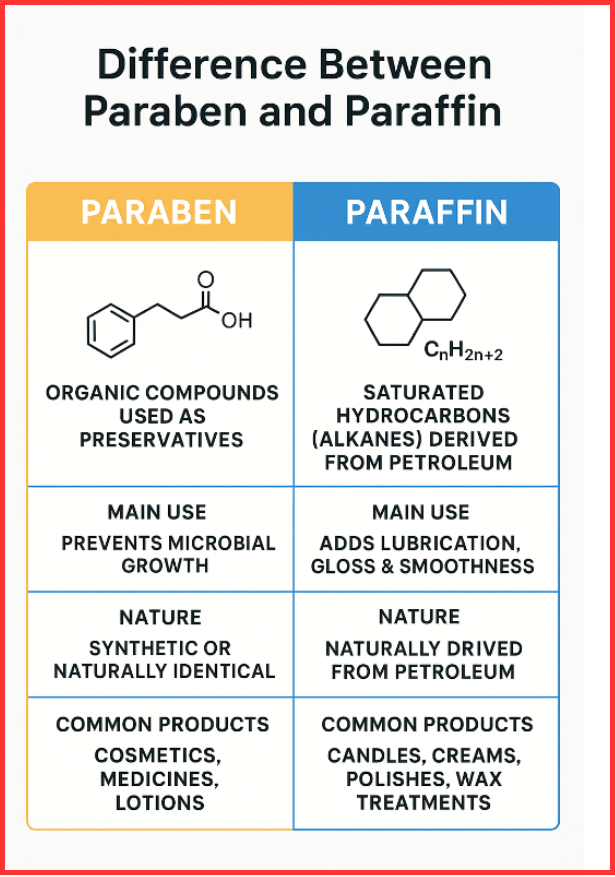
Summary – Difference Between Paraben and Paraffin
To summarize the Difference Between Paraben and Paraffin:
Parabens are preservative chemicals that prevent bacterial and fungal growth in cosmetics, pharmaceuticals, and some foods. Paraffin, however, is a petroleum-derived hydrocarbon used for lubrication, smoothness, gloss, and protective coatings.
Understanding the Difference Between Paraben and Paraffin helps consumers make informed choices when selecting skincare or cosmetic products.
Read Next: