The difference between irony and hypocrisy is simple: irony is when the opposite of what you expect happens, while hypocrisy is when a person pretends to have moral standards they do not follow. Although both involve contradictions, irony relates to situations or language, whereas hypocrisy refers to deceptive human behavior. This article explains the meaning, types, examples, and key differences for clarity.
What Is Irony? – Meaning and Examples
Irony refers to a situation or expression where the intended meaning is the opposite of what is said or expected. It often creates humor, surprise, or a twist of fate.
Simple Example of Irony
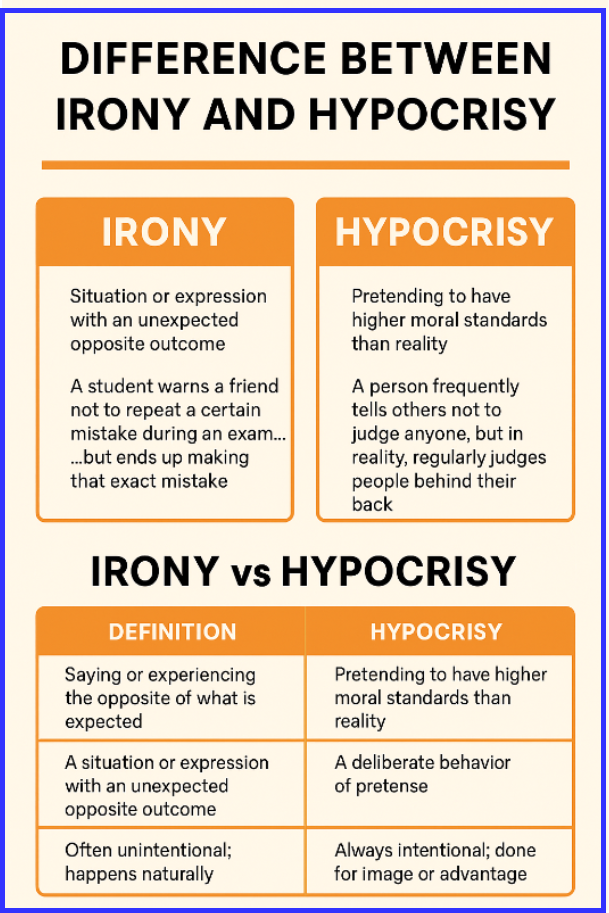
- A student warns a friend not to repeat a certain mistake during an exam… but ends up making that exact mistake.
This is ironic because the outcome is the opposite of what was expected.
Why Irony Occurs
Irony does not involve deception. It naturally occurs due to unexpected outcomes or opposing meanings.
Types of Irony
To understand the concept better, here are the most common types:
1. Situational Irony
The actual result is the opposite of what was expected.
Example: A fire station catching fire.
2. Verbal Irony
A person says something but means the opposite.
Example: Saying “What lovely weather!” during a storm.
3. Dramatic Irony
The audience knows something the characters do not.
Common in plays and movies.
4. Tragic Irony
A form of dramatic irony used in tragedies.
Example: Oedipus unknowingly fulfills the prophecy he was trying to avoid.
5. Cosmic Irony
A twist of fate controlled by destiny or a higher force.
Example: Winning the lottery the day after losing your job.
What Is Hypocrisy? – Meaning and Examples
Hypocrisy refers to pretending to have beliefs, values, or standards that one does not genuinely possess. It involves deliberate pretense and moral contradiction.
Simple Example of Hypocrisy
- A person frequently tells others not to judge anyone, but in reality, regularly judges people behind their back.
This shows intentional pretense.
Why Hypocrisy Happens
Hypocrisy is intentional. People use it to appear morally superior, gain respect, or hide their true behavior.
Areas Where Hypocrisy Occurs
- Behavior (preaching kindness but being rude)
- Beliefs (claiming honesty but lying often)
- Attitudes (condemning gossip but gossiping secretly)
- Opinions (criticizing others for actions they also do)
Hypocrisy vs Morality
While irony is neutral, hypocrisy carries a negative moral judgment because it involves deception and double standards.
Irony vs Hypocrisy: Key Differences
| Feature | Irony | Hypocrisy |
| Definition | Saying or experiencing the opposite of what is expected | Pretending to have higher moral standards than reality |
| Nature | A situation or expression with an unexpected opposite outcome | A deliberate behavior of pretense |
| Intent | Often unintentional; happens naturally | Always intentional; done for image or advantage |
| Role in Literature | Common literary device used for humor, drama, or suspense | Not a literary device; relates to character flaws |
| Moral Judgement | Neutral; not associated with wrongdoing | Negative; associated with dishonesty |
| Example | A lifeguard drowning | A person preaching honesty while lying frequently |
Summary: Difference Between Irony and Hypocrisy
- Irony is a twist of expectations or meanings.
- Hypocrisy is a false display of morals or values.
- Irony focuses on situations; hypocrisy focuses on behavior.
- Irony may be accidental; hypocrisy is deliberate.
Conclusion: Difference Between Irony and Hypocrisy
Understanding the difference between irony and hypocrisy helps clarify everyday contradictions. Irony refers to unexpected outcomes or opposite meanings, while hypocrisy refers to the intentional pretense of moral values. In conclusion, the irony and hypocrisy highlights how irony entertains or surprises, whereas hypocrisy deceives and misleads.
Read Next: