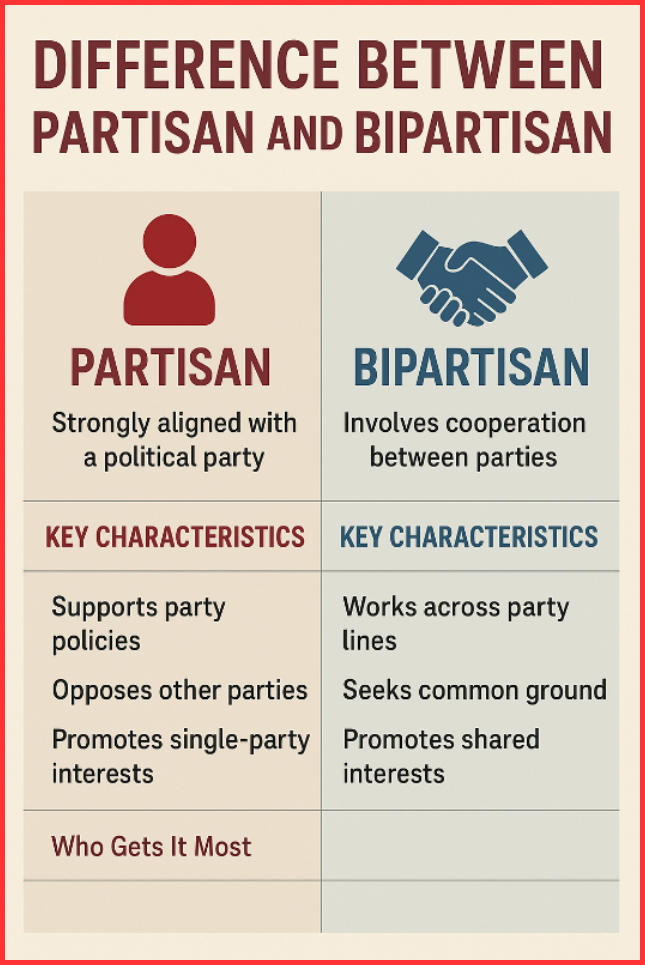
The difference between partisan and bipartisan lies in how many parties or groups are involved. Partisan refers to strong support for one political party, idea, or cause, while bipartisan means cooperation or involvement of two political parties. In simple terms, partisan = one side, and bipartisan = both sides working together. This article explains both terms in detail with definitions, examples, and a clear comparison.
Understanding the Term “Partisan”
1. Partisan as a Noun
As a noun, partisan refers to a strong and loyal supporter of a particular:
- Political party
- Leader
- Idea
- Cause
- Group
A partisan is not just supportive but often strongly biased, sometimes to the point of ignoring opposing arguments. Historically, the word also referred to members of military resistance groups (guerillas).
Examples:
- He was a partisan of the traditional ruling party.
- Partisan fighters ambushed the enemy at night.
2. Partisan as an Adjective
As an adjective, partisan describes actions, decisions, or attitudes that show clear bias toward one group or ideology.
Examples:
- Her partisan comments upset the neutral audience.
- The partisan newspaper published misleading political headlines.
Understanding the Term “Bipartisan”
1. Bipartisan Meaning
The word bipartisan comes from the prefix bi (meaning “two”) + “partisan.”
It is used only as an adjective and refers to cooperation or involvement of two political parties.
What Bipartisan Usually Describes
- Bills supported by two parties
- Joint resolutions
- Shared political decisions
- Policies created through cross-party collaboration
Examples:
- The bill passed because it received bipartisan support.
- A bipartisan committee was formed to resolve the issue.
Unlike “partisan,” bipartisan has no additional meanings beyond politics.
Key Differences Between Partisan and Bipartisan
1. Meaning
- Partisan: Support for a single party or cause.
- Bipartisan: Involvement or cooperation of two parties.
2. Parts of Speech
- Partisan: Used as both noun and adjective.
- Bipartisan: Used only as an adjective.
3. Bias vs. Cooperation
- Partisan: Implies bias or one-sided loyalty.
- Bipartisan: Implies cooperation and shared decision-making.
4. Other Meanings
- Partisan: Can also refer to a guerilla fighter.
- Bipartisan: Has no alternative meanings.
Difference Between Partisan and Bipartisan (Comparison Table)
| Feature | Partisan | Bipartisan |
| Meaning | Support for one party or cause | Cooperation of two political parties |
| Usage | Noun + Adjective | Adjective only |
| Tone | Biased, one-sided | Cooperative, neutral |
| Political Context | Divisive politics | Joint political action |
| Other Meanings | Can mean a guerilla fighter | No extra meanings |
Examples to Understand the Difference
- A partisan speech promotes one party’s ideology.
- A bipartisan agreement means both major parties agree on the issue.
- Media outlets may publish partisan content during elections.
- A bipartisan panel investigates matters using shared perspectives.
Conclusion: Difference Between Partisan and Bipartisan
In conclusion, the difference between partisan and bipartisan is simple yet important: partisan refers to one-sided support for a single group, while bipartisan refers to cooperation between two political parties. Understanding this distinction helps in interpreting political discussions, media reports, and governmental decisions. Using the keyword difference between partisan and bipartisan allows readers to clearly recognize how these terms influence political communication.
Read Next: