The key difference between animism and animatism is that animism believes in individual spirits with personalities dwelling in natural objects, whereas animatism refers to the belief in an impersonal supernatural power that exists in all forces and objects. This article explores the difference between animism and animatism in detail with clear explanations and examples.
What is Animism?
Animism is the belief that spirits inhabit natural objects, from trees and rivers to mountains and animals. The term comes from the Latin word “anima,” meaning soul.
Core Features of Animism
- Individual Spirits With Personalities
Spirits are believed to have traits such as gender, mood, power, and intentions.
Example: Many Native American tribes believe that animals, rivers, and mountains each possess unique spirits with specific roles. - Good and Evil Spirits
Some spirits are protective, while others are harmful, depending on their nature and the relationship humans maintain with them. - Interaction With Humans
In animistic cultures, people believe spirits can influence life events—such as health, harvests, and weather—especially if they are pleased or offended. - Anthropological Relevance
E. B. Tylor, a foundational anthropologist, introduced animism as the earliest form of religion. He described it as humanity’s first attempt to make sense of dreams, death, and the natural world through spiritual explanations.
What is Animatism?
Animatism refers to the belief in a universal, impersonal supernatural power present in all things—both living and nonliving. Unlike animism, this power is not tied to individual beings or personalities.
Core Features of Animatism
- Impersonal Power
The power does not belong to a spirit or deity. It simply exists everywhere.
Example: The Polynesian concept of mana, a force believed to reside in people, objects, or symbols, influencing status and authority. - Exists in All Forms
Rocks, storms, plants, animals, and even tools may possess different degrees of this power. - Common in Small-Scale Societies
Many tribal communities view the world as infused with energy or power that humans must respect and tap into properly.
Animism vs Animatism: Key Differences
Understanding the difference between animism and animatism becomes easier when comparing their core characteristics.
1. Spiritual Beings
- Animism: Believes in individual spirits.
- Animatism: Believes in impersonal power, not spirits.
2. Personality
- Animism: Spirits have distinct personalities and traits.
- Animatism: Power is formless and personality-less.
3. Nature of the Supernatural
- Animism: Multiple spirits with specific roles.
- Animatism: One generalized supernatural force.
4. Interaction With Humans
- Animism: Spirits can bless, punish, or communicate with humans.
- Animatism: Power influences life but does not interact personally.
5. Examples in Cultures
- Animism: Native American beliefs, Shinto (spirits in nature).
- Animatism: Polynesian mana, Melanesian belief in impersonal force.
Tabular Comparison: Animism vs Animatism
| Feature | Animism | Animatism |
| Core Belief | Spirits exist in natural objects | Impersonal supernatural power in all objects |
| Personality | Spirits have personalities | No personality attached |
| Supernatural Entities | Multiple spirits | One impersonal power |
| Examples | Spirits in trees, rocks, rivers | Mana in Polynesian cultures |
| Interaction with Humans | Spirits respond to human behavior | Power affects but does not interact personally |
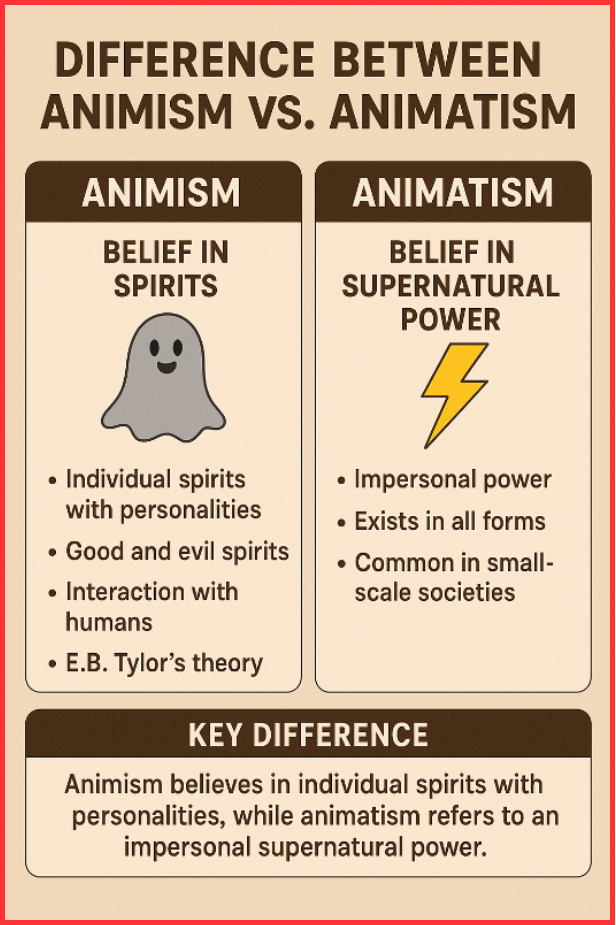
Conclusion: Key Difference Between Animism and Animatism
In conclusion, the difference between animism and animatism lies in how primitive and tribal societies conceptualize supernatural forces. Animism views the world as inhabited by spirits with distinct personalities, while animatism sees the universe as filled with an impersonal spiritual force. Understanding the difference between animism and animatism helps anthropologists uncover how early humans explained natural events and spiritual experiences.
Read Next: