The difference between covenant and promise lies in the nature of responsibility: a covenant is a mutual agreement with obligations on both sides, while a promise is a one-sided assurance made by a single party. Although many people use these words interchangeably, they are not the same. This article clearly explains what a covenant is, what a promise is, and how they differ, with examples to make the concepts easy to understand.
Understanding the Two Terms at a Glance
- Covenant: A formal, binding agreement between two or more parties.
- Promise: A personal assurance made by one party to do (or not do) something.
What Is a Covenant?
A covenant is a structured and often legally or morally binding agreement between two or more parties. In a covenant, each party has defined duties, conditions, and obligations. Breaking these obligations generally results in consequences—legal, moral, or spiritual.
1. Legal Meaning of Covenant
In law:
- A covenant is part of many contracts and property agreements.
- Example: A landlord may enter into a covenant with a tenant stating that the tenant must not use the property for commercial purposes.
2. Religious Meaning of Covenant
The word covenant is widely used in religious contexts, especially in Christianity, Judaism, and Islam.
Examples of biblical covenants:
- Noahic Covenant: God promises never to destroy the earth by flood.
- Abrahamic Covenant: God promises Abraham descendants and land.
- Mosaic Covenant: God gives laws to Moses, with blessings for obedience and penalties for disobedience.
- Davidic Covenant: God promises that the lineage of David will last forever.
In these examples, both God and the people have roles and conditions—obedience, worship, faithfulness, etc.
What Is a Promise?
A promise is an assurance given by one person to another that something will or will not happen. Unlike a covenant, a promise is not mutual—only one side carries the commitment.
Key Traits of a Promise
- It may be spoken, written, or implied.
- It normally does not carry legal consequences unless included in a contract.
- It expresses personal intention, goodwill, or hope.
Example of a promise:
- “I promise I will help you move tomorrow.”
In this case, only you are responsible for fulfilling the promise.
Everyday Promises
- A friend promising to return borrowed money.
- Parents promising to take children on a trip.
- A student promising to study harder.
Some promises are kept; others are not—but breaking them has no legal penalty, only emotional or moral consequences.
Key Differences Between Covenant and Promise
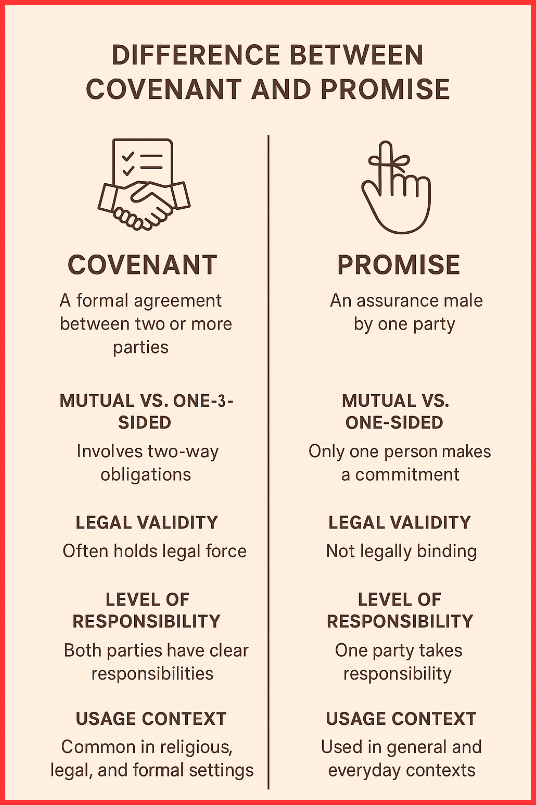
1. Mutual vs. One-Sided Commitment
- Covenant: Involves two-way obligations.
- Promise: Only one person makes a commitment; the other is passive.
2. Legal Validity
- Covenant: Often holds legal force (e.g., property covenants, business agreements).
- Promise: No legal validity unless part of a contract.
3. Level of Responsibility
- Covenant: Both parties have clear responsibilities.
- Promise: One party takes responsibility; the other party expects.
4. Usage Context
- Covenant: Common in religious, legal, and formal settings.
- Promise: Used in everyday language, casual situations, and personal interactions.
Comparison Table: Covenant vs Promise
| Feature | Covenant | Promise |
| Definition | Formal agreement between two or more parties | Assurance made by one party |
| Responsibility | Shared by all parties | Only one party responsible |
| Legal Validity | Often legally binding | Not legally binding |
| Context of Use | Religious, legal, formal | General and everyday |
| Examples | Noahic, Mosaic covenants; property covenants | “I will call you tomorrow” |
| Consequence of Breaking | Legal or moral consequences | Mostly moral or emotional impact |
Practical Examples
Example of a Covenant
Two businesses sign a partnership agreement:
- Company A provides funding.
- Company B manages operations.
Both sides have defined duties.
Example of a Promise
A child tells their parent:
- “I promise to complete my homework on time.”
Only the child holds responsibility.
Conclusion: Difference Between Covenant and Promise
In summary, the difference between covenant and promise rests on responsibility and structure. A covenant is mutual, binding, and often legal, while a promise is one-sided, voluntary, and informal. Understanding this difference is essential, especially in spiritual, legal, contractual, and personal contexts. Use the keyword difference between covenant and promise to remember that a covenant involves shared duties, whereas a promise involves only one person’s commitment.
Read Next: