The difference between dextrose, dextrin, and dextran lies mainly in their chemical structure, source, and biological function. Dextrose is a simple sugar that provides immediate energy, dextrin is a partially broken-down starch with moderate complexity, and dextran is a high-molecular-weight polysaccharide produced mainly through bacterial fermentation. Although all three are carbohydrates derived from glucose, their properties and applications vary widely.
What is Dextrose?
Dextrose is a monosaccharide, meaning it consists of a single sugar unit, and is chemically identical to glucose with the molecular formula C₆H₁₂O₆. It is one of the most essential carbohydrates in biological systems, acting as the primary fuel source for cells and supporting critical functions of the brain, muscles, and other organs. Dextrose is widely found in nature, occurring in fruits, honey, and various plant tissues, and it is also produced commercially through the enzymatic breakdown of starch, particularly from corn.
A key characteristic of dextrose is its fast absorption and utilization by the body. Because it requires little digestion, dextrose enters the bloodstream quickly through the small intestine, providing an immediate rise in blood glucose levels. This property makes it highly effective for rapid energy replenishment, especially during intense physical exertion or in medical situations such as hypoglycemia where quick restoration of blood sugar is necessary.
Applications of Dextrose
Dextrose plays an essential role in energy metabolism and storage. Within the body, it serves as the basic unit for the formation of glycogen, which is stored in the liver and muscles for later use. When energy demands increase during physical activity or when food intake is limited, glycogen is broken down to release glucose, helping to maintain stable blood sugar levels and supply continuous energy.
In medical and clinical settings, dextrose is extensively used due to its rapid metabolism. It is a key component of intravenous solutions, where it supports hydration, provides nutrition, and helps regulate blood glucose in patients who cannot eat normally. Dextrose is also indispensable in emergency care, particularly for the immediate treatment of hypoglycemia, as it delivers a fast-acting source of glucose to restore normal blood sugar levels and prevent complications.
In addition to healthcare applications, dextrose is widely utilized in nutrition and the food industry. Its high solubility and mild sweetness make it a common ingredient in beverages, baked goods, and processed foods, where it functions as both an energy source and a sweetener. Owing to its ability to deliver quick energy, dextrose is frequently included in sports nutrition products designed to support performance and recovery.
What is Dextrin?
Dextrin is a short-chain, starch-based carbohydrate formed through the partial breakdown of starch using heat, acids, or enzymatic treatment. This process reduces long starch molecules into smaller chains of linked glucose units, making dextrin structurally more complex than simple sugars like dextrose, yet significantly less complex than polysaccharides such as dextran. The extent of starch hydrolysis determines the length and behavior of dextrin molecules, resulting in a wide range of molecular sizes.
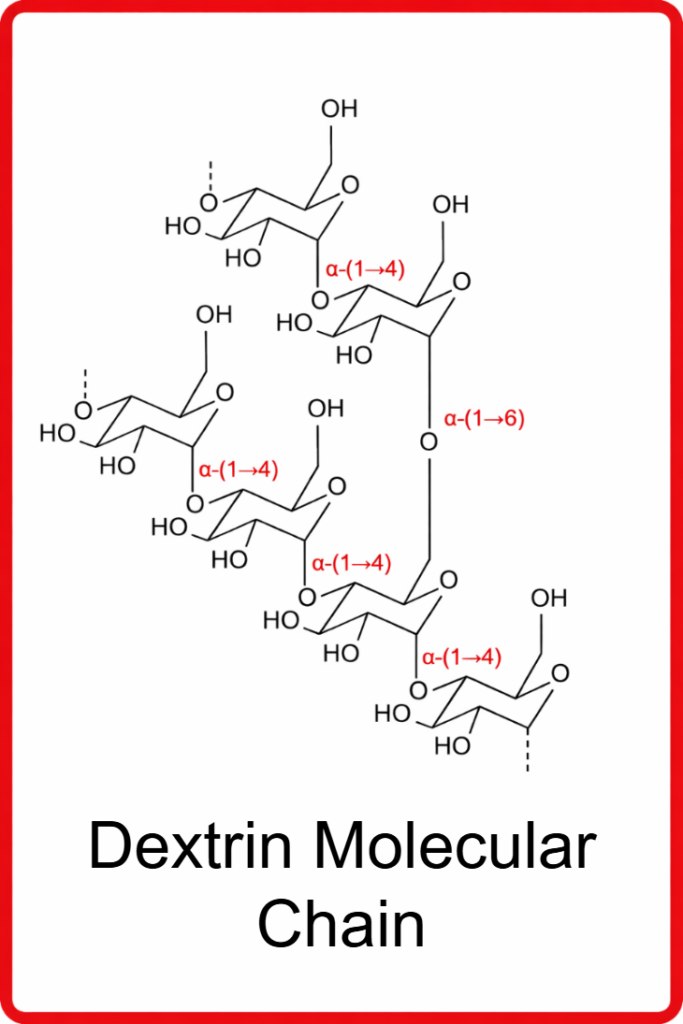
Because of this structural variability, dextrin exhibits favorable physical properties, including high water solubility and adjustable viscosity. When dissolved, it forms smooth, stable solutions, which makes it especially useful in applications requiring texture enhancement and consistency control. Rather than contributing sweetness, dextrin is primarily valued for its functional performance.
Applications of Dextrin
In the food industry, dextrin is widely used as a thickening and stabilizing agent in products such as sauces, gravies, and dressings. It also acts as a binder in processed foods, improving cohesion and preventing ingredient separation. Beyond food applications, dextrin serves as an effective adhesive in paper, textile, and packaging industries. Additionally, it functions as a carrier for flavors, colors, and functional additives, ensuring uniform distribution in formulations. In pharmaceuticals, dextrin is commonly used as an excipient in tablets and capsules, where it supports formulation stability and controlled release.
What is Dextran?
Dextran is a structurally complex polysaccharide composed of numerous glucose units connected in extensively branched chains. Unlike dextrose and dextrin, which are obtained through starch breakdown, dextran is synthesized by specific microorganisms during fermentation. This microbial origin gives dextran unique structural and functional characteristics that distinguish it from other glucose-based carbohydrates.
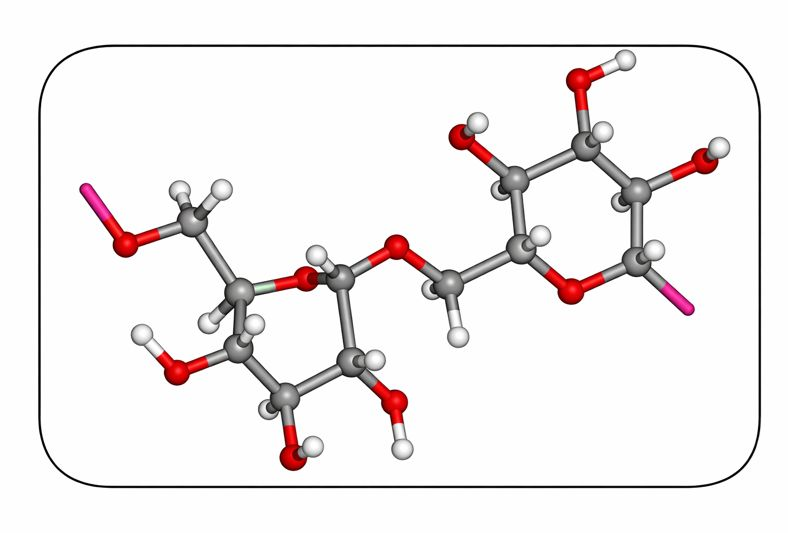
Dextran polymers exhibit a wide spectrum of molecular weights, ranging from a few thousand to several million units. This variation allows dextran to form highly viscous, stable aqueous solutions, with their thickness and flow properties being adjustable through controlled production methods such as microbial fermentation or enzymatic modification.
Applications of Dextran
Because dextran dissolves readily in water and shows predictable rheological behavior, it can be tailored for specialized industrial and medical applications.
One of dextran’s most valuable attributes is its excellent biocompatibility and biodegradability, which makes it especially suitable for biomedical use. In medicine, dextran is widely employed as a blood plasma volume expander to help restore blood volume in cases of shock or severe blood loss.
It also plays a key role in drug delivery technologies, where dextran-based carriers and nanoparticles enable controlled and targeted release of therapeutic agents. Additionally, dextran is used in tissue engineering, wound healing materials, biomedical coatings, hydrogels, and chromatography, highlighting its versatility across research and clinical fields.
Similarities Between Dextrose, Dextrin, and Dextran
- All three are carbohydrates
- Each is composed of glucose units
- All are used in food, pharmaceutical, or medical fields
- They play roles in energy metabolism or material formulation
Difference Between Dextrose, Dextrin, and Dextran
Definition
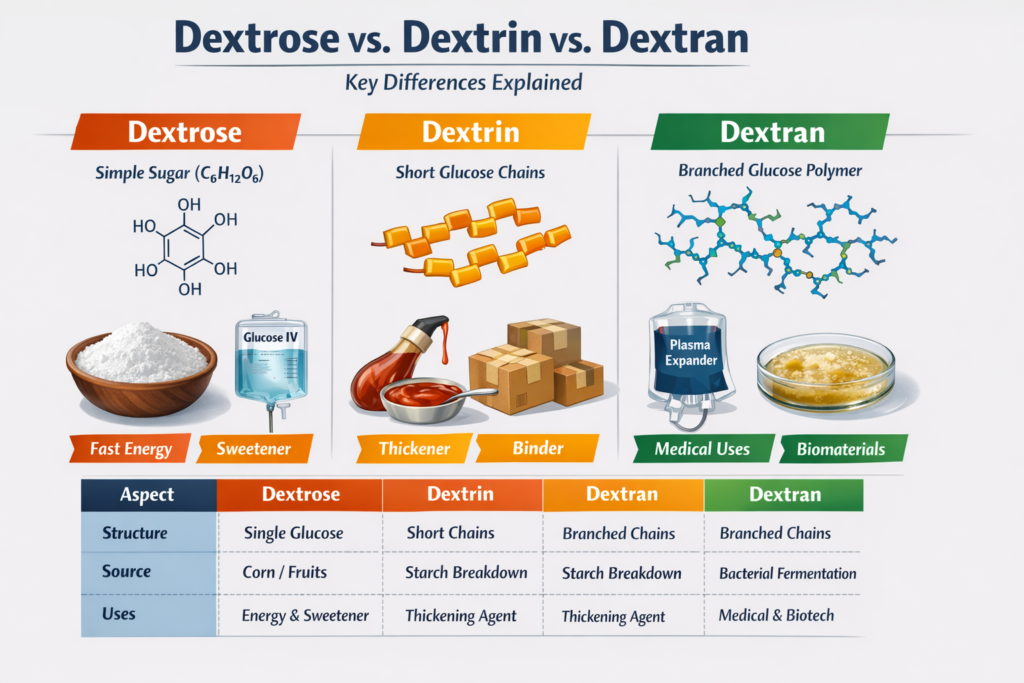
Dextrose is a simple sugar, dextrin is a partially degraded starch product, and dextran is a complex glucose polymer formed by bacterial activity.
Structure
Dextrose contains a single glucose molecule, dextrin consists of short glucose chains, while dextran is a long, branched polysaccharide.
Source
Dextrose is naturally present in foods and commercially extracted from starch, dextrin is derived from starch breakdown, and dextran is synthesized by microorganisms.
Applications
Dextrose is mainly used as an energy source and sweetener, dextrin serves as a thickener and binder, and dextran is widely used in medical and biomedical technologies.
Tabular Comparison: Dextrose vs Dextrin vs Dextran
| Factor | Dextrose | Dextrin | Dextran |
| Definition | A simple sugar identical to glucose | A partially hydrolyzed starch derivative | A complex glucose polymer produced by bacteria |
| Chemical Structure | Single glucose molecule | Short chains of glucose units | Long, branched glucose chains |
| Molecular Complexity | Very low | Moderate | Very high |
| Molecular Weight | Low | Variable | Thousands to millions |
| Source | Fruits, honey, starch hydrolysis | Partial breakdown of starch | Microbial fermentation |
| Digestion & Absorption | Rapid absorption | Slowly digested | Not used as energy |
| Solubility | Highly water-soluble | Highly water-soluble | Water-soluble, forms viscous solutions |
| Primary Function | Immediate energy supply | Functional and binding agent | Biomedical and structural material |
| Medical Applications | IV fluids, hypoglycemia treatment | Pharmaceutical excipient | Plasma expander, drug delivery |
| Food / Industrial Uses | Sweetener, energy drinks | Thickener, binder, adhesive | Chromatography, hydrogels |
| Biocompatibility | High | High | Very high |
Conclusion
In conclusion, the difference between dextrose, dextrin, and dextran is based on their molecular complexity, origin, and practical use. Dextrose is a fast-acting simple sugar, dextrin is a moderately complex starch derivative, and dextran is a highly structured polysaccharide produced by bacterial fermentation. While all three originate from glucose, their distinct characteristics make them suitable for very different nutritional, industrial, and medical applications.
Dextrose, dextrin, and dextran play important roles in nutrition, food processing, pharmaceuticals, and biomedical science. Understanding how they differ helps in choosing the right compound for specific industrial or medical uses.
Reference:
- “Dextrin.” National Center for Biotechnology Information. PubChem Compound Database, U.S. National Library of Medicine.
- “What to Know About Dextrose.” WebMD.
- Kathleen H. Miao; Kevin B. Guthmiller. “Dextran.” National Library of Medicine.
Read Next:
- Difference Between Pyelonephritis and Glomerulonephritis
- Difference Between Chemotaxis and Diapedesis
- Difference Between Isosmotic Hyperosmotic and Hypoosmotic
- Difference Between Apheresis and Dialysis
- Difference Between Male and Female Sternum
- Difference Between Junctional and Idioventricular Rhythm
- Difference Between Hemolysis and Crenation
- Difference Between Hunan, Szechuan, and Kung Pao