Understanding the Difference Between Fiance and Would Be is important because both terms are commonly used to describe a future partner, yet they are not the same. In simple terms, “fiancé/fiancée” is a formal term for an officially engaged partner, while “would-be” is an informal expression used before an engagement is finalized.
Let’s explore this difference in a detailed, easy-to-understand way.
What Is the Main Difference Between Fiance and Would Be?
- Fiancé/Fiancée → A man or woman who is officially engaged to be married.
- Would-be → A casual or cultural phrase used to refer to a future spouse, even before an official engagement.
In short:
Every fiancé/would-be is a future partner, but only “fiancé/fiancée” indicates a confirmed engagement.
Who Is a Fiance (or Fiancée)?
Meaning
A fiancé (male) or fiancée (female) is someone who is formally engaged to be married.
Characteristics
- Engagement has taken place.
- Often accompanied by a ring, ceremony, or announcement.
- Universally recognized in English-speaking countries.
- Used in legal, cultural, and social contexts.
Example
- “Rahul is her fiancé.”
- “She is my fiancée.”
What Does “Would Be” Mean?
Meaning
The term “would-be” is an informal expression meaning future spouse, used particularly in South Asian cultures like India, Bangladesh, Sri Lanka, and Pakistan.
Characteristics
- No formal engagement required.
- Used casually to refer to a planned or expected partner.
- Culturally accepted but not standard English in Western countries.
Example
- “He is my would-be husband.”
- “She is his would-be wife.”
Key Differences Between Fiance and Would Be
| Feature | Fiance / Fiancée | Would Be |
| Meaning | Officially engaged partner | Expected future spouse |
| Formality | Formal, globally recognized | Informal, region-specific |
| Engagement Status | Engagement is confirmed | Engagement may or may not be done |
| Usage | English language standard | Cultural phrase (mostly South Asia) |
| Legal Recognition | Often considered in legal/visa processes | Not legally recognized |
| Example | “She is my fiancée.” | “She is my would-be wife.” |
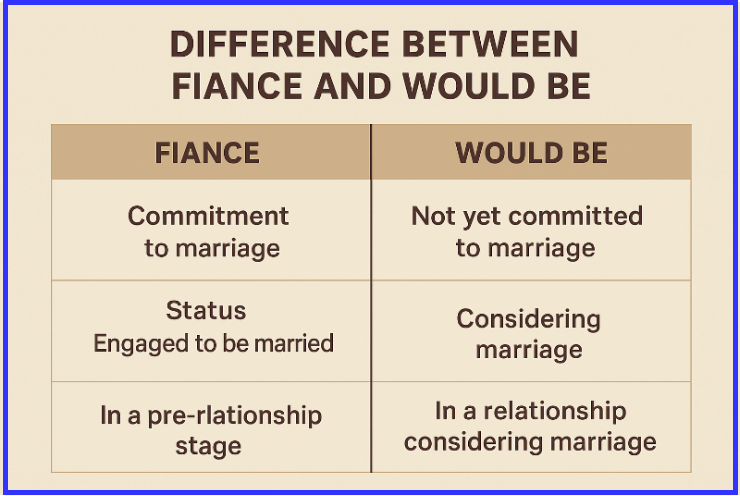
When Should You Use “Fiance” or “Would Be”?
Use Fiancé/Fiancée when:
- Engagement is officially done
- You are speaking or writing formally
- Applying for visas, documents, or invitations
- Introducing your partner in global/professional settings
Use Would-Be when:
- Engagement is not yet official
- You are speaking casually
- Talking in a cultural context where it is common
- You mean “future husband/wife” without formal confirmation
Is “Would Be Husband/Wife” Grammatically Correct?
Technically, it is not standard English, but it is widely understood in South Asia.
In Western English, it may sound unusual or confusing.
Correct alternatives include:
✔ future husband/wife
✔ partner-to-be
✔ spouse-to-be
Examples in Sentences
Using “Fiancé / Fiancée”
- “My fiancée and I are planning the wedding.”
- “He became her fiancé after the engagement ceremony.”
Using “Would-Be”
- “I met her would-be husband for the first time.”
- “She will meet her would-be in-laws next week.”
Conclusion: Difference Between Fiance and Would Be
In summary, the Difference Between Fiance and Would Be is based on formality and engagement status. A fiancé/fiancée is a partner who is officially engaged, whereas a would-be refers to a future spouse even when there is no formal engagement yet. Using the right term helps avoid confusion, especially in professional or international communication.
Read Next: