English learners often struggle with similar-sounding word forms, and “giving” and “given” are common examples. Although both come from the verb “give,” they are used in completely different grammatical contexts. Simply put, “giving” refers to an ongoing action, while “given” is mostly used as a past participle or an adjective. Understanding the difference helps avoid errors in writing, speaking, and comprehension.
What Is “Giving”?
“Giving” is the present participle of the verb give. It describes an action that is happening now, repeatedly, or continuously.
Core Meanings of “Giving”:
- The act of providing, donating, or handing something over
- Showing generosity (e.g., a giving nature)
- Used in phrasal verbs like giving up, giving in, giving away
Expanded Explanation
“Giving” expresses an active, ongoing movement from one person to another. It can also function as a noun (gerund) to describe an act—such as the joy of giving.
Sentence Examples of “Giving”:
- I am giving my friend a surprise gift tomorrow.
- She enjoys giving to charity because it makes her feel fulfilled.
- The team is giving their best effort to win the competition.
- He is slowly giving in to the demands after long negotiations.
- Their culture values giving help to anyone in need.
What Is “Given”?
“Given” is the past participle of give and is used to describe something already handed, offered, or granted. But it also takes on a second role as an adjective meaning specific, fixed, assumed, or known.
Core Meanings of “Given”:
- Something that has been provided or handed over
- A fact or condition accepted as true
- A fixed or specific amount/time
- Inclined or prone to something (e.g., He is given to anger)
Expanded Explanation
As an adjective, “given” commonly appears in formal writing, mathematics, and logic, meaning “known or assumed.”
Example: Given that X is true, Y will follow.
“Given” can also describe behavioral tendencies: She is given to overthinking.
Sentence Examples of “Given”:
- I have given him the documents he asked for.
- She is given to worrying about small issues.
- At any given moment, thousands of flights are in the air.
- It is given that all citizens are equal before the law.
- You must submit the form within the given deadline.
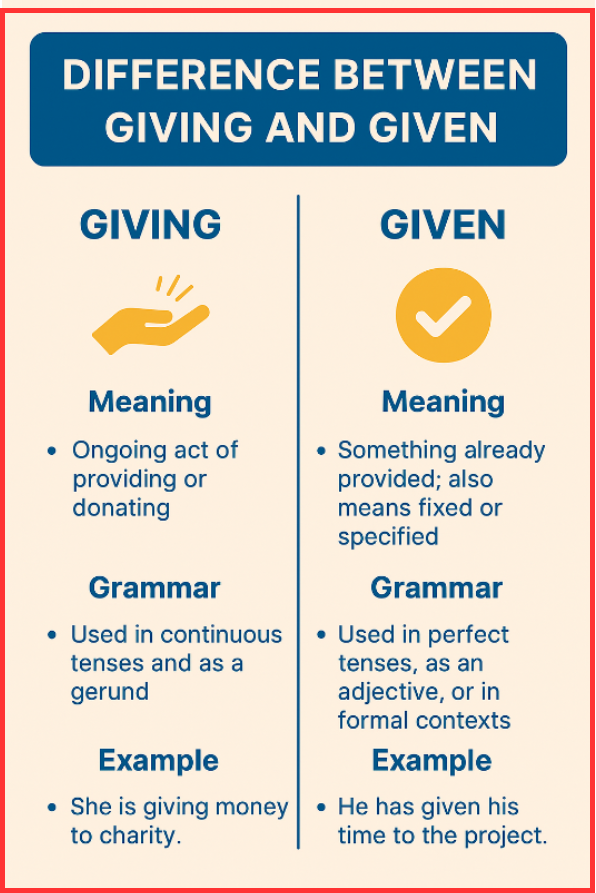
Difference Between Giving and Given
Here is a clear comparison to understand how the two forms differ:
| Feature | Giving | Given |
| Verb Form | Present participle of give | Past participle of give |
| Meaning | Ongoing act of providing or donating | Something already provided; also means fixed or specified |
| Grammar Use | Used in continuous tenses and as a gerund | Used in perfect tenses, as an adjective, or in formal contexts |
| Pronunciation Confusion | Rare | Often confused with “giving” due to similar sound |
| Additional Meaning | Can describe generosity | Can describe tendency or inclination |
| Example | “She is giving money to charity.” | “He has given his time to the project.” |
Conclusion
The difference between giving and given lies mainly in tense and usage: “giving” expresses an ongoing action, while “given” describes something completed, fixed, or assumed. Although they sound similar, their roles in sentences are entirely different. Mastering their usage strengthens both spoken and written English, helping learners communicate clearly and accurately.
Read Next: