The difference between institute and institution lies mainly in their meanings: an institute is an organization created for a specific purpose—usually education, research, or a professional field—whereas an institution refers to either an established organization or a long-standing practice, law, or custom in society. This is the direct and most important distinction between the two words.
Both terms often overlap when referring to organizations, but only “institution” is used to describe systems, customs, or traditions such as marriage, judiciary, or religion.
What Is an Institute?
An institute is an organization created for a specific purpose, especially in the fields of:
- Education
- Research
- Science & technology
- Professional training
Common Examples
- Indian Institute of Technology (IIT)
- Massachusetts Institute of Technology (MIT)
- Institute of Chartered Accountants
- Stockholm Environment Institute
The word “institute” comes from the Latin instituere, meaning “to build,” “establish,” or “educate.”
Example Sentences
- The government established an institute to promote renewable energy research.
- A new technical institute will offer skill-development programs.
- The event was organized by the students of the Massachusetts Institute of Technology.
“Institute” as a Verb
As a verb, institute means:
- to begin
- to introduce
- to establish a system or policy
Example: The company instituted a new safety policy.
What Is an Institution?
The word institution has two main meanings:
1. An Established Organization
An institution can be:
- educational
- religious
- financial
- professional
- social
Examples:
- universities
- hospitals
- banks
- charities
- religious organizations
2. A Long-Standing Practice or Law
An institution can also mean a widely accepted societal system or tradition, such as:
- institution of marriage
- institution of democracy
- institution of slavery (historical context)
Example Sentences
- Political and religious institutions play a major role in governance.
- She joined a professional institution to get the required certification.
- The institution of marriage varies across cultures.
- Taxes were imposed on banks and financial institutions.
Similarities Between an Institute and an Institution
Both words can be used to describe an organization created for a specific purpose, especially in:
- education
- research
- professional training
- science and technology
This overlap is why many people use them interchangeably.
Difference Between Institute and Institution (Key Points)
| Feature | Institute | Institution |
| Primary Meaning | An organization created for a specific purpose | Either an organization or a long-established practice or custom |
| Scope | Narrow and specific | Broader; can describe traditions, laws, or systems |
| Use in Society | Primarily educational or research-based | Can describe social, legal, or cultural systems |
| Examples | IIT, medical institute, research institute | Marriage, judiciary, banks, universities |
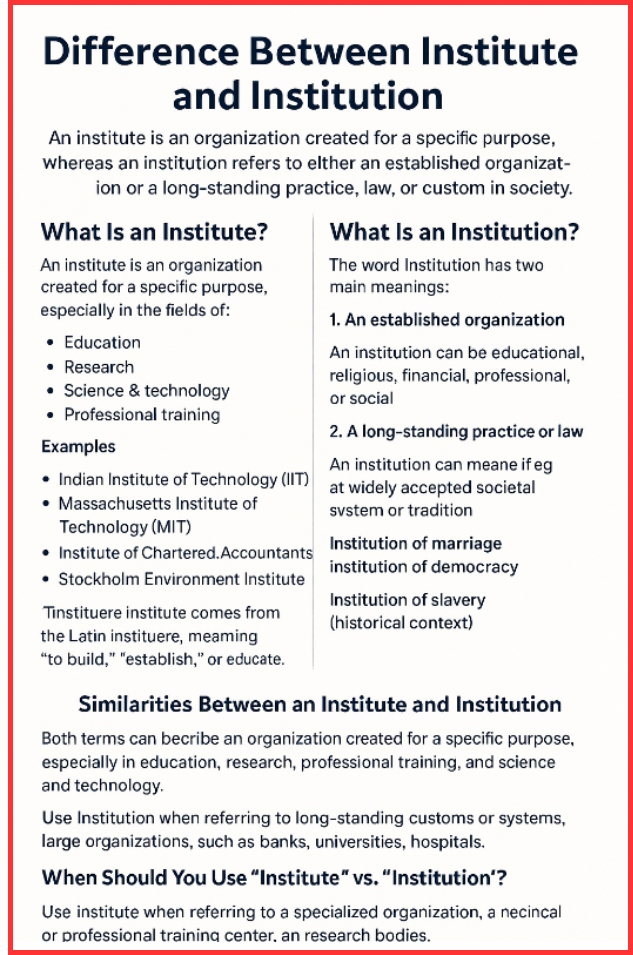
When Should You Use “Institute” vs “Institution”?
Use Institute when referring to:
- A specialized organization
- Technical or professional training centers
- Research bodies
Use Institution when referring to:
- Long-standing customs or systems
- Large organizations (banks, universities, hospitals)
- Established societal structures
Summary – Difference Between Institute and Institution
The difference between institute and institution is primarily based on meaning.
An institute is an organization created for a specific purpose such as education, research, or professional skill development.
An institution, however, has a broader meaning—it can refer to both an established organization and an established law, custom, or societal practice.
Understanding the difference between institute and institution helps in using these terms accurately in academic writing, professional communication, and daily usage.
Read Next: