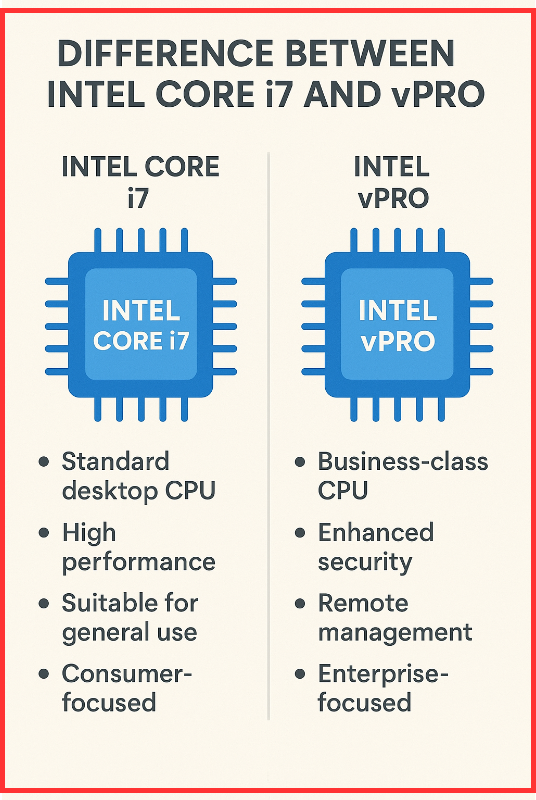
The difference between Intel Core i7 and vPro is that Intel Core i7 refers to a family of high-performance processors, while Intel vPro is a set of business-oriented security and manageability technologies built into compatible Intel processors and chipsets. In simple terms, Core i7 is the CPU, whereas vPro is a collection of advanced enterprise features that may or may not be included with a Core i7 processor.
When comparing modern computers, many users confuse processor labels such as Intel Core i7 with enterprise features like Intel vPro. Although these terms often appear together, they serve very different purposes. This article clearly explains the difference between Intel Core i7 and vPro, how each works, and when you actually need one or both.
What Is Intel Core i7?
Intel Core i7 is a high-performance, multi-core processor series designed for users who need powerful computing capabilities. It is known for its impressive speed, intelligent multitasking, and capability to handle resource-intensive applications.
Key Features of Intel Core i7
1. Turbo Boost Technology
Automatically increases clock speed during heavy workloads such as video editing or gaming.
2. Hyper-Threading Technology
Allows each core to run two threads simultaneously, enabling smoother multitasking.
Example: Running a video editor, multiple browser tabs, and a game simultaneously.
3. Intel Smart Cache
Offers a large, efficient cache system for faster access to frequently used data—especially beneficial for gaming and 3D rendering.
4. Integrated Memory Controller
Supports high-speed DDR3/DDR4 RAM with low latency for improved performance in data-intensive applications.
5. QuickPath Interconnect (QPI)
Enables fast communication between CPU cores and components, reaching speeds up to 25.6 GB/sec in earlier generations.
6. Multimedia Enhancements (Intel HD Boost)
Improves performance in media creation, video editing, and computational tasks.
What Is Intel vPro?
Intel vPro is not a processor, but a platform of technologies built to improve security, remote management, and reliability—mainly targeted toward businesses and IT departments.
Core Components of Intel vPro
1. Intel Active Management Technology (Intel AMT)
Allows IT teams to remotely monitor, repair, and update systems—even if the PC is powered off.
2. Intel Trusted Execution Technology (TXT)
Protects systems from malware during boot and runtime.
3. Intel Virtualization Technology (VT-x and VT-d)
Enables secure virtualization and remote system control.
Example: An IT admin installing OS updates on hundreds of PCs remotely.
4. AES-NI Hardware Encryption
Accelerates encryption and enhances data security—important for laptops storing sensitive information.
5. Anti-Theft Technology
Can lock or disable a system if it’s reported stolen.
6. Remote Encryption Management
Allows unlocking encrypted drives even before boot, ensuring high-level data protection.
7. KVM Remote Control
Lets IT see the user’s screen even outside the operating system, solving boot-level issues remotely.
Difference Between Intel Core i7 and vPro
| Feature / Aspect | Intel Core i7 | Intel vPro |
| Category | Processor family (CPU) | Security + manageability technology platform |
| Purpose | High performance for heavy workloads | Business IT management, remote access, security |
| Main Use Case | Gaming, editing, design, multi-tasking | Enterprise environments, secure laptops, remote IT management |
| Includes? | CPU cores, Turbo Boost, Hyper-Threading | AMT, AES-NI, VT-x/VT-d, Anti-Theft |
| Hardware or Software? | Hardware (processor) | Combination of hardware features and firmware |
| Can a Core i7 have vPro? | Yes, only if it is a “Core i7 vPro” variant | Depends on CPU + chipset support |
| Example Use | Gaming PC, video editing workstation | Corporate laptops with remote IT support |
Real-World Examples
Example 1: Home User
A student buying a laptop for gaming and editing will benefit from Core i7, not necessarily vPro.
Example 2: IT-Managed Office
A company with 300 employees needs to upgrade all systems overnight. vPro enables remote updates without interrupting users.
Example 3: Security-Sensitive Environments
Banks, hospitals, and government offices prefer vPro-enabled laptops for strong built-in encryption and anti-theft protections.
Conclusion: Difference Between Intel Core i7 and vPro
The difference between Intel Core i7 and vPro lies in their purpose—Core i7 is a performance-oriented processor family, while vPro is a business-focused platform offering advanced security and manageability features. In many systems, you can find Core i7 with vPro, combining high performance with enterprise-grade protection. Understanding this difference helps users and businesses make smarter purchasing decisions based on speed, security, and management needs.
Read Next: