The difference between Nazarene and Baptist lies mainly in their beliefs about salvation and baptism. Nazarenes believe salvation can be lost through sin, while Baptists believe salvation is permanent once a person is truly saved. They also differ in how and when baptism should be performed. Although both belong to Protestant Christianity, their theological interpretations, practices, and historical roots set them apart.
When comparing Christian denominations, the difference between Nazarene and Baptist becomes especially important because both groups share Protestant foundations yet hold distinct beliefs about salvation, holiness, and baptism. In simple terms, Nazarenes emphasize holiness and the possibility of losing salvation, while Baptists focus on believer’s baptism and eternal security. This article breaks down the history, beliefs, worship practices, examples, and key doctrinal differences to help you understand these two denominations clearly.
Who Are Nazarenes?
The Church of the Nazarene emerged from the Holiness Movement in 19th-century North America. Today, the denomination has over 2 million members worldwide, including believers in India, Bangladesh, and the United States.
Core Beliefs of Nazarenes
- Personal Holiness: Strong emphasis on living a holy life rooted in the teachings of John Wesley.
- Salvation Can Be Lost: Nazarenes believe a Christian can fall away from faith through sin or disobedience.
- Sanctification: They teach “entire sanctification,” meaning a believer can reach a state of deeper spiritual maturity.
- Baptism for All Ages: They accept infant, youth, and adult baptism.
Example
A Nazarene believer might say:
“Faith requires a holy life every day. If I turn away from Christ, I can lose salvation.”
Who Are Baptists?
Baptists are a major Protestant group with over 100 million followers worldwide. Their roots trace back to John Smyth, a 17th-century English pastor who promoted baptism for believers only.
Core Beliefs of Baptists
- Believer’s Baptism Only: They reject infant baptism and baptize only those who consciously choose faith.
- Baptism by Immersion: The believer is fully immersed in water, symbolizing the death and resurrection of Jesus.
- Eternal Security: Most Baptists believe, “Once saved, always saved.”
- Authority of Scripture: Baptists emphasize the Bible as the sole authority.
Example
A Baptist believer may say:
“Once you believe in Jesus, your salvation is secure forever.”
Key Differences Between Nazarene and Baptist
Below is a clear and structured comparison for easy understanding.
1. Beliefs About Salvation
- Nazarene: Salvation can be lost if a believer turns away or repeatedly sins.
- Baptist: Salvation cannot be lost; it is guaranteed once a person is truly saved.
2. Baptism Practices
- Nazarene: Allows baptism for infants, youth, and adults; method varies (immersion, pouring, sprinkling).
- Baptist: Baptizes only believers; always by full immersion.
3. Doctrinal Background
- Nazarene: Rooted in Wesleyan-Holiness teachings (John Wesley).
- Baptist: Rooted in Reformed Protestantism (Calvinist influence).
4. View of Holiness
- Nazarene: Strong focus on holy living and sanctification.
- Baptist: Focus on faith-based salvation rather than sanctification emphasis.
5. Church Practices
- Nazarene: More flexible worship styles, emphasis on spiritual growth.
- Baptist: Traditionally conservative but varies widely among Baptist groups.
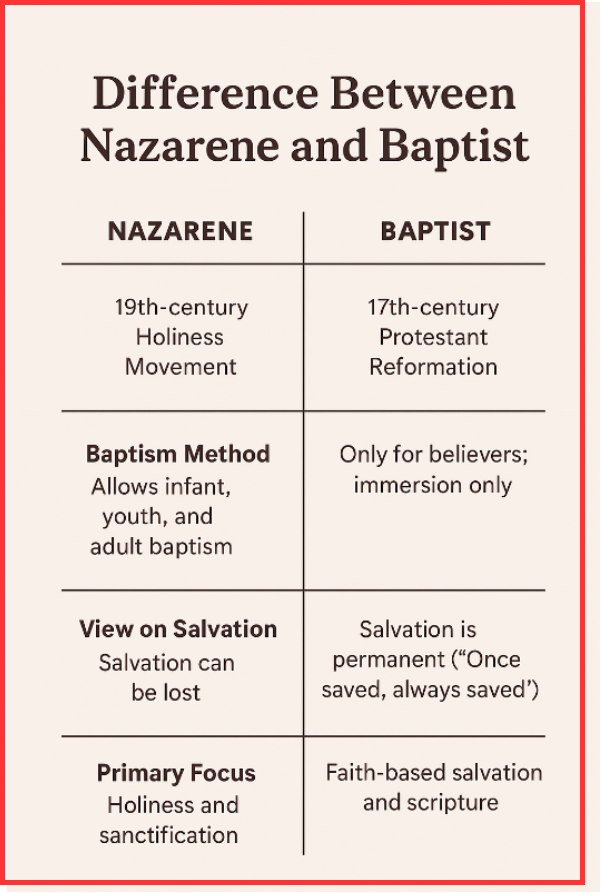
Tabular Comparison: Nazarene vs Baptist
| Feature | Nazarene | Baptist |
| Origin | 19th-century Holiness Movement | 17th-century Protestant Reformation |
| Baptism Method | Allows infant, youth, and adult baptism | Only for believers; immersion only |
| View on Salvation | Salvation can be lost | Salvation is permanent (“Once saved, always saved”) |
| Primary Focus | Holiness and sanctification | Faith-based salvation and scripture |
| Infant Baptism | Permitted | Not permitted |
Conclusion: Key Difference Between Nazarene and Baptist
The difference between Nazarene and Baptist mainly centers on salvation and baptism. Nazarenes believe salvation can be lost and allow baptism for all ages, while Baptists practice believer’s baptism and emphasize eternal security. Understanding these distinctions helps anyone exploring Protestant Christianity to choose a denomination aligned with their beliefs. In summary, the difference between Nazarene and Baptist highlights how Christian denominations can share the same faith yet express it in unique ways.
Read Next: