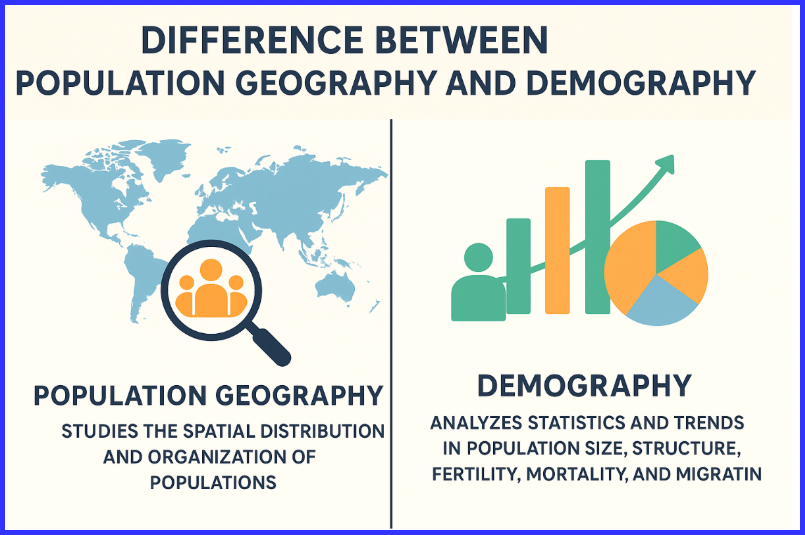
The Difference Between Population Geography and Demography lies in their approach to studying human populations. While population geography examines the spatial distribution, patterns, and interaction of populations with the environment, demography focuses on statistical data about population size, structure, and trends over time.
In simple terms: population geography studies the “where” and “why” populations are distributed, whereas demography studies the “who” and “how many.”
This article provides a detailed comparison, global examples, applications, and case studies to help you understand these fields better.
What Is Population Geography?
Population geography is a subfield of human geography that explores how people are distributed across space, their densities, migration patterns, and interactions with the environment.
Key Focus Areas
- Population Distribution – Study of where populations are concentrated.
- Population Density – Number of people per square kilometer or mile.
- Migration Patterns – Internal and international movements.
- Urbanization & Settlement Patterns – Cities, towns, rural settlements, and megacities.
- Population-Environment Interaction – How populations affect and are affected by natural landscapes.
Global Examples
- High-Density Areas:
- Bangladesh – ~1,200 people/km²
- Singapore – ~8,000 people/km²
- Sparse Population Regions:
- Sahara Desert – Low population due to extreme conditions
- Siberia – Cold climate and difficult terrain limits settlement
Real-World Applications
- Urban planning and zoning
- Disaster management (e.g., flood-prone areas)
- Sustainable resource allocation
- Agricultural planning based on population pressures
What Is Demography?
Demography is the statistical study of human populations, focusing on how they change and develop over time. The term comes from the Greek words “Demos” meaning “people” and “Grapho” meaning “to describe or measure.” This field examines essential population trends such as birth and death rates, age structure, fertility, mortality, and migration.
By collecting and analyzing population data over a period of time—often a year or more—demographers can identify patterns, understand growth or decline, and interpret the social and economic factors influencing these changes. Demography, therefore, plays a key role in understanding how populations evolve and how societies plan for the future.
Key Focus Areas
- Population Size – Total population of a country or region.
- Population Structure – Age and sex distribution (e.g., population pyramids).
- Fertility & Mortality Rates – Birth rates, death rates, and life expectancy.
- Migration Statistics – Immigration, emigration, and net migration.
- Population Growth Trends – Predicting future population size and structure.
Global Examples
- Population Census: India (1.4 billion), China (1.4 billion)
- Fertility Analysis: Niger – High fertility rate (~6.8 children per woman)
- Life Expectancy Study: Japan – ~84 years, Nigeria – ~54 years
- Migration Trends: Syrian refugee crisis – millions displaced in the Middle East and Europe
Real-World Applications
- Government policy-making (healthcare, pensions, housing)
- International aid and development planning
- Education and labor force projections
- Epidemiology and public health interventions
Similarities Between Population Geography and Demography
- Both study human populations and their dynamics.
- Both rely on census data, surveys, and statistical analysis.
- Both influence policy-making, urban planning, and resource management.
- Both examine population growth, migration, and distribution trends.
Difference Between Population Geography and Demography (Comparision Table)
| Aspect | Population Geography | Demography |
| Definition | Studies spatial distribution, density, and human–environment interactions. | Statistical study of population size, structure, and trends. |
| Focus | “Where” populations are located and why spatial patterns exist. | “Who” makes up the population and “how many.” |
| Scope | Migration patterns, urbanization, rural–urban distribution, population–environment interaction. | Birth rates, death rates, fertility, mortality, life expectancy, population growth. |
| Methods | Maps, GIS, spatial analysis, field surveys. | Census data, surveys, demographic models, statistical tools. |
| Examples | Urban–rural patterns, population clusters, migration case studies. | National census reports, population pyramids, fertility/mortality analyses. |
| Applications | Urban planning, disaster management, resource management, settlement planning. | Policy-making, public health, development planning, labor market analysis. |
| Time Orientation | Focuses on spatial and temporal patterns. | Focuses on quantitative trends and changes over time. |
Case Studies: Population Geography vs Demography
1. Population Geography Case Study: Urban Growth in China
- Study focused on Shanghai and Beijing, mapping population density and urban sprawl.
- GIS data revealed migration from rural areas to cities.
- Policy implications included transportation planning and housing development.
2. Demography Case Study: Fertility Trends in Sub-Saharan Africa
- Statistical analysis of birth rates across countries like Niger, Nigeria, and Ethiopia.
- Found high fertility rates linked to education and health factors.
- Results used for family planning policies and UN development programs.
3. Combined Application
- Population geographers can map the areas with high birth rates and analyze spatial implications for resource distribution.
How Demography and Population Geography Collect and Analyze Data
Data Methods and Analytical Perspectives
Both Demography and Population Geography depend heavily on data gathering and analysis to understand human populations. Demographers mainly use census records, vital registration data, and structured surveys to obtain information on population size, age composition, fertility, mortality, and migration trends.
These datasets are then examined using statistical tools to create demographic patterns, forecasts, and mathematical population models.
Population geographers, however, often adopt a blend of numerical and descriptive approaches to study how populations are distributed and how they change across spaces. They make use of spatial analysis tools such as Geographic Information Systems (GIS) to map population density and distribution patterns.
Along with this, they may also conduct field observations, interviews, and regional case studies to explore the social, economic, and environmental influences that shape population characteristics in specific locations.
Focus and Perspective
Demography emphasizes the quantitative dimension of population studies. It deals with measurable aspects such as population size, structure, and changes over time, using statistical analysis to interpret trends in fertility, mortality, and migration.
Demographers generally work at broader national or regional scales, aiming to explain the causes behind population growth and decline.
In contrast, Population Geography concentrates on the spatial dimension of population behavior. It studies where people live, why they live there, and how their distribution relates to natural and cultural landscapes.
Population geographers examine how elements like climate, availability of resources, transportation facilities, and patterns of urban development shape settlement and migration trends across different places.
Summary
The Difference Between Population Geography and Demography can be summarized as:
- Population Geography: Spatial study of population distribution, density, and interactions with the environment.
- Demography: Statistical study of population characteristics, trends, and growth patterns.
Both are interconnected fields: demography provides data for population geographers, while geography adds spatial context to demographic analysis.
FAQs: Population Geography vs Demography
No. Population geography relies on demographic data to analyze spatial patterns effectively.
Yes, demography can study population statistics without spatial context, but geographic perspective adds depth and understanding.
Both. Demography provides numbers; geography shows where populations are concentrated.
Urban-rural population patterns in India, population clusters in Europe, migration mapping in the Middle East.
India census data, fertility and mortality trends in Africa, global population projections by the UN.
References:
1. “What Is Demography?” International Union for the Scientific Study of Population.
2. “Population Study ~ NCI Dictionary of Cancer Terms.” National Cancer Institute.
3. “Demography.” Wikipedia, Wikimedia Foundation.
Read Next: