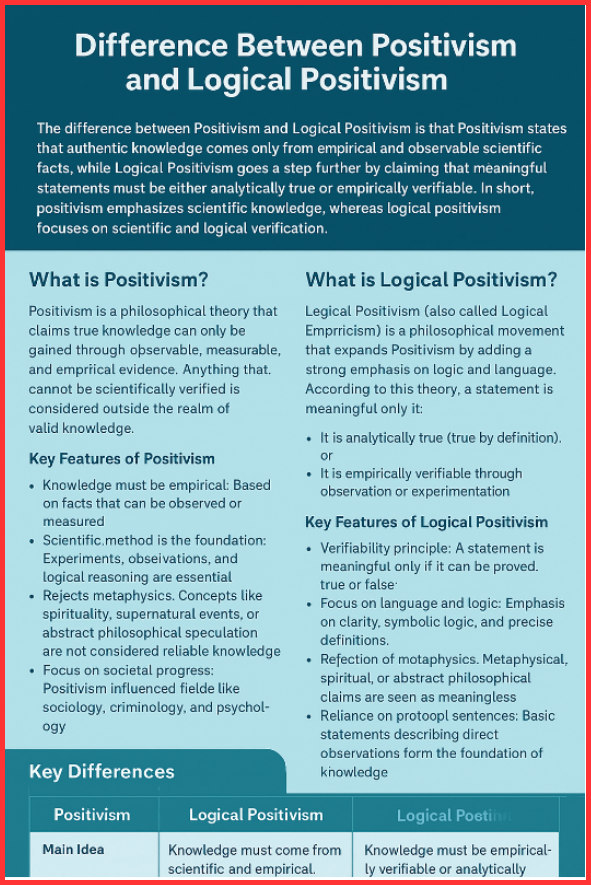
The difference between Positivism and Logical Positivism is that Positivism states that authentic knowledge comes only from empirical and observable scientific facts, while Logical Positivism goes a step further by claiming that meaningful statements must be either analytically true or empirically verifiable. In short, positivism emphasizes scientific knowledge, whereas logical positivism focuses on scientific and logical verification.
Both Positivism and Logical Positivism shaped modern scientific thinking and philosophical analysis. While they may sound similar, they differ in their historical roots, scope, and approach to meaning and verification.
This article clearly explains the Difference Between Positivism and Logical Positivism, along with definitions, origins, characteristics, and examples.
What is Positivism?
Positivism is a philosophical theory that claims true knowledge can only be gained through observable, measurable, and empirical evidence. Anything that cannot be scientifically verified is considered outside the realm of valid knowledge.
Key Features of Positivism
- Knowledge must be empirical: Based on facts that can be observed or measured.
- Scientific method is the foundation: Experiments, observations, and logical reasoning are essential.
- Rejects metaphysics: Concepts like spirituality, supernatural events, or abstract philosophical speculation are not considered reliable knowledge.
- Hierarchy of sciences: Auguste Comte proposed that sciences evolve progressively from simple to complex.
- Focus on societal progress: Positivism influenced fields like sociology, criminology, and psychology.
Origin of Positivism
Positivism was founded in the 19th century by Auguste Comte, a French philosopher. He proposed that society moves through three stages:
- Theological Stage
- Metaphysical Stage
- Scientific/Positive Stage
Comte believed that only the scientific stage represents true knowledge.
Examples of Positivism
- A biologist studying plant growth through controlled experiments
- A sociologist collecting data via surveys to analyze social behavior
- A doctor diagnosing a disease based on test reports and observations
What is Logical Positivism?
Logical Positivism (also called Logical Empiricism) is a philosophical movement that expands Positivism by adding a strong emphasis on logic and language. According to this theory, a statement is meaningful only if:
- It is analytically true (true by definition), or
- It is empirically verifiable through observation or experimentation.
Logical positivists rejected metaphysics even more strongly than classical positivists because metaphysical statements cannot be verified.
Key Features of Logical Positivism
- Verifiability principle: A statement is meaningful only if it can be proved true or false.
- Focus on language and logic: Emphasis on clarity, symbolic logic, and precise definitions.
- Rejection of metaphysics: Metaphysical, spiritual, or abstract philosophical claims are seen as meaningless.
- Reliance on protocol sentences: Basic statements describing direct observations form the foundation of knowledge.
Origin of Logical Positivism
Logical Positivism emerged in the early 20th century through the Vienna Circle, with key thinkers like:
- Moritz Schlick
- Rudolf Carnap
- Otto Neurath
It was heavily influenced by advancements in science and analytical philosophy.
Examples of Logical Positivism
- “Water boils at 100°C at sea level” → verifiable
- “Triangles have three sides” → analytically true
- “God exists” → not verifiable, hence meaningless in logical positivist terms
Positivism vs Logical Positivism: Key Differences
| Aspect | Positivism | Logical Positivism |
| Main Idea | Knowledge must come from scientific and empirical evidence. | Knowledge must be empirically verifiable or analytically true. |
| Focus | Observation and scientific method. | Verification, logic, and meaning of statements. |
| View on Metaphysics | Rejects metaphysics but not always completely. | Completely rejects metaphysical statements as meaningless. |
| Origin | Developed in the 19th century by Auguste Comte. | Developed in the 20th century by the Vienna Circle. |
| Method | Broad scientific approach. | Strict verifiability and logical analysis. |
| Examples Used | Empirical scientific research. | Logical and empirical verification of statements. |
Summary : Difference Between Positivism and Logical Positivism
- Positivism focuses on scientific and empirical knowledge.
- Logical Positivism adds logical analysis and the verifiability principle to define what is meaningful.
- Logical positivism is a more refined and restrictive version of positivism.
Conclusion: Difference Between Positivism and Logical Positivism
The Difference Between Positivism and Logical Positivism lies in their scope: positivism emphasizes scientific knowledge based on observation, while logical positivism requires both scientific evidence and logical/analytic verification for a statement to be meaningful. Together, these philosophies shaped modern scientific inquiry and analytical thinking.
Read Next: