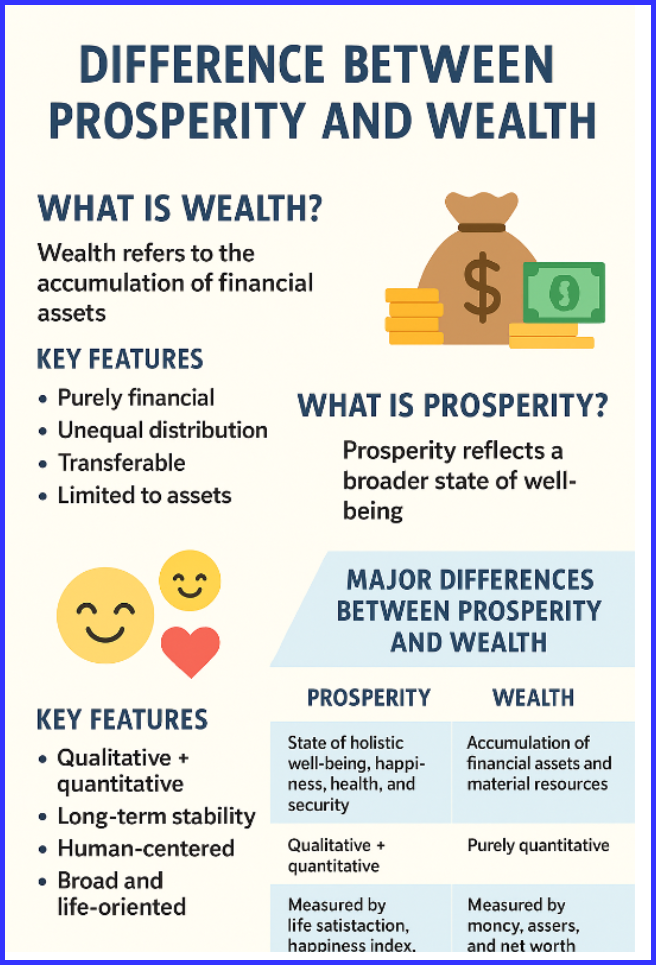
The difference between prosperity and wealth is that wealth refers to the accumulation of financial assets, while prosperity reflects a broader state of well-being that includes happiness, health, security, and personal fulfillment. In simple terms: wealth measures what you have; prosperity measures how well you live.
Although both terms are linked to success, they carry completely different meanings in life, economics, and personal growth. Understanding this difference helps individuals, governments, and businesses focus not only on money but also on long-term well-being.
What Is Wealth?
Wealth is a quantitative measure. It includes:
- Money (cash, bank balance, digital assets)
- Property
- Investments (stocks, bonds, mutual funds)
- Business ownership
- Material resources
Key Features of Wealth:
- Purely financial: Wealth deals with measurable assets.
- Unequal distribution: According to the 2024 Global Wealth Report, the richest 1% own nearly 44% of global wealth.
- Transferable: Wealth can be inherited, saved, or invested.
- Limited to assets: It does not measure happiness, mental peace, or personal health.
Example of Wealth:
- A person owning ₹10 crore in real estate and ₹2 crore in investments is “wealthy.”
- A corporation generating high profits possesses wealth.
- Nations like the USA, China, and Japan top the global wealth rankings due to strong financial assets.
Sentence Examples of Wealth
- Owning multiple properties, luxury cars, and large investments is a clear sign of wealth.
- After years of business success, Meera built enough wealth to retire early and travel the world.
- Countries like the United States and China possess tremendous wealth due to their strong industrial and financial sectors.
- A family with high income, valuable assets, and significant savings is considered wealthy by economic standards.
- Wealth can be measured through net worth, which includes real estate, stocks, savings, and business ownership.
What Is Prosperity?
Prosperity is a holistic measure of overall well-being, not just financial success. It includes:
- Good physical and mental health
- Stable income
- Meaningful relationships
- Safety and security
- Life satisfaction and happiness
- Personal growth and freedom
Key Features of Prosperity:
- Qualitative + quantitative: Combines money with well-being.
- Long-term stability: Prosperity focuses on sustainable growth and life satisfaction.
- Human-centered: Includes emotional, social, and community factors.
Example of Prosperity:
- A family with moderate income but good health, strong bonds, work-life balance, and financial stability is “prosperous.”
- Countries like Finland, Denmark, and Switzerland rank high in prosperity due to happiness, safety, and quality of life—not just wealth.
Sentence Examples of Prosperity
- A community with good schools, safe neighborhoods, and happy families is a true example of prosperity, even if people earn moderate incomes.
- Despite not being rich, Rohan feels prosperous because he enjoys good health, meaningful relationships, and peaceful living.
- Nations like Finland and Denmark show prosperity by offering high-quality healthcare, education, and work–life balance.
- A person who finds joy in their career, maintains financial stability, and lives stress-free can be considered prosperous.
- Prosperity shines through when someone has emotional well-being, financial security, and a supportive social environment.
Major Differences Between Prosperity and Wealth
| Factors | Prosperity | Wealth |
| Definition | State of holistic well-being, happiness, health, and security | Accumulation of financial assets and material resources |
| Nature | Qualitative + quantitative | Purely quantitative |
| Measurement | Measured by life satisfaction, happiness index, health index | Measured by money, assets, and net worth |
| Scope | Broad and life-oriented | Narrow and financial-oriented |
| Dependency | Depends on mindset, health, relationships, opportunities | Depends on income, investments, financial planning |
| Transferability | Cannot be inherited exactly (personal experience) | 100% transferable |
| Examples | Healthy life, strong relationships, work-life balance | Property, bank savings, investments |
| Sustainability | Focuses on long-term well-being | Focuses on accumulating more money |
| Government Index | Global Prosperity Index, Happiness Index | Global Wealth Report, GDP per capita |
| Outcome | Peace, satisfaction, holistic growth | Financial power and material comfort |
Real-Life Comparison Examples
Example 1:
- A person earning ₹20 lakh/year but constantly stressed, unhealthy, and unhappy is wealthy but not prosperous.
- Another earning ₹8 lakh/year, living peacefully with family, saving consistently, and staying healthy is prosperous even without high wealth.
Example 2:
A rich businessman might have multiple properties but may lack sleep, mental peace, or family connections → wealth without prosperity.
Example 3:
A small farmer with enough savings, good health, community support, and a peaceful environment may experience prosperity without extreme wealth.
Prosperity and Wealth in Nation Building
Wealthy Nations:
- USA, China, Germany
- High GDP
- Strong financial markets and industries
Prosperous Nations:
- Finland, Denmark, Norway
- High happiness
- Low corruption
- Strong welfare and healthcare systems
A country can be wealthy without being prosperous, and prosperous without extreme financial wealth.
Which Is More Important—Prosperity or Wealth?
Both matter, but prosperity is the ultimate goal.
Wealth helps build security and comfort, but prosperity gives meaning, joy, and inner stability.
Wealth creates comfort; prosperity creates contentment.
Conclusion
The difference between prosperity and wealth is clear: wealth is about what you own, while prosperity is about how well you live. True success comes when wealth supports a prosperous, balanced, peaceful, and fulfilling life. Understanding the difference between prosperity and wealth helps individuals and nations focus on holistic growth, not just financial accumulation.
Read Next: