The Difference Between Relief and Landscape lies in what they describe on the Earth’s surface. Relief refers to the variation in elevation and slope of land, showing highs and lows like mountains, hills, and valleys. In contrast, landscape refers to the overall appearance of an area, combining relief, vegetation, water bodies, and human-made features.
In short: relief is about the shape and elevation of land, landscape is the visual combination of landforms and other features. Keep reading to explore types, examples, formation processes, and significance of both.
What Is Relief?
Relief describes the vertical and horizontal variations in the Earth’s surface, including elevation differences, slopes, and undulations. It highlights highlands, lowlands, mountains, plateaus, hills, and valleys in a region.
Types of Relief
- Mountainous Relief – High elevation areas with steep slopes.
- Example: Himalayas
- Plateau Relief – Elevated flat regions.
- Example: Deccan Plateau, India
- Plain Relief – Low-lying flat or gently sloping land.
- Example: Indo-Gangetic Plain, India
- Valley Relief – Low areas between hills or mountains.
- Example: Great Rift Valley, Africa
Importance of Relief
- Climate Influence: Mountainous relief affects rainfall and temperature.
- Water Flow: Determines river courses, drainage patterns, and flood zones.
- Settlement & Agriculture: Flat relief favors farming; high relief may limit settlements.
- Transportation & Infrastructure: Roads and railways depend on relief for planning.
What Is a Landscape?
A landscape is the visible appearance of an area, seen from a particular viewpoint. It includes relief (elevation), water bodies, vegetation, soil types, and human-made structures. Landscapes can be natural, cultural, or a combination of both.
Types of Landscapes
- Natural Landscape – Shaped entirely by nature.
- Example: Sahara Desert – Sand dunes, rocky areas, and sparse vegetation.
- Cultural Landscape – Shaped or modified by humans.
- Example: New York City – Skyscrapers, roads, and parks integrated into the terrain.
- Combined Landscape – Features both natural and human elements.
- Example: Tuscany, Italy – Rolling hills, rivers, forests, and farmlands.
Elements of a Landscape
- Relief – Elevation, slope, hills, valleys, and mountains.
- Water bodies – Rivers, lakes, and oceans.
- Vegetation – Forests, grasslands, crops.
- Human structures – Roads, buildings, farmlands, and cities.
Similarities Between Relief and Landscape
- Both describe features of the Earth’s surface.
- Both are studied in geography for understanding natural processes and human interaction.
- Both influence agriculture, settlement, and ecosystem distribution.
- Both change over time due to erosion, tectonics, climate, and human activities.
Difference Between Relief and Landscape (Comparison Table)
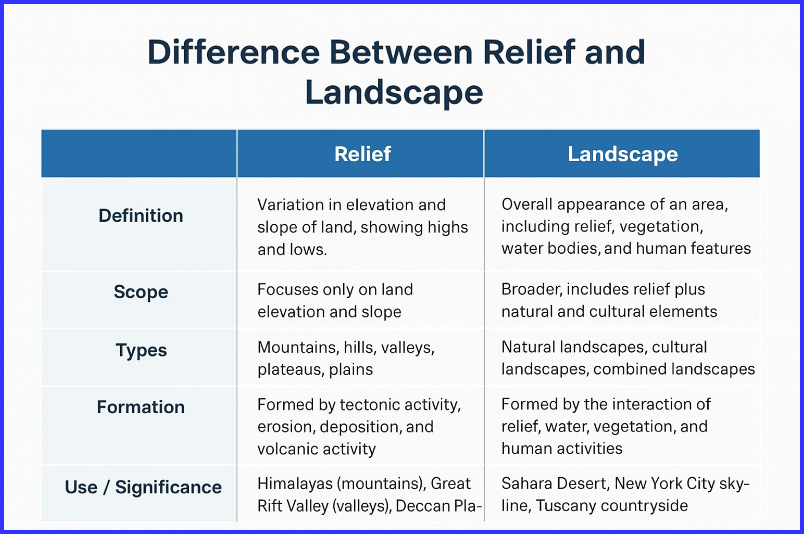
| Aspect | Relief | Landscape |
| Definition | Variation in elevation and slope of land, showing highs and lows. | Overall appearance of an area, including relief, vegetation, water bodies, and human features. |
| Scope | Focuses only on land elevation and slope. | Broader, includes relief plus natural and cultural elements. |
| Types | Mountains, hills, valleys, plateaus, plains. | Natural landscapes, cultural landscapes, combined landscapes. |
| Formation | Formed by tectonic activity, erosion, deposition, and volcanic activity. | Formed by the interaction of relief, water, vegetation, and human activities. |
| Examples | Himalayas (mountains), Great Rift Valley (valleys), Deccan Plateau. | Sahara Desert, New York City skyline, Tuscany countryside. |
| Use / Significance | Influences climate, water flow, agriculture, and settlement. | Helps study environment, culture, tourism, urban planning, and scenic value. |
Summary
The Difference Between Relief and Landscape can be summarized as:
- Relief – Represents the shape, slope, and elevation of land, including hills, mountains, valleys, and plateaus.
- Landscape – Represents the visible combination of relief, vegetation, water bodies, and human-made structures.
Every landscape includes relief as one of its key components, but not every relief feature constitutes a landscape on its own.
FAQs: Relief and Landscape
No. Relief refers to elevation and slope, while landscape refers to the overall appearance, including relief, water, vegetation, and human structures.
Yes, cities are cultural landscapes, combining buildings, roads, parks, and natural features.
Relief determines elevation, slope, and drainage patterns, which influence vegetation, human settlement, and overall appearance.
Himalayas (mountains), Deccan Plateau (plateau), Great Rift Valley (valley).
Sahara Desert (natural), New York City (cultural), Tuscany countryside (combined).
Reference:
1. “What Does the Term ‘Relief’ Mean in Geography?” Thought.com
2. “Landscape.” National Geographic Education
Read Next: