The difference between structure and infrastructure lies in their purpose and scope. Structure refers to how different parts are arranged to form a complete system, whereas infrastructure refers to the foundational facilities and services needed for the functioning of a society, organization, or system. This clear distinction helps in fields like engineering, management, construction, and social sciences.
What Is Structure?
A structure is anything made up of multiple components arranged together in a specific pattern or system. It refers both to the physical assembly of parts and the organizational arrangement of elements.
Examples of Structure
- Physical structures:
- A bridge built using beams, cables, and concrete.
- A building formed by columns, slabs, and roofing systems.
- Organizational structures:
- A company hierarchy that includes managers, supervisors, and employees.
- The structure of an education system with primary, secondary, and higher education levels.
- Sentence structure in grammar:
- Subject + Verb + Object arrangement.
Structure focuses on how parts are put together and how they work as a whole.
What Is Infrastructure?
Infrastructure refers to the essential physical systems, services, and institutions that support the functioning of a society or organization. It forms the base upon which communities, economies, and organizations operate.
Dictionary Definitions
- Oxford Dictionary:
“Basic physical and organizational structures and facilities needed for the operation of a society or enterprise.” - American Heritage Dictionary:
“The basic facilities, services, and installations needed for the functioning of a community or society such as transportation, communication systems, water and power lines, and public institutions.”
Types of Infrastructure
1. Hard Infrastructure
These are physical networks vital for economic development and societal functioning:
- Roads, highways, bridges
- Railways and airports
- Power generation and distribution systems
- Water supply and sewage systems
2. Soft Infrastructure
These are institutions that support the social, cultural, and economic well-being of a nation:
- Education system
- Healthcare system
- Law enforcement
- Financial institutions
- Governmental administration
Examples of Infrastructure
- Telephone networks enabling communication
- Electricity grids powering industries and homes
- Schools and universities forming the educational backbone
- Hospitals maintaining public health
Infrastructure focuses on what supports society and ensures continuity of essential services.
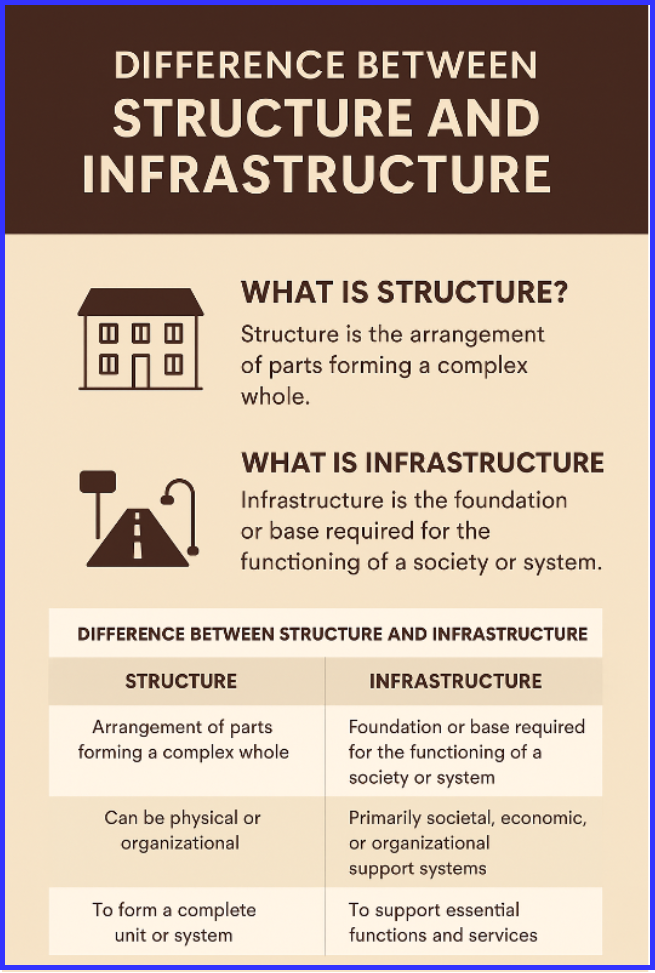
Difference Between Structure and Infrastructure (Tabular Comparison)
| Aspect | Structure | Infrastructure |
| Meaning | Arrangement of parts forming a complex whole | Foundation or base required for the functioning of a society or system |
| Scope | Can be physical or organizational | Primarily societal, economic, or organizational support systems |
| Purpose | To form a complete unit or system | To support essential functions and services |
| Examples | Building structure, company structure, sentence structure | Roads, water supply, hospitals, electricity grid |
| Nature | Internal arrangement | External support system |
| Dependence | Infrastructure may support structures | Structure does not necessarily support infrastructure |
Key Takeaways
- A structure is about arrangement and composition.
- Infrastructure is about foundational support for functioning and development.
- Structure can exist without infrastructure, but infrastructure often houses or supports structures.
Conclusion
The main difference between structure and infrastructure is that structure refers to how components are organized to form a whole, while infrastructure refers to the foundational systems and services that support societies, organizations, and economies. Understanding this distinction is essential in engineering, management, urban planning, and public policy.
Read Next: