Sympathy means feeling concern or sorrow for someone’s situation from the outside, while empathy means understanding and sharing the other person’s feelings from their point of view.
In simple words, sympathy says, “I feel for you,” and empathy says, “I feel with you.”
What is Sympathy?
Sympathy is when you recognize someone is hurting and feel sorry for them, but you do not personally experience their emotions.
You stay emotionally distant.
Example Sentence: Sympathy Style
- It must be really hard to lose your job.
- That situation sounds very challenging to handle.
- I can imagine how upsetting that experience must have been.
- It must feel disappointing to face such setbacks.
- Dealing with this must be exhausting for you.
You are acknowledging their pain, but not necessarily feeling what they feel.
Illustration (Imagine This):
A friend falls down. You stand beside them and say,
“Oh no, are you okay? I feel bad for you.”
You care, but you’re not sharing the feeling.
Sentence using Sympathy
- She expressed sympathy by offering comforting words to her friend who was feeling sad.
- Showing sympathy helps coworkers feel supported during tough deadlines.
- Parents show sympathy when they acknowledge their child’s disappointment.
- Volunteers express sympathy when they comfort people going through hardships.
- Sympathy in daily life can make others feel understood and cared for.
What is Empathy?
Empathy is when you put yourself in someone’s shoes and try to feel what they are feeling. You connect emotionally and mentally.
Example Sentence: Empathetic Style
Here are 5 example sentences in the same empathetic style:
- I can see how difficult it is to cope with a loved one’s illness. I remember feeling anxious and helpless when my family went through the same situation.
- It must be really frustrating to deal with constant delays at work. I’ve felt that stress myself when deadlines piled up unexpectedly.
- “I understand how isolating moving to a new city can feel. I felt lonely and unsure when I had to start over in a new place.
- I know how upsetting it is to face criticism for something you care about. I’ve experienced that disappointment too and it was hard to handle.
- It sounds exhausting to manage so many responsibilities at once. I’ve been there and remember feeling completely overwhelmed at times.
You are communicating understanding and emotional connection.
Illustration (Imagine This):
If your friend falls down, you kneel beside them and say,
“That must have hurt. I remember how painful it was when I fell. I am here with you.”
You are sharing the feeling, not just observing it.
Sentences using Empathy
- He showed empathy by listening carefully when his friend shared their problems.
- Practicing empathy helps coworkers support each other during stressful projects.
- Parents demonstrate empathy when they patiently understand their child’s feelings.
- Volunteers rely on empathy to provide meaningful help to those in need.”
- “Empathy in daily life can make small acts of kindness feel more genuine and heartfelt.
Key Differences Between Sympathy and Empathy
| Aspect | Sympathy | Empathy |
| Meaning | Feeling sorry for someone | Understanding and sharing someone’s feelings |
| Emotional Distance | Emotional distance exists | Emotional closeness is created |
| Perspective | Viewed from the outside | Seen from the other person’s viewpoint |
| Expression | “I feel bad for you.” | “I understand and feel with you.” |
| Connection Level | Surface-level concern | Deep emotional connection |
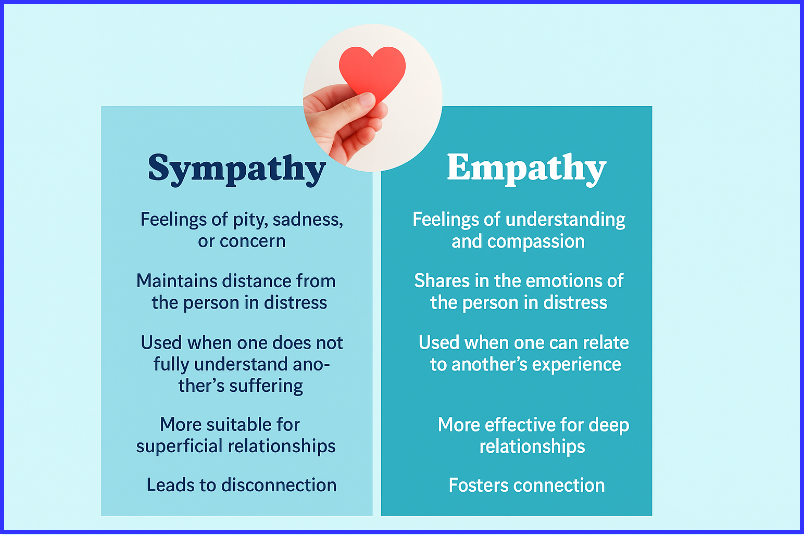
Examples in Daily Life- Symapthy & Empathy
| Situation | Sympathy Response | Empathy Response |
| Friend is crying | “Don’t cry, everything will be okay.” | “I can see you’re really hurting. Do you want to talk about it?” |
| Someone failed an exam | “That’s sad. Better luck next time.” | “I know how disappointing that feels. I’m here if you need help studying.” |
| A colleague looks stressed | “You seem stressed. Take care.” | “I’ve gone through stressful days too—what’s weighing on your mind?” |
Simple Illustration to Visualize the Difference
|
|
|
|
in pain
in pain
Sympathy vs Empathy- Core Differences
Emotion is the Core Difference
The main distinction between sympathy and empathy lies in how emotions are experienced. Sympathy involves recognizing someone else’s suffering, but it tends to be more cognitive and creates a subtle distance between the person experiencing pain and the one acknowledging it.
Impact on Relationships
The type of response often depends on the closeness of the relationship. In professional or casual settings—like a colleague or supervisor experiencing a loss—sympathy may be more suitable to maintain social boundaries. However, for close friends or family, empathy is usually expected, as gestures like sending a card or flowers might not fully convey genuine emotional support.
Connection vs Disconnection
Social psychologist Brené Brown notes that empathy fosters connection, while sympathy can unintentionally create separation. Statements such as “I feel sorry for you” or “It could have been worse” may come across as patronizing or pitying, leaving the sufferer feeling unsupported. True empathy involves emotionally resonating with the other person’s experience, not just acknowledging it.
Understanding at Different Levels
Empathy reflects a desire to deeply understand another person’s emotions, even if one cannot solve their problem. Sympathy, on the other hand, often occurs without fully relating to or grasping the suffering, sometimes shifting attention back to the listener instead of the person in distress.
By cultivating empathy, individuals can create stronger emotional bonds and genuinely support those around them, while over-reliance on sympathy may unintentionally widen emotional gaps.
Conclusion
The difference between sympathy and empathy lies in the depth of emotional connection. Sympathy involves caring for someone from the outside, while empathy goes further by stepping into the other person’s emotional world.
Learning to be empathetic helps in building stronger relationships, trust, and emotional support.
Read Next: