The difference between vested and invested lies in their meaning and usage: vested refers to rights, authority, or interests that are legally guaranteed or personally biased, while invested refers to putting money, time, or effort into something for future benefit. This article clearly explains the meaning of both terms with examples, plus a complete comparison table for easy understanding.
Understanding the Difference Between Vested and Invested
Although vested and invested sound somewhat similar, they have completely different meanings, pronunciations, and uses. Mixing them up often changes the meaning of a sentence, especially in legal, financial, and everyday contexts. Below is a detailed explanation of both words.
What Does “Vested” Mean?
The word vested commonly appears in phrases like vested interest, vested power, or vested rights. It indicates something that is:
- Guaranteed or secured by law
- Inalienable or permanent
- Certain and not dependent on future conditions
1. Vested Interest
A vested interest means having a personal stake or bias in something.
Example:
Cigarette manufacturers lobbying against strict laws do so because they have a vested interest in tobacco sales.
2. Vested Rights
A vested right is a right that is fixed, legal, and cannot be taken away.
Example:
An employee may have a vested right to a pension after completing a certain number of years.
What Does “Invested” Mean?
Invested is the past tense and past participle of invest. It refers to putting something valuable—usually money, time, or effort—into a goal, business, or relationship expecting a positive outcome.
Examples of Invested
- The couple lost the money they had invested in the company when its shares crashed.
- Graham invested his savings in blue-chip stocks.
- A student who has invested time and effort in studying may feel disappointed after an unexpected result.
Where We Use “Invested”
- Financial investments: stocks, bonds, businesses
- Personal effort: time, energy, learning, relationships
- Emotional investment: caring deeply about an outcome
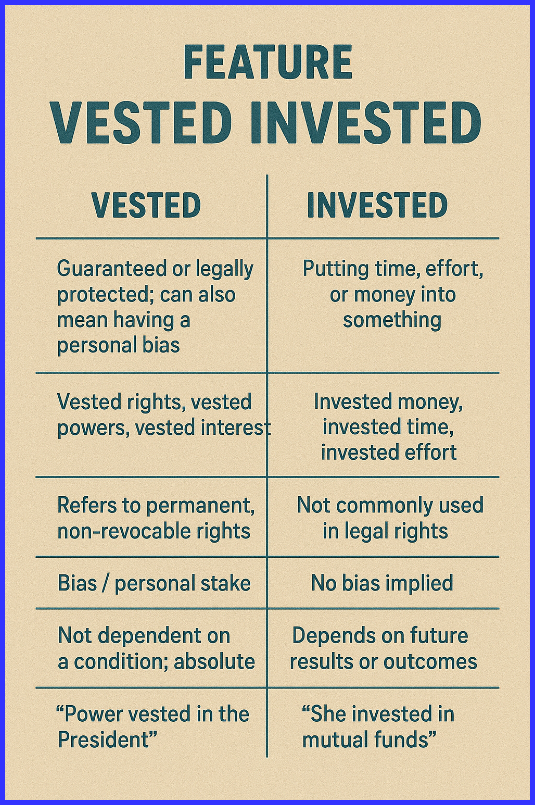
Key Differences Between Vested and Invested( Comparison Table)
| Feature | Vested | Invested |
| Meaning | Guaranteed or legally protected; can also mean having a personal bias | Putting time, effort, or money into something |
| Common Usage | Vested rights, vested powers, vested interest | Invested money, invested time, invested effort |
| Legal Context | Refers to permanent, non-revocable rights | Not commonly used in legal rights |
| Bias / Personal Stake | Indicates bias due to personal benefit (vested interest) | No bias implied |
| Dependency | Not dependent on a condition; absolute | Depends on future results or outcomes |
| Example | “Power vested in the President” | “She invested in mutual funds” |
| Incorrect Phrase | — | “Invested interest” is incorrect |
| Correct Phrase | “Vested interest” | — |
Examples to Make the Difference Clear
- Correct: He has a vested interest in the project because he benefits directly.
- Incorrect: He has an invested interest.
- Correct: She invested her savings in real estate.
- Correct: The constitution gives vested powers to certain authorities.
Conclusion
Understanding the difference between vested and invested helps avoid common grammar mistakes. Vested refers to rights, authority, or biased interest that is secure and protected by law, while invested refers to committing money, time, energy, or effort with the expectation of future benefits. Always remember, it is vested interest, never invested interest. Using the keyword difference between vested and invested correctly ensures clarity in both formal and everyday communication.
Read next: