The Difference Between Apathy and Indifference is that apathy refers to a lack of feeling, interest, or emotional response, often due to emotional fatigue or disconnection, while indifference refers to a neutral, intentional lack of concern, where a person chooses not to react or engage.
In simple words,
Apathy = emotional numbness or absence of feeling,
Indifference = choosing not to care.
Meaning of Apathy
Apathy refers to a state where a person lacks emotion, enthusiasm, motivation, or concern. They are not necessarily choosing to ignore something — they simply do not feel the emotional drive to care or act.
It is often seen in situations of emotional exhaustion, depression, stress, or burnout.
Apathy Etymology
The word apathy comes from Greek:
- a- meaning “without”
- pathos meaning “emotion,” “feeling,” or “suffering”
Original meaning: “without feeling”
Over time, the term came to describe emotional numbness or lack of motivation.
Sentence Examples of Apathy
- He watched the news of the crisis with complete apathy, showing no emotional reaction.
- Due to burnout, she felt apathy towards activities she once enjoyed.
- The team’s apathy during practice resulted in a poor match performance.
- He was aware of the problem but responded with apathy, unable to feel concerned.
- Her apathy made others think she didn’t care, although she simply felt exhausted.
Apathy Attributes
People experiencing apathy often seem disconnected from their emotions and surroundings. They may feel mentally tired, unmotivated, or emotionally “shut down.” This is usually not a choice — it is a psychological state resulting from stress, overwhelm, or depression.
Apathetic individuals may:
- Lack enthusiasm or energy
- Struggle to engage emotionally
- Feel numb or “empty”
- Lose interest in hobbies, people, or goals
Meaning of Indifference
Indifference refers to a deliberate lack of concern or neutral attitude toward something. A person who is indifferent is capable of feeling, but chooses not to involve themselves emotionally.
They may understand the situation — they simply decide it does not matter to them.
Indifference Etymology
The word indifference comes from Latin:
- in- meaning “not”
- differentia meaning “difference”
Original meaning: “not making a distinction” or “not caring one way or another.”
Sentence Examples of Indifference
- She responded to the compliment with indifference, neither happy nor upset.
- His indifference to success or failure made him appear calm in all situations.
- The manager showed indifference toward employee complaints.
- He remained indifferent, even though the decision affected everyone else.
- The artist accepted criticism with indifference, knowing it could not change his vision.
Indifference Attributes
Indifferent individuals are emotionally capable but choose to stay neutral. They may do so:
- To avoid emotional involvement
- To stay calm or detached
- Because the issue doesn’t personally matter
They often appear:
- Calm and composed
- Neutral and analytical
- Non-reactive
Similarities Between Apathy and Indifference
- Both apathy and indifference involve reduced emotional responsiveness or lack of strong feelings.
- In both conditions, a person shows emotional detachment, appearing less affected by events or circumstances around them.
- Both states can result in low motivation to act, participate, or express opinions.
- Apathy and indifference can weaken communication and relationships, as others may feel ignored or unsupported.
- In both cases, the individual may seem uninterested or disconnected, even if the causes behind their behavior differ.
- Both can lead to social withdrawal, where the person avoids deeper conversations or emotional involvement.
Key Differences Between Apathy and Indifference
| Feature | Apathy | Indifference |
| Meaning | Lack of emotion or motivation | Choosing not to care or engage |
| Emotional State | Emotionally numb | Emotionally neutral |
| Cause | Fatigue, stress, or emotional overload | Personal choice or deliberate detachment |
| Behavior | Withdrawn, unresponsive | Calm, unconcerned, unaffected |
| Example | Someone stops caring due to burnout | Someone does not care because the matter seems unimportant |
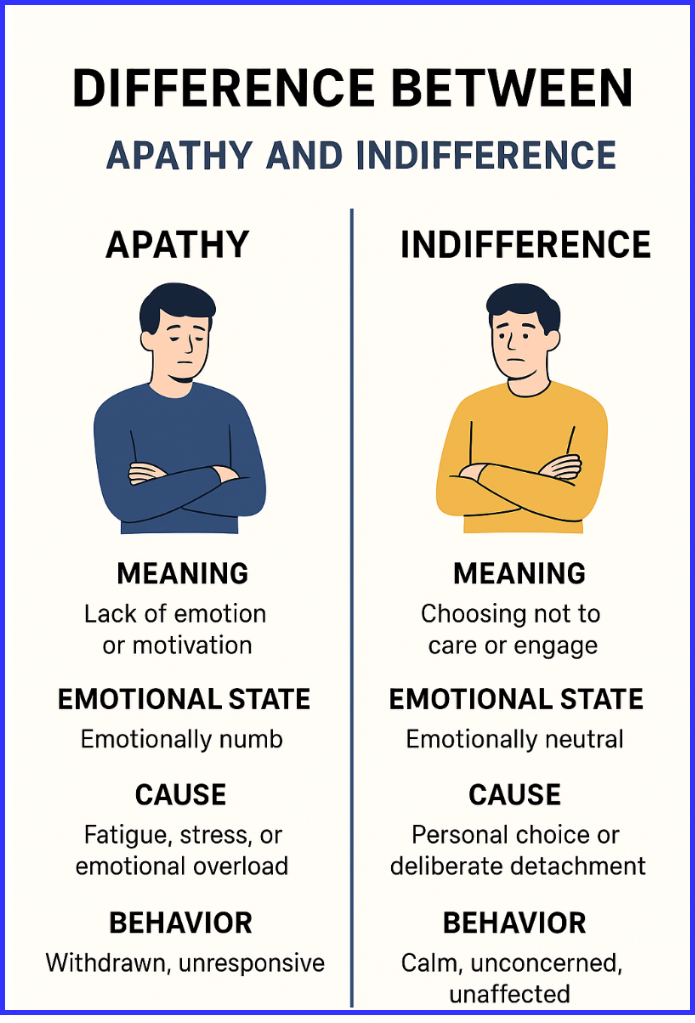
Easy Illustration to Understand the Difference
A student does not study because they feel nothing — no motivation, no worry, no interest.
Indifference:
A student does not study because they choose not to, believing the test does not matter.
Story: The Classroom Example- Apathy vs Indifference
Riya once enjoyed learning. She used to ask questions, share ideas, and smile during lessons. But recently, she sat silently, staring at her desk. She didn’t respond to the teacher, didn’t interact with classmates, and showed no interest in anything happening around her. She was not choosing to ignore the class — she simply could not feel anything anymore. This was apathy, a result of emotional exhaustion and burnout.
Karan, however, was different. He understood the lessons and had the ability to participate, but he chose not to. He believed studying was unimportant and felt there was no reason to make an effort. Karan wasn’t emotionally drained — he was indifferent because he decided not to care.
Riya needed empathy, support, and emotional healing.
Karan needed motivation, encouragement, and a sense of purpose.
Although their behavior looked similar from the outside, the reason behind it was very different — clearly showing the Difference Between Apathy and Indifference.
Conclusion
Understanding the Difference Between Apathy and Indifference is important for recognizing emotional well-being.
While apathy reflects emotional numbness or exhaustion, indifference is a conscious choice to stay neutral. Recognizing this difference helps us respond with empathy — supporting those experiencing apathy and engaging meaningfully with those who choose indifference.
FAQs- Apathy vs Indifference
The main difference is that apathy is an emotional state where a person feels numb or disconnected due to fatigue or stress, while indifference is a conscious choice to not care or get involved.
Yes. Both can appear as a lack of interest or emotional reaction. However, the internal reasons are different — apathy comes from emotional depletion, while indifference comes from intentional detachment.
Apathy often stems from emotional burnout, depression, stress, trauma, or fatigue. It is not a voluntary behavior but a psychological response to overwhelming mental load.
Not necessarily. Indifference can sometimes be healthy, such as when avoiding unnecessary drama or staying calm in stressful situations. The key is whether it harms relationships or responsibilities.
Overcoming apathy may involve rest, emotional support, counseling, lifestyle balance, and reconnecting with meaningful activities. Professional help may be required if it is linked to mental health conditions.
References:
1. Apathy– Wikipedia.
2. Indifference-Vocabularly.com
Read Next: