The difference between beta alanine and L alanine lies in their role in the body: beta alanine is a non-proteinogenic amino acid, whereas L alanine is a proteinogenic amino acid that becomes part of protein structures. This structural distinction also leads to major functional differences in metabolism, muscle performance, and protein synthesis.
Understanding Amino Acids
Amino acids are the fundamental units that build proteins. They are generally classified into two major categories:
- Proteinogenic amino acids – incorporated into proteins during translation.
- Non-proteinogenic amino acids – naturally occurring but not used to build proteins.
Beta alanine belongs to the second category, while L alanine belongs to the first.
What Is Beta Alanine?
Beta alanine is a naturally occurring non-proteinogenic beta amino acid. Unlike most amino acids, its amino group is attached to the β-carbon instead of the α-carbon. Its chemical name is 3-aminopropanoic acid.
Key Characteristics of Beta Alanine
- Does not participate in protein synthesis.
- Lacks a stereocenter and therefore has no stereoisomers.
- Acts primarily as a precursor to carnosine, a dipeptide stored in muscles.
- Higher beta alanine intake → increased carnosine levels → reduced fatigue and enhanced athletic performance.
- Found in supplements used by athletes to improve training output.
- Serves as a structural component of anserine and pantothenic acid (vitamin B5).
What Is L Alanine?
L alanine is a proteinogenic α-amino acid incorporated into proteins during translation. Its chemical name is 2-aminopropanoic acid, and it exists in stereoisomeric forms, with the L-form being biologically active.
Key Characteristics of L Alanine
- Participates directly in protein synthesis.
- One of the most abundant amino acids in proteins, making up 7–8% of residues in many protein structures.
- Produced naturally in the body from L-aspartate via enzymatic reactions.
- Used in cell culture media, pharmaceutical products, infusion solutions, and as a food additive.
- Supports energy production and glucose metabolism.
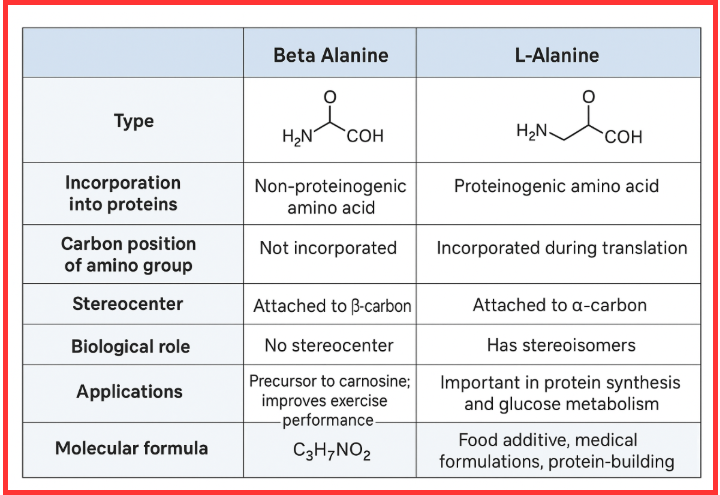
Beta Alanine vs L Alanine: Comparison Table
| Feature | Beta Alanine | L Alanine |
| Type | Non-proteinogenic amino acid | Proteinogenic amino acid |
| Incorporation into Proteins | Not incorporated | Incorporated during translation |
| Carbon Position of Amino Group | Attached to β-carbon | Attached to α-carbon |
| Stereocenter | No stereocenter | Has stereoisomers |
| Biological Role | Precursor to carnosine; improves exercise performance | Important in protein synthesis and glucose metabolism |
| Applications | Sports supplements, biochemical precursors | Food additive, medical formulations, protein-building |
| Molecular Formula | C₃H₇NO₂ | C₃H₇NO₂ (same formula, different structure) |
Similarities Between Beta Alanine and L Alanine
Both amino acids share a few core attributes:
- Occur naturally in biological systems
- Have the same molecular formula (C₃H₇NO₂)
- Support various metabolic functions
- Differ primarily in structural arrangement, not elemental composition
Detailed Difference Between Beta Alanine and L Alanine
The structural difference—β-carbon vs α-carbon placement—defines the functional difference:
- Beta alanine influences muscle endurance by boosting carnosine levels.
- L alanine is embedded in proteins and supports metabolic pathways such as glucose–alanine cycling.
This difference in biochemical roles makes each amino acid uniquely valuable in nutrition, physiology, and supplementation.
Conclusion: Key Difference Between Beta Alanine and L Alanine
In summary, the difference between beta alanine and L alanine comes down to structure and function: beta alanine is a non-proteinogenic amino acid used to enhance muscle carnosine levels, while L alanine is a protein-building amino acid essential for metabolism and protein synthesis. Understanding these differences helps you choose the right amino acid depending on whether your goal is muscle performance or metabolic support.
Reference:
1. McMillen, Matt. “Beta-Alanine: Uses and Risks.” WebMD.
2. “Alpha-Alanine: Overview, Uses, Side Effects, Precautions, Interactions, Dosing and Reviews.” WebMD.
Read Next: