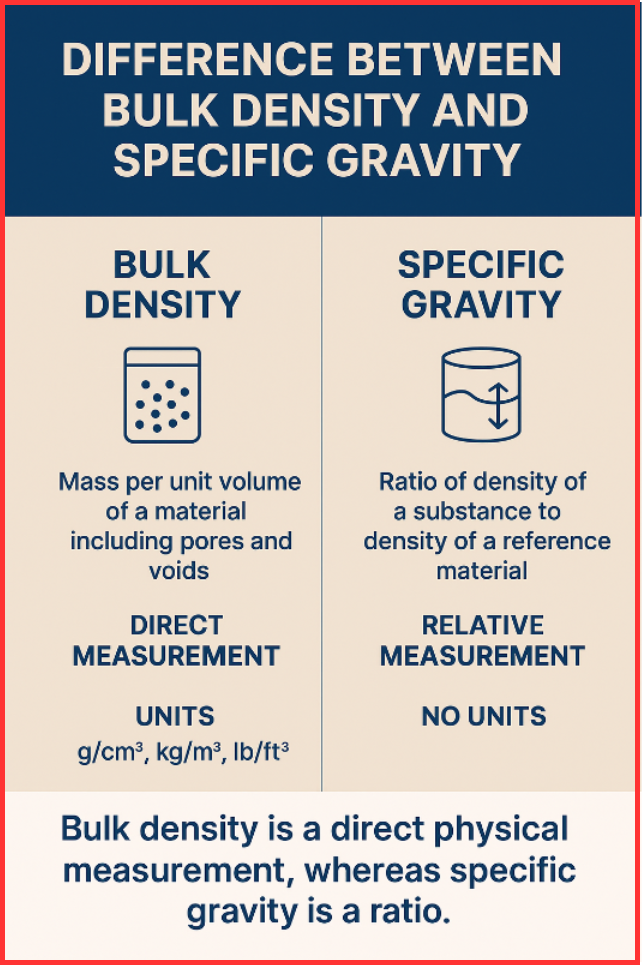
The Difference Between Bulk Density and Specific Gravity lies in how each property describes a material: bulk density is a direct measurement of mass per unit volume, while specific gravity is a relative comparison of a material’s density to that of a reference substance (usually water). In simple terms, bulk density tells you how heavy a material is in a given space, whereas specific gravity tells you how heavy it is compared to water.
Both parameters are widely used in engineering, geology, construction, mining, agriculture, and material science to understand how substances behave in storage, flow, transport, and processing.
What Is Bulk Density?
Bulk density refers to the mass of a material per unit volume, including any internal pores, voids, and spaces between particles. It is commonly expressed in g/cm³, kg/m³, or lb/ft³.
Key Points About Bulk Density
- Includes void spaces between particles, unlike true density, which excludes pores.
- A direct measurement—you simply measure mass and volume.
- Used extensively in:
- Soil science (to understand compaction and fertility)
- Agriculture (grain storage, fertilizer application)
- Mining and minerals (ore handling)
- Construction (sand, cement, aggregate quality)
- Powder technology (flowability and packing characteristics)
How Bulk Density Is Measured
Bulk density (ρ_bulk) is calculated as:
ρ_bulk = Mass of material / Total volume occupied
For powders and granular materials, bulk density may vary due to:
- Particle size and shape
- Moisture content
- Degree of compaction
- Storage and handling conditions
Why Bulk Density Matters
- Determines storage capacity
- Affects transportation cost
- Influences material flow in hoppers, silos, conveyors
- Helps set fertilizer spreading rates
- Indicates soil health (high bulk density = compacted soil with poor aeration)
What Is Specific Gravity?
Specific gravity (SG), also called relative density, is the ratio of the density of a substance to the density of a reference material.
Most commonly:
- Liquids → compared to water at 4°C
- Gases → compared to air at room temperature
- Solids → compared to water
Key Points About Specific Gravity
- It is a ratio, so it has no units.
- Indicates whether a substance will sink or float in water.
- Widely used in:
- Petroleum industry (API gravity)
- Battery testing (lead-acid battery electrolyte SG)
- Chemical manufacturing
- Food and beverage processing
- Mineral identification (gemology and geology)
Why Specific Gravity Matters
- Helps classify fluids and materials
- Assists in design calculations for pumps, pipes, and storage systems
- Used for quality control in industries dealing with liquids
- Helps identify minerals based on density differences
Important Note
Specific gravity varies with:
- Temperature
- Pressure
Therefore, the measurement conditions must be clearly stated.
Bulk Density vs Specific Gravity (Tabular Comparison)
| Parameter | Bulk Density | Specific Gravity |
| Meaning | Mass per unit volume of a material including pores and voids | Ratio of a material’s density to the density of a reference substance |
| Type of Value | Direct measurement | Relative measurement |
| Units | g/cm³, kg/m³, lb/ft³ | No units |
| Depends On | Particle packing, moisture content, compaction | Density of sample and reference material |
| Used For | Soil analysis, powders, aggregates, grains, ores | Liquid comparison, minerals, chemical solutions |
| Influence of Temperature & Pressure | Minor | Significant |
| Application Examples | Fertilizer spreading, soil health, material handling | Battery testing, petroleum industry, mineral identification |
| Indicates | How heavy a material is in a given volume | Whether a material floats or sinks (if water is reference) |
Practical Examples
Bulk Density Example
- A bag of cement weighing 50 kg occupies 0.033 m³.
Bulk density = 50 ÷ 0.033 = 1500 kg/m³
Specific Gravity Example
- If a liquid has density 1.2 g/cm³ and water has density 1.0 g/cm³:
Specific gravity = 1.2 ÷ 1.0 = 1.2 (it will sink)
Summary – Difference Between Bulk Density and Specific Gravity
To summarize the Difference Between Bulk Density and Specific Gravity, bulk density is a direct physical measurement of how much mass is packed into a given volume, while specific gravity is a ratio showing how dense a substance is compared to water or another reference material.
Bulk density is crucial for evaluating solids and powders, whereas specific gravity is vital for assessing liquids and identifying materials. Understanding both helps in engineering design, material handling, quality control, and scientific analysis.
Reference:
1. “Specific Gravity.” Encyclopædia Britannica, Encyclopædia Britannica, Inc.