The difference between a dynasty and an empire is that a dynasty refers to a line of rulers from the same family ruling over a region or kingdom for generations, while an empire refers to a large political state that controls multiple territories or nations, often ruled by a single powerful emperor.
In simple words:
- Dynasty = Ruling family / bloodline
- Empire = Large kingdom ruling many lands and people
Meaning of Dynasty
A dynasty is a sequence of rulers who belong to the same family and hold power over a region or kingdom across generations.
The defining feature of a dynasty is hereditary succession, meaning leadership passes from parent to child.
Dynasty – Etymology
The word “dynasty” comes from:
- Greek: dunasteia — meaning “power, lordship, rule”
- Root: dunastes — meaning “ruler”, from dunamis — “strength”
So, a dynasty literally refers to a family holding power.
Sentence Examples of Dynasty
- The Mughal Dynasty ruled large parts of India for centuries.
- Ancient China is known for many ruling dynasties like the Han Dynasty.
- The Pharaohs of Egypt belonged to powerful dynastic families.
- The company stayed under one family’s leadership, becoming a modern-day business dynasty.
- Historians study how dynasties rise and fall over generations.
Dynasty Attributes
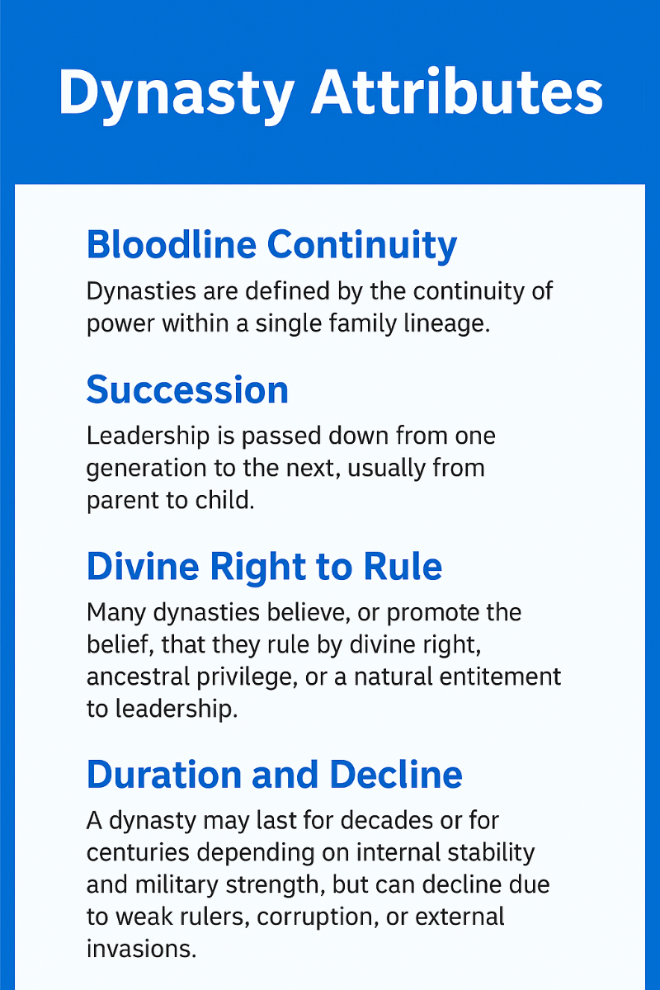
Dynasties are defined by the continuity of power within a single family lineage. Leadership is passed down from one generation to the next—usually from parent to child—making the family name central to authority and governance. Many dynasties believe, or promote the belief, that they rule by divine right, ancestral privilege, or a natural entitlement to leadership. This idea helps strengthen loyalty and obedience among the population.
A dynasty can endure for many decades or even centuries, depending on how strong and stable its internal structure is. Factors such as the ability to maintain political alliances, control the military, and manage economic resources play a crucial role in its survival. When the rulers are competent and respected, a dynasty often experiences peace, stability, and cultural growth.
Because power remains within the same family for multiple generations, cultural values, administrative policies, and traditions tend to remain consistent. This continuity can foster a strong sense of identity, shared heritage, and national pride. Artistic styles, architecture, religion, and social customs often flourish and become deeply rooted in society during long-lasting dynasties.
However, dynasties are also vulnerable. Problems may arise when the ruling family faces weak leadership, internal power struggles, corruption, or economic failures. If rulers become disconnected from the needs of the people or the military loses loyalty, the dynasty may weaken.
Additionally, external invasions, rebellions, or foreign influence can threaten the dynasty’s control. Over time, these pressures can lead to decline and may result in the dynasty being replaced by another family or a new form of government.gacy but can decline due to weak rulers, corruption, or external invasions.
Real-World Example of a Dynasty
The Qing Dynasty (China) –
The Qing Dynasty ruled China from 1644 to 1912 and was led by the Aisin-Gioro family. Power passed from one family member to another for 268 years, making it one of the longest-lasting dynasties in history. During this period, Chinese art, culture, and government followed traditions set by the ruling family.
Meaning of Empire
An empire is a vast political unit consisting of multiple regions, kingdoms, or nations that are controlled by one central authority — usually an emperor.
Empires expand through conquest, diplomacy, or colonization.
Empire – Etymology
The word “empire” comes from:
- Latin: imperium — meaning “command, authority, rule”
- Root of imperator — meaning “emperor”
Thus, an empire refers to a large territory ruled with supreme authority.
Sentence Examples of Empire
- The Roman Empire controlled vast parts of Europe, Asia, and Africa.
- The British Empire once ruled territories across the world.
- The emperor expanded his empire through military conquest.
- Empires often brought both development and conflict.
- The rise and fall of empires shape world history.
Empire Attributes
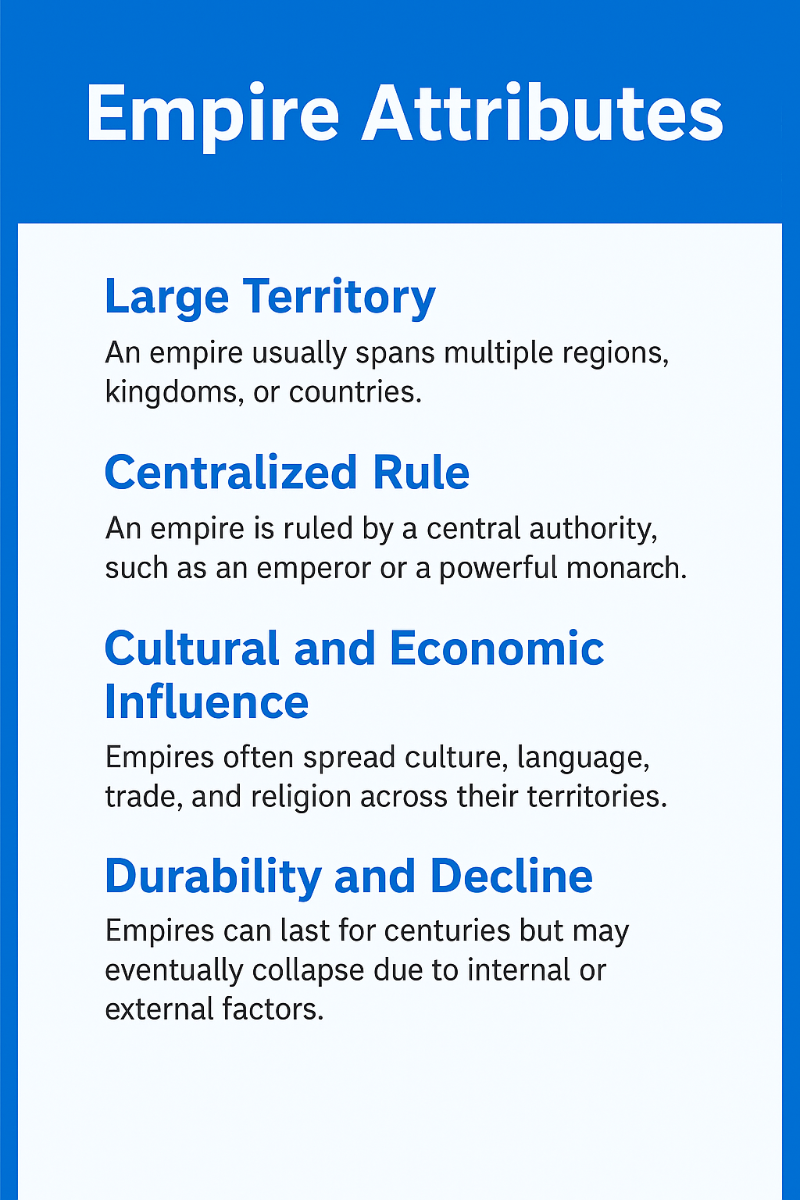
Empires are generally large political units that control vast geographic areas, which may include multiple kingdoms, regions, or nations. These territories often contain diverse groups of people, each with their own languages, cultures, and traditions. To manage such diversity, empires are usually governed through a centralized authority, most commonly under an emperor or a powerful ruling class that makes key decisions and oversees administration.
Empires often play a major role in shaping culture, language, trade, art, science, and religion. As they expand, they spread their way of life and influence across different lands. This cultural blending can lead to rich advancements in architecture, literature, education, and technology.
However, maintaining control over such large territories can require military strength, strategic alliances, and systems of taxation. Sometimes, the ruling power may use force, strict laws, or heavy taxes to keep regions under control. While this may help the empire grow, it can also lead to resentment, revolts, and conflict among the population.
Over time, many empires face challenges such as over-expansion, economic strain, corruption, or rebellions from conquered groups. When these pressures grow too strong, an empire may weaken and eventually collapse. Despite this, the cultural and historical influence of empires often continues long after they fall.
Real-World Example of an Empire
The Roman Empire –
The Roman Empire was one of the most powerful empires in world history. It controlled parts of Europe, North Africa, and Western Asia under the rule of emperors like Augustus and Constantine. It expanded by conquering new lands and ruled different cultures under a central authority. The empire influenced law, language, architecture, and government for centuries.
Key Differences Between Dynasty and Empire
| Feature / Attribute | Dynasty | Empire |
| Meaning | A dynasty refers to a continuous line of rulers from the same family, where authority is inherited over generations. | An empire is a large political unit that controls several regions or nations under one supreme authority, often an emperor. |
| Basis of Power | Family bloodline / hereditary rule. | Territorial control and supreme authority of the emperor or central ruler. |
| Succession | Leadership usually passes strictly within the same family. | Leadership may be hereditary, but can also be gained through conquest, appointment, or takeover. |
| Size / Territory | May be small or limited to one kingdom or region. | Usually large, covering multiple regions, kingdoms, or countries. |
| Government Structure | Mostly centralized around one ruling family and their supporters. | Can be centralized or divided into provinces and governed by appointed officials. |
| Duration | Can continue for many generations if the family retains power. | Duration varies—some empires last centuries, others collapse quickly due to wars or revolts. |
| Examples | Han Dynasty, Ming Dynasty, Romanov Dynasty. | Roman Empire, British Empire, Mughal Empire. |
Easy Illustration to Understand the Difference
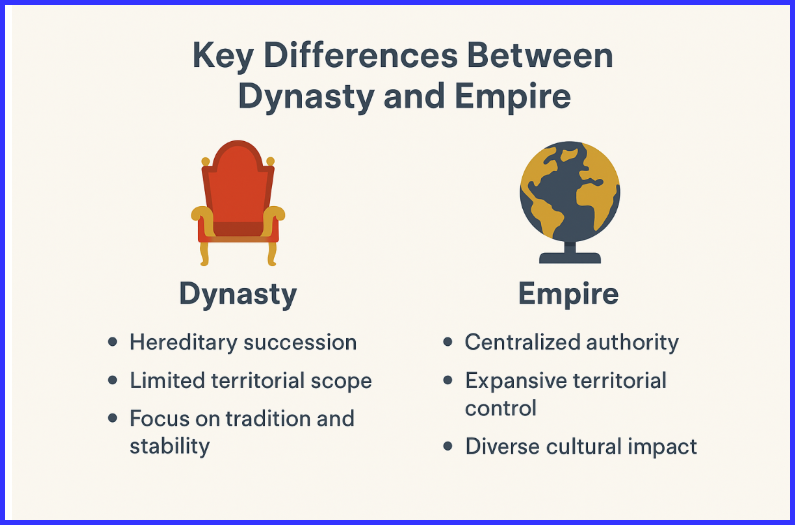
- Dynasty: A family that rules one kingdom generation after generation.
- Empire: A ruler who controls many kingdoms and lands, not just one.
Story: Dynasty vs Empire
In an ancient land, there lived a young prince named Arav. He belonged to a royal family that had governed the same kingdom for many generations. This long family rule was known as the Aravian Dynasty. The people respected Arav’s lineage because his ancestors had ruled with fairness.
Far beyond Arav’s kingdom stood a vast land ruled by Emperor Zoran. His empire stretched across mountains, deserts, and oceans. Many different kingdoms obeyed him, not because of family tradition, but because of his power and conquest.
Where Arav represented family heritage, Zoran represented dominance and expansion.
The people saw that:
- A dynasty continues a family’s rule.
- An empire expands a ruler’s power across many lands.
Conclusion
In summary, dynasties and empires are two unique systems of rule, each defined by distinct features. Dynasties depend on hereditary succession, smaller territories, and a focus on tradition and stability. Empires, by contrast, hold vast lands under centralized power and influence multiple cultures. While dynasties value continuity and long-term rule, empires are often more dynamic and prone to cycles of expansion and decline. Both have profoundly shaped human civilization, leaving lasting legacies that still impact the modern world.
Understanding the difference between dynasty and empire helps us see how history is shaped by leadership, power, expansion, and heritage. While a dynasty emphasizes family succession, an empire focuses on large-scale political control. Both have influenced civilizations, cultures, and the course of world history.
References:
1. “Dynasty.” Wikipedia. Wikipedia Foundation.
2. “Empire.” Wikipedia. Wikipedia Foundation.
Read Next: