The Difference Between Functionalism and Neofunctionalism lies in their scope: functionalism explains broad international cooperation across global issues, while neofunctionalism specifically focuses on regional integration, especially within frameworks like the European Union. In simple terms, functionalism promotes collaboration through international institutions, whereas neofunctionalism explains how economic, political, and social spillovers push regions toward deeper integration.
Both theories are central to international relations and sociology, helping us understand how societies and states interact, cooperate, and evolve.
What is Functionalism?
Functionalism is a theory in international relations that emphasizes how international organizations, institutions, and norms help countries cooperate. Functionalists believe that when states share common needs—such as health, education, communication, or trade—they naturally collaborate to solve problems.
Key Features of Functionalism
- Emphasis on global cooperation: Countries work together on social, economic, scientific, and humanitarian issues.
- Role of international institutions: Organizations like WHO, UNESCO, and IMF help reduce conflict by providing rules and structure.
- Focus on interdependence: The world becomes more peaceful when states depend on each other.
Example of Functionalism
When countries work together through the World Health Organization to fight pandemics, that cooperation reflects functionalist thinking—shared problems encourage joint solutions.
What is Neofunctionalism?
Neofunctionalism is a more specific theory developed by Ernst B. Haas (1958) to explain regional integration, especially in Europe. It argues that cooperation in one sector naturally creates spillover effects, leading to deeper integration in other sectors.
Key Features of Neofunctionalism
- Focus on regional integration: Mostly applied to the European Union (EU).
- Spillover effect: Integration in trade may lead to integration in transport, environment, and later political decision-making.
- Shift of loyalties: Citizens, interest groups, and businesses gradually trust supranational institutions more than national ones.
- Technocratic automaticity: Regional institutions gain increasing autonomy and push for further integration.
Example of Neofunctionalism
The creation of the European Coal and Steel Community (ECSC) led to the European Economic Community (EEC), which eventually evolved into the European Union (EU)—a perfect example of spillover integration.
Similarities Between Functionalism and Neofunctionalism
Both theories share some common ground:
- They emphasize cooperation as a driver of stability.
- They highlight functional benefits from working together.
- They see institutions as essential tools for reducing conflict and increasing coordination.
- Both oppose purely power-based theories like realism.
Difference Between Functionalism and Neofunctionalism (Tabular Form)
| Feature | Functionalism | Neofunctionalism |
| Scope | Global, broad cooperation | Regional integration |
| Main Focus | International institutions and problem-solving | Spillover effects and regional decision-making |
| Originator | David Mitrany | Ernst B. Haas |
| Approach | Collaborative and issue-based | Strategic and spillover-driven |
| Role of Institutions | Facilitate cooperation globally | Gain autonomy and drive integration regionally |
| Application Example | WHO, UNESCO, IMF | European Union (EU) |
| View of the State | States cooperate through shared interests | States integrate when economic ties deepen |
| Integration Process | Based on functional needs | Triggered by economic and political spillovers |
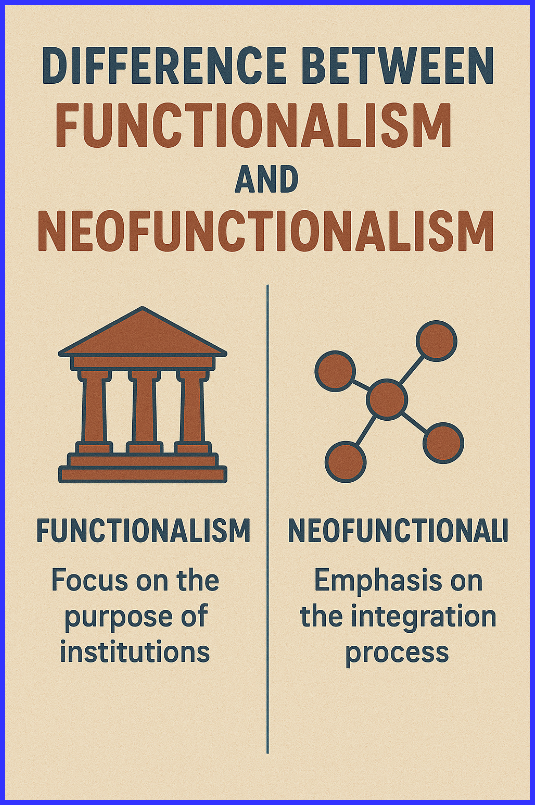
Summary – Functionalism vs Neofunctionalism
The Difference Between Functionalism and Neofunctionalism is that functionalism explains broad global cooperation, while neofunctionalism explains regional integration, especially through spillover effects. Functionalism highlights shared needs and global institutions, whereas neofunctionalism focuses on how regional institutions gain power and push states toward deeper integration.
Reference:
1. “Neofunctionalism.” Wikipedia. Wikipedia Foundation.
2. “Functionalism in International Relations; Definition and Applications in Practice.” The Kootneeti.
Read Next: