The difference between mulberry and boysenberry lies mainly in the plant they grow on—mulberries grow on trees, whereas boysenberries grow on low-trailing vines. Boysenberries are also larger and juicier, while mulberries come in multiple colors and vary more in flavor. This simple difference forms the basis for identifying both berries.
Both berries may look similar at first glance, but their origins, appearance, taste, and growth habits make them distinct. Below is a complete breakdown to help you understand them better.
What Is Mulberry?
Mulberries are the fruits of mulberry trees (Morus species), belonging to the Moraceae family. These berries resemble elongated blackberries and come in purple, black, red, and even white varieties.
Popular types include:
- Black Mulberry (Morus nigra)
- White Mulberry (Morus alba) – considered a modern superfood
- Red or American Mulberry (Morus rubra)
Taste and Texture
- White mulberries → very sweet
- Dark mulberries → sweet-tart
- Texture is soft and juicy with a mild floral note.
Nutritional Profile
Fresh mulberries contain:
- 88% water
- 60 calories per cup
- Iron, Vitamin C, antioxidants, fiber
Common Uses
Mulberries can be eaten fresh or added to:
- Smoothies
- Jams and jellies
- Pies and cobblers
- Wine and dessert sauces
- Granola or oatmeal (especially dried mulberries)
Benefits
Mulberries may help support better blood sugar control, reduce cholesterol levels, and improve antioxidant intake.
What Is Boysenberry?
Boysenberries are human-created hybrid berries made by crossing multiple fruits:
- Loganberry
- European raspberry
- American dewberry
- European blackberry
They were introduced by Rudolph Boysen, making the berry a unique cultivated fruit rather than a naturally occurring one.
Appearance and Size
- Large, soft berries (≈ 8 grams each)
- Deep maroon color
- Thin skin and large seeds
- Extremely juicy and prone to leaking when ripe
Taste
Boysenberries blend the:
- Tartness of blackberries
- Sweetness of raspberries
Growth Pattern
Boysenberries grow on low trailing vines, not trees. They thrive in warm climates and appear in farmers’ markets from late May through summer.
Common Uses
Great for:
- Syrups
- Pies
- Jams and preserves
- Desserts
- Fresh snacking (if consumed quickly due to rapid spoilage)
Similarities Between Mulberry and Boysenberry
Both fruits share some common traits:
- Both are aggregate fruits.
- Both have a sweet-tart flavor.
- Mostly harvested in the summer months.
- Both spoil quickly unless frozen or canned.
- Both used in jams, desserts, and fresh snacking.
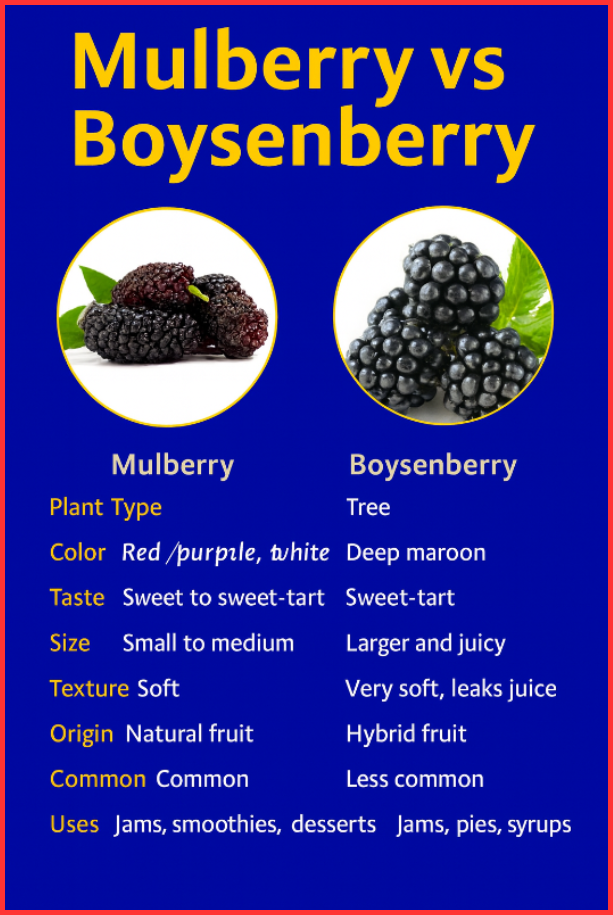
Mulberry vs Boysenberry (Tabular Comparison)
| Feature | Mulberry | Boysenberry |
| Plant Type | Tree | Vine |
| Color | Red, purple, black, white | Deep maroon |
| Taste | Sweet / sweet-tart | Sweet-tart |
| Size | Small to medium | Large and juicy |
| Texture | Soft | Very soft |
| Origin | Natural fruit | Hybrid fruit |
| Availability | Common | Less common |
| Uses | Jams, smoothies, desserts | Jams, pies, syrups |
Summary – Difference Between Mulberry and Boysenberry
The difference between mulberry and boysenberry primarily depends on their growth pattern and origin. Mulberries grow on trees and appear in several colors, while boysenberries grow on low-trailing vines and have a deep maroon hue. Boysenberries are hybrid berries with a juicier texture, whereas mulberries offer a wide flavor range depending on the variety.
Overall, both fruits are delicious, but their plant type and flavor profile make them uniquely different.
FAQ: Mulberry vs Boysenberry
No. Mulberries grow on trees, while blackberries grow on bushes. Blackberries are firmer and tarter.
Boysenberries are deep maroon, softer, larger, and sweeter. Blackberries are black, firmer, and more tart.
Both are aggregate fruits, but mulberries grow on trees and are larger and less sweet than raspberries.
No. Mulberries are aggregate fruits, not botanical berries.
Reference:
1. “What are Mulberries?” The Spruce Eats.
2. “What are Boysenberries?” All Recipes.
Read Next: