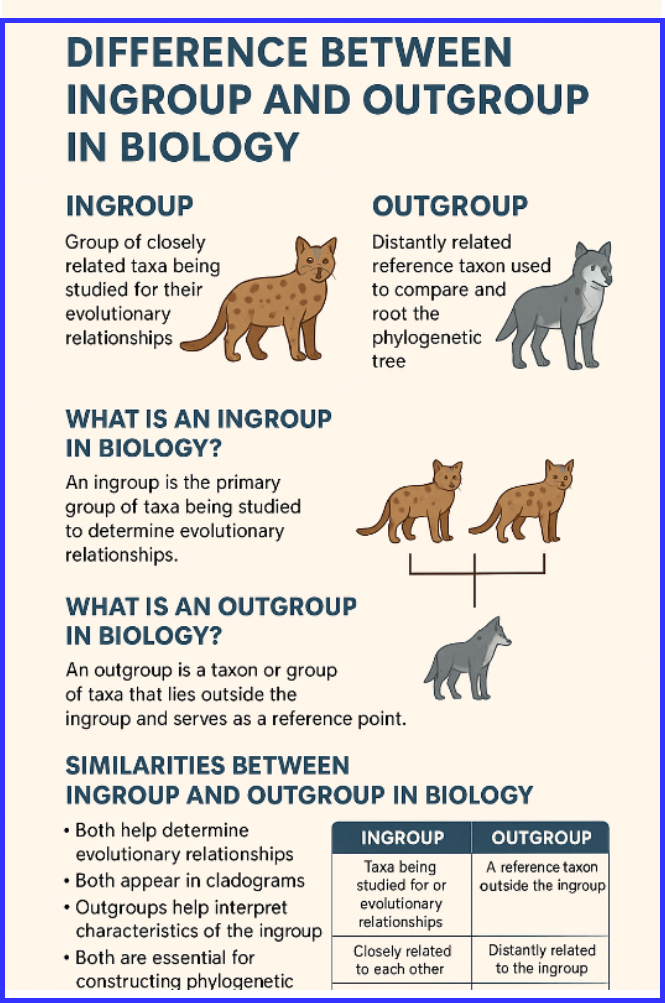
The difference between ingroup and outgroup in biology is that an ingroup consists of closely related taxa being studied for their evolutionary relationships, while an outgroup is a distantly related reference taxon used to compare and root the phylogenetic tree. This distinction helps biologists understand evolutionary pathways more accurately.
What Are Ingroup and Outgroup in Biology? – Overview
In phylogenetics and cladistics, organisms are grouped based on their evolutionary ancestry. Scientists use the most recent common ancestor to classify organisms into clades, and these relationships are represented using a cladogram.
Within this process, ingroup and outgroup play essential roles in identifying evolutionary connections and rooting phylogenetic trees.
What Is an Ingroup in Biology?
An ingroup is the primary group of taxa being studied to determine evolutionary relationships. These organisms:
- Are closely related to one another
- Share a recent common ancestor
- Form sister taxa on a cladogram
- Split from the same node on the evolutionary tree
Example of an Ingroup
If a researcher is studying the evolution of cats, lions, and leopards, these three form the ingroup, as they belong to the same family (Felidae) and share many biological similarities.
What Is an Outgroup in Biology?
An outgroup is a taxon or group of taxa that lies outside the ingroup and serves as a reference point. Outgroups are:
- Distantly related to the ingroup
- Used to root the cladogram
- Helpful for identifying ancestral vs. derived traits
- Positioned at the base of the tree
Example of an Outgroup
If the ingroup consists of cats, lions, and leopards, a suitable outgroup might be a wolf or hyena, which is related but clearly outside the Felidae family.
Why Are Outgroups Important?
Outgroups help biologists to:
- Determine where the ingroup fits in a larger evolutionary tree
- Differentiate ancestral traits from derived traits
- Validate and strengthen cladistic analysis
Without an outgroup, rooting the phylogenetic tree would be difficult and evolutionary direction would remain unclear.
Similarities Between Ingroup and Outgroup in Biology
Both groups share several important roles in phylogenetics:
- Both help determine evolutionary relationships
- Both appear in cladograms
- Outgroups help interpret characteristics of the ingroup
- Both are essential for constructing phylogenetic trees
Difference Between Ingroup and Outgroup in Biology (Tabular Comparison)
| Feature | Ingroup | Outgroup |
| Definition | Taxa being studied for evolutionary relationships | A reference taxon outside the ingroup |
| Relationship | Closely related to each other | Distantly related to the ingroup |
| Common Ancestor | Shares a recent common ancestor | Does not share the same recent ancestor |
| Role in Cladogram | Main focus of analysis | Used to root and compare |
| Function | Helps understand internal evolutionary patterns | Helps determine ancestral vs. derived traits |
| Example | Cats, lions, leopards | Wolf or hyena |
Summary – Ingroup vs Outgroup in Biology
In biology, the difference between ingroup and outgroup is crucial for accurate phylogenetic analysis. The ingroup consists of closely related organisms sharing a common ancestor, while the outgroup is a distant relative used as a reference point to root the evolutionary tree and identify trait patterns. Understanding the relationship between ingroup and outgroup helps biologists build reliable evolutionary models and interpret how species evolved over time.
Thus, the difference between ingroup and outgroup in biology remains a fundamental concept in evolutionary studies, cladistics, and taxonomy.
Reference:
1.“Phylogenetic Systematics, A.k.a. Evolutionary Trees.” Reading Trees: A Quick Review,
2. “Outgroup (Cladistics).” Wikipedia, Wikimedia Foundation, 13 Oct. 2019,
Read Next:
- Difference Between Etiology and Pathophysiology
- Difference Between DNA Fingerprinting and DNA Profiling
- Difference Between Detritivores and Saprotrophs
- Difference Between Glenoid Cavity and Acetabulum
- Difference Between Mycoplasma and Mycobacterium
- Pinnatifid vs. Pinnatisect: Key Differences Explained
- Phosphodiester Bond vs. Phosphoester Bond
- Cloning vs. Subcloning
- Chemoorganotrophs vs. Chemolithotrophs
- Acantholysis vs. Acanthosis
- Flatbread vs. Pita