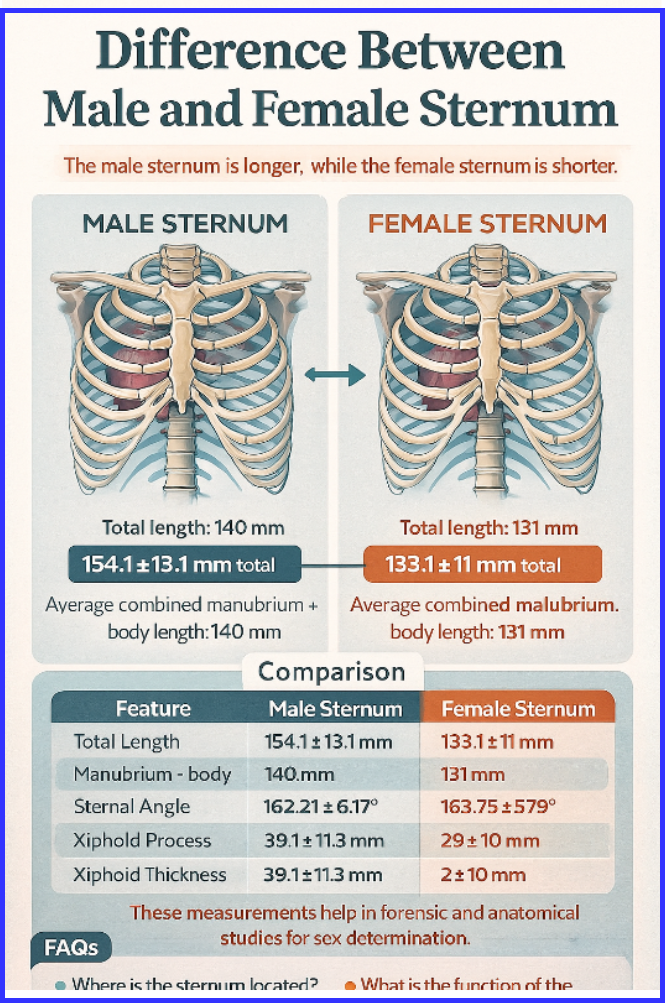
The difference between male and female sternum is mainly based on length—the male sternum is longer, while the female sternum is shorter. On average, the combined length of the manubrium and mesosternum in males is around 140 mm, whereas in females it is about 131 mm. This measurement is one of the key indicators used in forensic science and anatomy for sex determination.
The sternum, commonly known as the breastbone, is a flat T-shaped bone located in the center of the chest. It works together with the ribcage to protect vital organs including the heart, lungs, stomach, esophagus, and major blood vessels.
What Is the Sternum?
The sternum is divided into three major parts:
- Manubrium – the upper portion
- Body (Mesosternum) – the long central part
- Xiphoid Process – the small lower extension
These three segments provide structure, protection, and muscular attachment points.
What is Male Sternum?
The male sternum is typically longer, thicker, and slightly broader. It is often used in forensic anthropology due to its measurable characteristics.
Key Characteristics of Male Sternum
- Mean length: 154.1 ± 13.1 mm
- Combined manubrium + body length: 140 mm
- Sternum Index (SI): 50.11 ± 10.02 mm
- Manubrium length: 51.2 ± 6 mm
- Sternal angle: 162.21 ± 6.17°
- Manubrium thickness: 9.2 ± 1.5 mm
- Xiphoid process length: 39.1 ± 11.3 mm
- Xiphoid process thickness: 6.6 ± 1.6 mm
Example
During forensic identification, if a sternum sample shows a total length near 150 mm, it typically suggests male anatomy.
Whaat is Female Sternum?
The female sternum is shorter and slightly thinner when compared to its male counterpart.
Key Characteristics of Female Sternum
- Mean length: 133.1 ± 11 mm
- Combined manubrium + body length: 131 mm
- Sternum Index (SI): 54.47 ± 10.00 mm
- Manubrium length: 46.7 ± 5.1 mm
- Sternal angle: 163.75 ± 5.79°
- Manubrium thickness: 8 ± 1.6 mm
- Xiphoid process length: 29 ± 10 mm
- Xiphoid process thickness: 6 ± 1.3 mm
Example
If a sternum obtained from a skeleton shows a total length around 130 mm, it most likely belongs to a female.
Similarities Between Male and Female Sternum
Both male and female sternum share key features:
- Each sternum consists of manubrium, body, and xiphoid process.
- Both protect chest organs such as the heart and lungs.
- Both support rib articulation and muscular attachment.
- Both play a role in biological sex differentiation.
Difference Between Male and Female Sternum (Tabular Comparison)
| Feature | Male Sternum | Female Sternum |
| Total Length | 154.1 ± 13.1 mm | 133.1 ± 11 mm |
| Manubrium + Body Length | 140 mm | 131 mm |
| Sternum Index (SI) | 50.11 ± 10.02 mm | 54.47 ± 10.00 mm |
| Manubrium Length | 51.2 ± 6 mm | 46.7 ± 5.1 mm |
| Sternal Angle | 162.21 ± 6.17° | 163.75 ± 5.79° |
| Manubrium Thickness | 9.2 ± 1.5 mm | 8 ± 1.6 mm |
| Xiphoid Process Length | 39.1 ± 11.3 mm | 29 ± 10 mm |
| Xiphoid Thickness | 6.6 ± 1.6 mm | 6 ± 1.3 mm |
Summary – Difference Between Male and Female Sternum
The difference between male and female sternum primarily lies in size and proportions.
- Male sternum → longer, thicker, larger manubrium, longer xiphoid process.
- Female sternum → shorter, thinner, higher sternum index.
These anatomical differences help in forensic identification, medical diagnosis, and anthropological studies.
Conclusion: Difference Between Male and Female Sternum
In conclusion, the difference between male and female sternum mainly lies in overall length, proportions, and thickness. The male sternum is typically longer and more robust, while the female sternum is shorter and slimmer. These variations make the sternum an important structure for sex determination in anatomy and forensic science.
FAQs: Male and Female Sternum
In the center of the chest, attached to ribs via cartilage.
A vertical, T-shaped flat bone with three parts: manubrium, body, and xiphoid process.
Protects heart and lungs, supports ribs, and provides attachment to muscles.
About 154.1 ± 13.1 mm on average.
About 133.1 ± 11 mm on average.
Reference:
1. “Standard Female and Male Sternum“. Research Gate.
2. “Sexing the Human Sternum.” American Journal of Physical Anthropology, U.S. National Library of Medicine.
Read Next:
- Difference Between Glenoid Cavity and Acetabulum
- Difference Between Hand and Arm
- Difference Between Ingroup and Outgroup in Biology
- Difference Between Etiology and Pathophysiology
- Difference Between DNA Fingerprinting and DNA Profiling
- Cloning vs. Subcloning
- Female Clavicle vs. Male Clavicle: What’s the Difference?