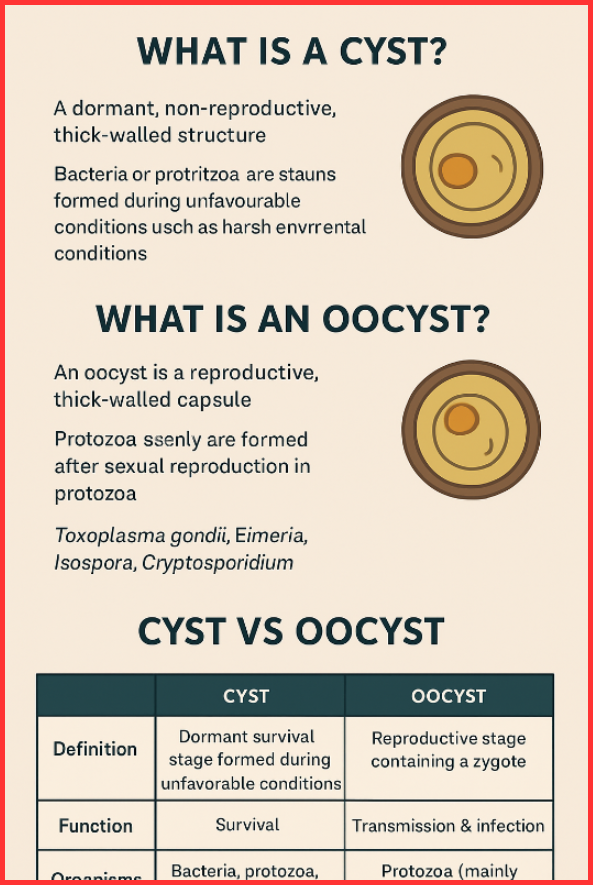
The difference between cyst and oocyst is that a cyst is a dormant survival stage formed by bacteria or protozoa during harsh environmental conditions, while an oocyst is a thick-walled reproductive stage found in the life cycle of protozoa that contains a fertilized zygote. This simple distinction helps differentiate a non-reproductive survival structure (cyst) from a reproductive, infective stage (oocyst) in microorganisms.
What Is a Cyst?
A cyst is a dormant, non-reproductive, thick-walled structure that many microorganisms (including bacteria, protozoa, and parasitic larvae) form to survive unfavorable conditions such as:
- Lack of nutrients
- Extreme temperature
- Toxic chemicals
- Low moisture
- Oxygen shortage
Purpose of a Cyst
The main purpose of a cyst is survival, not reproduction.
When conditions improve, the cyst wall breaks open through a process called excystation, allowing the organism to return to normal activity.
How Cysts Are Formed (Encystment)
Encystment involves:
- Cytoplasmic contraction
- Thickening of the outer wall
- Formation of protective layers
Cyst Wall Composition
- Bacteria: Cyst walls contain peptidoglycan
- Protozoa: Cyst walls are typically made of chitin
Examples of Cysts
- Amoeba cysts formed during dry conditions
- Giardia cysts transmitted through contaminated water
- Larval parasites encysting within host tissues
What Is an Oocyst?
An oocyst is a reproductive, thick-walled capsule formed in the life cycle of certain protozoa—especially those belonging to the phylum Apicomplexa.
This group includes parasites such as:
- Toxoplasma gondii
- Eimeria
- Isospora
- Cryptosporidium
How an Oocyst Forms
Oocysts are formed after sexual reproduction in protozoa:
- Male and female gametocytes develop
- Microgamete (male) fuses with macrogamete (female)
- A zygote is formed
- The zygote becomes enclosed within a tough oocyst wall
Why Oocysts Are Important
Oocysts are infective stages.
For example:
- Consuming oocysts of Toxoplasma gondii from contaminated food or soil causes toxoplasmosis
- Cryptosporidium oocysts cause severe diarrhea when ingested through contaminated water
Once inside a host, oocysts release sporozoites or bradyzoites, starting a new life cycle.
Cyst vs Oocyst – Tabular Comaparion
| Feature | Cyst | Oocyst |
| Definition | Dormant survival stage formed during unfavorable conditions | Reproductive stage containing a zygote |
| Function | Survival | Transmission & infection |
| Organisms | Bacteria, protozoa, parasitic larvae | Protozoa (mainly Apicomplexa) |
| Wall Thickness | Thick wall for protection | Very thick wall for infectivity |
| Type of Cell | Non-reproductive | Reproductive |
| Formation | By encystment during stress | After fertilization of gametes |
| Example | Giardia cyst, Amoeba cyst | Toxoplasma, Eimeria, Cryptosporidium oocysts |
Similarities Between Cysts and Oocysts
Both structures share common features:
- Thick protective walls
- Help microorganisms survive in harsh environments
- Increase transmission potential
- Found in many protozoan life cycles
Summary – Difference Between Cyst and Oocyst
A cyst is a non-reproductive dormant stage that allows microorganisms to survive until favorable conditions return. In contrast, an oocyst is a reproductive, infective stage formed after sexual fusion in protozoa, containing a zygote that develops into infective forms. Understanding the difference between cyst and oocyst is crucial in microbiology, parasitology, and disease control.
Reference:
1.“Difference Between Spore and Cyst in Bacteria | Definition, Features, Function.” Pediaa.Com, 22 Aug. 2017.
2.“Oocyst.” Encyclopædia Britannica, Encyclopædia Britannica, inc.
Read Next: