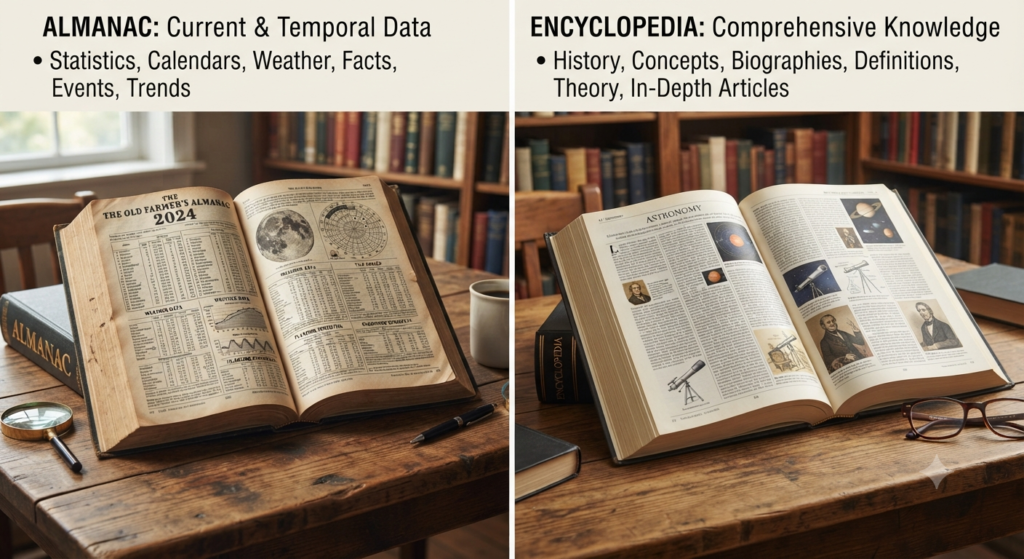
The main difference between Almanac vs. Encyclopedia is that an almanac is an annually updated reference book containing current facts, statistics, calendars, weather information, and important events, whereas an encyclopedia is a comprehensive reference work that provides detailed explanations and in-depth knowledge on a wide range of subjects. In Almanac vs. Encyclopedia, an almanac is ideal for finding quick, up-to-date information, while an encyclopedia is better suited for research and gaining a deeper understanding of a topic.
Comparision Table: Almanac vs. Encyclopedia
The following table highlights the key differences between an almanac and an encyclopedia.
| Feature | Almanac | Encyclopedia |
|---|---|---|
| Definition | A reference book containing annual facts, statistics, calendars, and important events. | A comprehensive reference work explaining subjects in detail. |
| Purpose | Provides quick facts and current information. | Provides detailed knowledge and explanations. |
| Publication Frequency | Usually published annually. | Updated periodically or continuously, especially online. |
| Coverage | Current events, weather, statistics, calendars, records, and practical information. | Almost every academic, scientific, historical, and cultural subject. |
| Information Depth | Brief and concise. | Detailed and comprehensive. |
| Organization | Usually arranged by topic, date, or category. | Generally arranged alphabetically by subject. |
| Best For | Quick reference and current data. | Research and detailed learning. |
| Volume | Usually one volume. | Single or multiple volumes; online versions are also available. |
| Updates | Updated every year. | Updated as new information becomes available. |
| Examples | World Almanac, Farmer’s Almanac. | Encyclopaedia Britannica, Wikipedia. |
What Is an Almanac?
An almanac is a reference publication that presents practical and statistical information for a specific year. It focuses on providing quick access to useful facts rather than detailed explanations.
A typical almanac may include:
- Calendars and important dates
- Weather information
- Astronomical events
- Sunrise and sunset timings
- Moon phases
- Population statistics
- Sports records
- Economic data
- Government information
- Historical anniversaries
Since most almanacs are updated every year, they provide current information that may change over time.
Features of an Almanac
- Published annually
- Contains concise information
- Includes updated statistics
- Easy to use for quick reference
- Covers practical everyday information
What Is an Encyclopedia?
An encyclopedia is a comprehensive collection of knowledge that provides detailed information about various subjects or a specific field.
Each topic is presented as an individual article containing explanations, history, important facts, illustrations, and references.
Modern encyclopedias are available in both printed and digital formats, making information easily accessible worldwide.
Features of an Encyclopedia
- Covers a wide range of subjects
- Provides detailed explanations
- Organized alphabetically
- Suitable for research and academic studies
- Updated periodically to reflect new discoveries
Almanac vs. Encyclopedia: Key Differences
Although both are reference books, they differ in several important ways.
Purpose
The primary purpose of an almanac is to provide quick access to current facts, statistics, and practical information. It is typically published every year and includes data such as calendars, weather forecasts, astronomical events, holidays, sports records, economic statistics, and important dates. Because the information is presented in a concise format, an almanac is ideal for fast fact-checking and everyday reference.
An encyclopedia, in contrast, is designed to provide comprehensive knowledge and detailed explanations on a wide variety of subjects. Rather than listing facts alone, it explains concepts, historical events, scientific principles, people, places, and other topics in depth. Encyclopedia articles are usually organized alphabetically or by subject, making them valuable resources for research, education, and gaining a thorough understanding of a topic.
Content and Depth of Information
An almanac contains concise, up-to-date information on a wide range of topics, making it an excellent source for quick reference. It typically includes statistics, calendars, weather forecasts, astronomical events, historical anniversaries, government data, sports records, economic indicators, population figures, and other yearly information. Since almanacs are updated annually, they focus on presenting current facts rather than detailed explanations. As a result, they provide an overview of many subjects but usually do not explore any topic in depth.
An encyclopedia, by contrast, is designed to provide comprehensive and well-researched knowledge on a vast range of subjects. Its articles explain concepts in detail and often include historical background, scientific principles, definitions, illustrations, maps, references, and examples to help readers understand a topic thoroughly. Encyclopedias cover disciplines such as history, science, geography, literature, technology, medicine, arts, and culture, making them valuable resources for research, education, and in-depth learning.
Publication Schedule and Updates
An almanac is typically published once every year, with each new edition containing updated facts, statistics, calendars, weather information, astronomical events, government data, sports records, and other time-sensitive information. Because it focuses on annual data and current events, older editions gradually lose relevance as new information becomes available.
An encyclopedia, in contrast, is not usually published on a fixed annual schedule. Traditional printed encyclopedias are revised whenever significant new information or discoveries need to be included, while online encyclopedias are updated continuously to reflect the latest research and developments. Since most encyclopedia articles cover subjects whose core concepts remain relatively stable, they generally require less frequent updates than almanacs, except for topics involving current events, technology, or scientific advancements.
Organization and Structure
An almanac is organized to help readers locate information quickly. Instead of providing lengthy articles, it divides content into practical sections such as calendars, weather, astronomy, sports, government, economics, agriculture, and historical events. Depending on the publication, information may be arranged by month, date, topic, or category, with tables, charts, indexes, and statistical summaries that make finding specific facts fast and convenient.
An encyclopedia, in contrast, is organized primarily in alphabetical order, with each topic presented as a separate article or entry. Some specialized encyclopedias may also group information by subject or theme. Encyclopedia articles are interconnected through cross-references, illustrations, maps, diagrams, and bibliographies, allowing readers to move from general topics to more specific ones and explore a subject in greater depth. This structured approach makes encyclopedias especially useful for systematic study, research, and detailed learning.
Usage and Audience
An almanac is best suited for readers who need quick, up-to-date information without reading lengthy articles. It is commonly used to look up current statistics, weather forecasts, calendars, astronomical events, sports records, population data, government facts, and other annually updated information. Almanacs are popular among students, teachers, journalists, travelers, farmers, quiz enthusiasts, and anyone looking for fast factual answers or practical everyday information.
An encyclopedia, on the other hand, is intended for readers who want a deeper understanding of a subject. It is widely used for academic research, school and college assignments, professional reference, and self-learning. Encyclopedias provide comprehensive explanations, historical context, scientific principles, illustrations, and references, making them valuable resources for students, educators, researchers, and professionals seeking reliable and authoritative knowledge.
Similarities Between Almanac and Encyclopedia
Although an almanac and an encyclopedia serve different purposes, they share several common features:
- Provide reliable and factual information.
- Help readers locate information quickly.
- Cover a wide range of topics for reference and learning.
- Serve as valuable educational resources in schools, colleges, and libraries.
- Are available in print as well as digital or online formats.
- Are widely used by students, teachers, researchers, professionals, and general readers.
Advantages of an Almanac
An almanac is a practical reference source that offers several benefits for students, professionals, and general readers:
- Updated annually: Each edition includes the latest facts, statistics, records, and important events.
- Quick access to information: Presents data in a concise format, making it easy to find answers within minutes.
- Reliable current data: Provides recent information on weather, population, government, economics, sports, and other topics.
- Covers multiple subjects: Combines calendars, astronomical data, historical events, and statistical information in a single resource.
- Easy to carry and use: Most almanacs are available as compact printed books and digital editions for convenient access.
- Useful for everyday reference: Ideal for checking facts, planning activities, solving quizzes, and obtaining general knowledge without reading lengthy articles.
Advantages of an Encyclopedia
An encyclopedia is one of the most valuable reference resources for learning and research because it provides detailed and well-organized information on a wide range of subjects.
- Comprehensive coverage: Explains topics thoroughly, from basic concepts to advanced details.
- Reliable and authoritative information: Articles are typically prepared and reviewed by subject experts.
- Ideal for research and education: Widely used for school assignments, academic research, and professional reference.
- Clear and structured explanations: Presents information in a logical manner, making complex topics easier to understand.
- Rich learning resources: Many encyclopedias include illustrations, maps, diagrams, photographs, charts, and bibliographies to improve understanding.
- Broad subject coverage: Contains articles on history, science, geography, literature, technology, medicine, arts, and many other fields within a single reference source.
When Should You Use an Almanac?
An almanac is the right reference source when you need current facts, statistics, or other time-sensitive information. It is especially useful for quick lookups rather than detailed study.
Use an almanac if you are looking for:
- Current population and demographic statistics
- Weather records, climate data, and forecasts
- Calendars, holidays, and important annual dates
- Sunrise, sunset, moon phases, and other astronomical information
- Government, economic, and agricultural statistics
- Sports records, rankings, and notable achievements
- Historical events and significant anniversaries
- Fast, reliable facts for planning, quizzes, or general reference
When Should You Use an Encyclopedia?
An encyclopedia is the best choice when you need detailed, well-organized information on a subject. It provides comprehensive explanations, making it an excellent resource for learning, research, and academic study.
Choose an encyclopedia when you want to:
- Understand scientific, technical, or mathematical concepts in depth
- Study historical events, civilizations, and important discoveries
- Complete school, college, or university research projects
- Learn about famous people, places, organizations, or historical figures
- Explore subjects such as science, history, geography, literature, medicine, technology, and the arts
- Find reliable background information before conducting advanced research
- Gain a thorough understanding of a topic through detailed articles, illustrations, maps, and references
Examples of Almanacs and Encyclopedias
Popular Almanacs
- The World Almanac and Book of Facts
- The Old Farmer’s Almanac
- TIME Almanac
Popular Encyclopedias
- Encyclopaedia Britannica
- World Book Encyclopedia
- Wikipedia
- Stanford Encyclopedia of Philosophy
Conclusion
The comparison of Almanac vs. Encyclopedia shows that both are valuable reference resources, but they are designed for different purposes. An almanac is ideal for finding current facts, statistics, calendars, and annual information quickly. In contrast, an encyclopedia provides detailed, well-organized knowledge that supports research, education, and in-depth understanding.
If you need fast, up-to-date information, choose an almanac. If you need comprehensive explanations and detailed learning, an encyclopedia is the better option.
Frequently Asked Questions (FAQs)
The main difference is that an almanac provides annual facts, statistics, calendars, and current information, whereas an encyclopedia offers detailed explanations and comprehensive knowledge on various subjects.
Yes. Most almanacs are published annually with updated facts, statistics, and important events.
Yes. Encyclopedias provide much more detailed information than almanacs and are better suited for research and learning.
An encyclopedia is generally better for research because it explains topics in depth and often includes references.
Yes. Both are reference books, but they serve different purposes. An almanac is best for quick facts, while an encyclopedia is best for comprehensive information.
Read Next: