The difference between factory and production plant is that a factory is a specialized industrial facility designed for the large-scale manufacturing of finished goods, whereas a production plant is a broader term that refers to any facility where materials are processed, manufactured, assembled, or refined.
Although many people use these terms interchangeably, they are not exactly the same. A factory mainly focuses on mass production using organized production lines and automated machinery, while a production plant may handle one or multiple stages of the production process and can produce intermediate components or finished products.
Both factories and production plants are important parts of the industrial manufacturing process, but they serve different roles depending on the type of production and industry. Understanding the difference between a factory and a production plant helps students, engineers, manufacturers, and industry professionals use these terms correctly.
Comparison: Factory vs Production Plant (Tabular Form)
The following comparison table highlights the key differences between a factory and a production plant based on their purpose, scope, production process, output, automation, and industrial applications.
| Feature | Factory | Production Plant |
|---|---|---|
| Definition | Facility designed for large-scale manufacturing of finished goods | Broad industrial facility where materials are processed, manufactured, assembled, or refined |
| Purpose | Mass production of standardized products | Processing, manufacturing, assembling, or refining products |
| Scope | Specific type of manufacturing facility | Broader term that includes factories and other industrial facilities |
| Primary Function | Converts raw materials into finished goods | May perform one or multiple stages of production |
| Production Stage | Usually complete manufacturing process | Partial or complete production process |
| Output | Primarily finished manufactured goods | Intermediate materials, processed materials, components, or finished goods |
| Size | Usually large | Can be small, medium, or large |
| Layout | Assembly-line based | Depends on the production process |
| Production Volume | High-volume continuous production | Varies according to industry requirements |
| Product Variety | Usually standardized products | Standardized or customized products |
| Automation Level | Generally high | Low to high depending on the industry |
| Machinery | Heavy manufacturing and assembly equipment | Equipment varies according to the production process |
| Workforce | Specialized manufacturing workforce | Engineers, technicians, operators, and production staff |
| Flexibility | Less flexible due to standardized production | More flexible for different production processes |
| Industries | Automotive, electronics, textiles, consumer goods | Chemical, oil & gas, food, pharmaceuticals, steel, power, automotive |
| Raw Material Handling | Raw materials enter production lines | Raw materials may be processed, refined, assembled, or packaged |
| Quality Control | Focus on finished product quality | Quality checks throughout production stages |
| Supply Chain Role | Final manufacturing facility | May supply materials, components, or finished products |
| Energy Consumption | Generally high | Depends on the production process |
| Investment Cost | Usually high | Varies widely based on the industry |
| Examples | Car factory, furniture factory, garment factory | Oil refinery, cement plant, steel plant, pharmaceutical plant, semiconductor fabrication plant |
| Relationship | Every factory is a production plant | Not every production plant is a factory |
What is a Factory?
A factory is a place where raw materials are turned into finished goods. It is a type of manufacturing facility designed for large-scale production. Factories use an organized manufacturing process to produce the same products quickly and efficiently.
Most factories have production lines, heavy machinery, and skilled workers. Many also use automation to increase production speed, reduce costs, and improve product quality. This helps manufacturers produce large quantities of goods with consistent quality.
Factories are commonly found in industries such as automotive, electronics, textiles, furniture, food processing, and consumer goods. Their main purpose is to manufacture standardized products in large volumes.
A factory is also an industrial facility, but it has a more specific role than a production plant. While every factory is a type of production plant, not every production plant is a factory. Some production plants process raw materials or manufacture components instead of producing finished goods.
Key Characteristics of a Factory
- Large industrial facility designed for high-volume manufacturing.
- Focused on mass production of standardized products.
- Uses production lines to manufacture goods quickly and efficiently.
- Relies on automation and advanced machinery to improve productivity.
- Produces finished goods ready for sale or distribution.
- Maintains strict quality control to ensure product consistency.
- Operates continuously or in shifts to maximize production output.
- Common in industries such as automotive, electronics, textiles, and consumer goods.
What is a Production Plant?
A production plant is an industrial facility where materials are processed, manufactured, assembled, or refined into products. It is a broad term that includes many types of manufacturing facilities, including factories.
Unlike a factory, a production plant may handle only one stage of the manufacturing process or the entire production cycle. Some plants process raw materials, while others assemble components, refine products, or manufacture finished goods. The size of a production plant can range from a small workshop to a large industrial complex.
Production plants are used in many industries, including oil and gas, chemicals, food processing, pharmaceuticals, steel, electronics, and automotive manufacturing. The equipment and level of automation depend on the type of production and the products being made.
In simple terms, every factory is a production plant, but not every production plant is a factory. A factory mainly focuses on the large-scale production of finished goods, whereas a production plant can perform different manufacturing or processing activities.
Types of Production Plants
Production plants are classified based on the type of work they perform. Some plants process raw materials, while others manufacture, assemble, package, or refine products. The most common types include:
- Processing plants – Convert raw materials into usable products, such as oil refineries, food processing plants, and chemical plants.
- Assembly plants – Assemble components into finished products, such as automobiles, electronics, and home appliances.
- Manufacturing plants – Produce parts, tools, machinery, or finished products using various manufacturing processes.
- Packaging plants – Package finished products for storage, transportation, and distribution.
- Refining plants – Purify or refine raw materials into more useful products, such as petroleum refineries and sugar refineries.
Each type of production plant plays a specific role in the manufacturing process and helps move products from raw materials to the final market.
Key Characteristics of a Production Plant
- Broad category of industrial facility used for manufacturing, processing, assembling, or refining products.
- Can vary in size, from small workshops to large industrial complexes.
- May handle one or multiple production stages depending on the manufacturing process.
- Flexible structure and design to suit different production requirements.
- Automation level varies by industry, from manual operations to fully automated systems.
- Used across many sectors, including oil and gas, chemicals, food processing, pharmaceuticals, and automotive.
- Can operate independently or within larger manufacturing systems as part of the production chain.
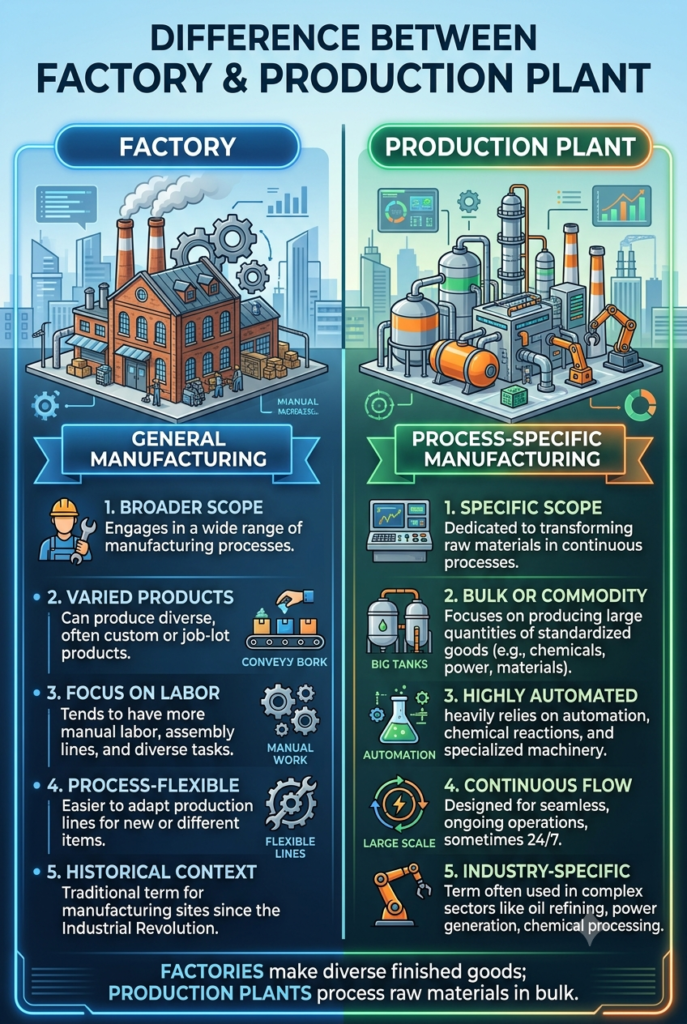
Factory vs Production Plant: Key Differences
1. A factory is a large industrial facility. It converts raw materials into finished goods. In contrast, a production plant processes or assembles products.
2. Factories focus on mass production of finished goods. However, production plants may handle only specific production stages.
3. Factories are large and highly structured. On the other hand, production plants can be small, medium, or large.
4. Factories run continuous production systems. Therefore, they ensure fast and standardized output. In contrast, production plants adjust production as needed.
5. Factories use multiple production lines and heavy machines. Likewise, production plants use tools based on the process type.
6. Factories depend heavily on automation. In contrast, production plants may use both machines and manual labor.
7. Factories produce uniform products in large quantities. However, production plants can also produce custom items.
8. Factories are located in industrial or urban areas. Similarly, production plants can be located in rural or industrial zones.
9. Factories play a central role in final production. As a result, they act as core manufacturing units. Production plants support specific stages.
10. Factories follow strict production standards. Therefore, they ensure consistency and efficiency. In contrast, production plants are more flexible.
11. A factory is a specific production facility for mass manufacturing. A production plant is a broader term that includes factories and other industrial units.
Examples of Factory vs Production Plant
- A car manufacturing unit producing thousands of identical cars daily is a factory.
- An oil refinery or chemical processing unit is a production plant.
- A smartphone assembly line is a factory, while a chip manufacturing unit is a production plant.
- A textile factory producing fabric at scale is a factory, while a dyeing or finishing unit is a production plant.
- A beverage bottling facility producing standardized soft drinks is a factory.
- A pharmaceutical manufacturing facility producing medicines is a production plant.
- A steel mill producing steel coils and sheets is a production plant.
- A furniture manufacturing unit producing identical furniture items in large quantities is a factory.
Conclusion – Factory vs Production Plant
The difference between factory and production plant mainly lies in their scope and function. A factory is a specialized manufacturing facility that focuses on the large-scale production of finished goods using organized production lines, machinery, and automation. In contrast, a production plant is a broader industrial facility where materials may be processed, manufactured, assembled, or refined at different stages of the manufacturing process.
Although every factory is a type of production plant, not every production plant is a factory. Production plants can produce raw materials, intermediate products, components, or finished goods, depending on the industry and production requirements.
In simple terms, if the primary goal is high-volume manufacturing of standardized products, the facility is generally called a factory. If it performs one or more stages of manufacturing, processing, or refining, it is more accurately described as a production plant. Understanding the difference between a factory and a production plant helps students, engineers, manufacturers, and industry professionals use these terms correctly.
Frequently Asked Questions (FAQs)
Yes. Every factory is a type of production plant, but not every production plant is a factory.
There is no fixed size difference. Factories are often large manufacturing facilities, but production plants can range from small facilities to massive industrial complexes depending on the industry.
Yes, a production plant can be part of a larger factory setup.
Industries such as oil, gas, chemicals, food processing, automotive, and electronics use production plants.
The main purpose of a factory is to produce large quantities of standardized goods efficiently.
No. A factory is a specific type of manufacturing plant that mainly focuses on producing finished goods on a large scale. A manufacturing plant is a broader term that can include factories as well as facilities that process, assemble, or refine products.
Read Next: