The difference between glycine and L-glycine is simple: glycine refers to the amino acid in general, while L-glycine is the biologically active isomer that the human body actually uses to build proteins. In most biological and nutritional contexts, “glycine” typically means L-glycine because this is the only form incorporated into proteins.
What Is Glycine?
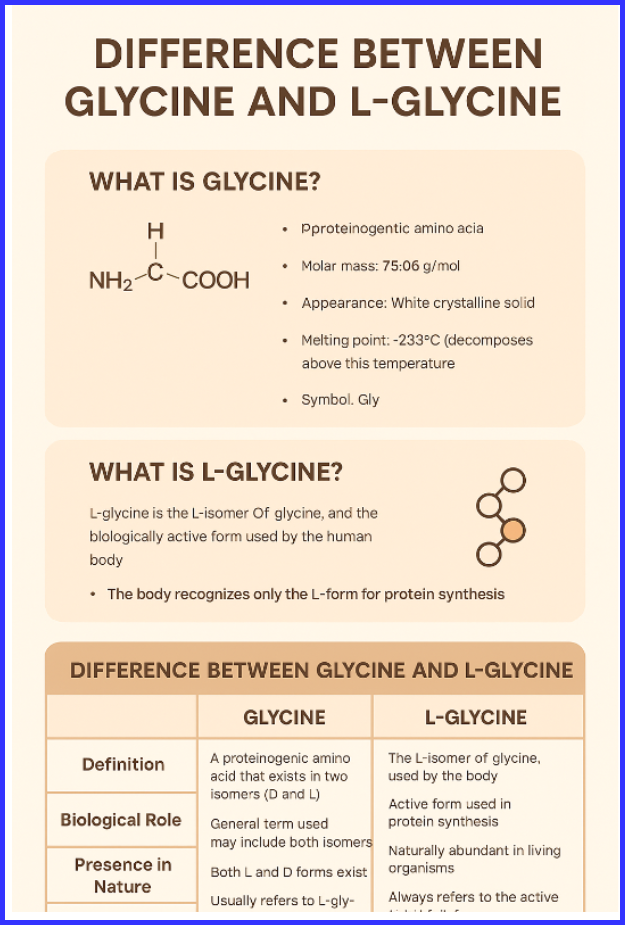
Glycine is the simplest proteinogenic amino acid, containing only a single hydrogen atom as its side chain. Its chemical formula is NH₂-CH₂-COOH, making it the smallest amino acid in the human body.
Key Characteristics of Glycine
- Molar mass: 75.06 g/mol
- Appearance: White crystalline solid
- Melting point: ~233°C (decomposes above this temperature)
- Symbol: Gly
Where Glycine Comes From
Glycine is naturally found in protein-rich foods such as:
- Meat and poultry
- Fish
- Dairy products
- Legumes
Functions and Uses of Glycine
Glycine plays several important roles in the body:
- Protein synthesis: A core building block of collagen and other proteins
- Neurotransmission: Acts as an inhibitory neurotransmitter
- Metabolism: Helps form heme, creatine, and glutathione
Common Applications of Glycine
- Medical use: Sometimes used to support treatment of sleep disorders, schizophrenia, stroke recovery, and metabolic syndrome
- Food industry: Used as an additive in animal feeds and certain processed foods
- Cosmetics: Functions as a buffering agent in skin-care products
- Chemical industry: Acts as a precursor for organic compounds
What Is L-Glycine?
L-glycine is the L-isomer of glycine and the biologically active form used by the human body. Amino acids occur in two isomeric forms—D and L. Among these, L-glycine is the one naturally incorporated into human proteins.
Why L-Glycine Matters
- The body recognizes only the L-form for protein synthesis.
- Enzymes, metabolic pathways, and cellular processes interact exclusively with L-glycine.
- Nutritional supplements labeled “glycine” typically contain L-glycine.
Example
When collagen is synthesized, the amino acid incorporated is always L-glycine, not D-glycine.
Difference Between Glycine and L-Glycine (Comparison Table)
| Feature | Glycine | L-Glycine |
| Definition | A proteinogenic amino acid that exists in two isomers (D and L) | The L-isomer of glycine, used by the body |
| Biological Role | General term; may include both isomers | Active form used in protein synthesis |
| Presence in Nature | Both L and D forms exist | Naturally abundant in living organisms |
| Use in Supplements | Usually refers to L-glycine but may indicate the general form | Always refers to the active biological form |
| Application in Cells | Not specific; includes both isomers | Incorporated into proteins and metabolic pathways |
Summary – Glycine vs L-Glycine
To summarize, the difference between glycine and L-glycine is that glycine refers to the amino acid in its general form, while L-glycine is the specific, biologically active version the body uses for protein synthesis and metabolism. In most nutritional or biochemical contexts, “glycine” implicitly means L-glycine, since this is the natural and functional isomer.
Understanding the difference between glycine and L-glycine helps clarify amino acid labeling, supplement information, and biochemical functions.
Reference:
1. “Glycine: Uses, Side Effects, Interactions, Dosage, and Warning.” WebMD,
Read Next: