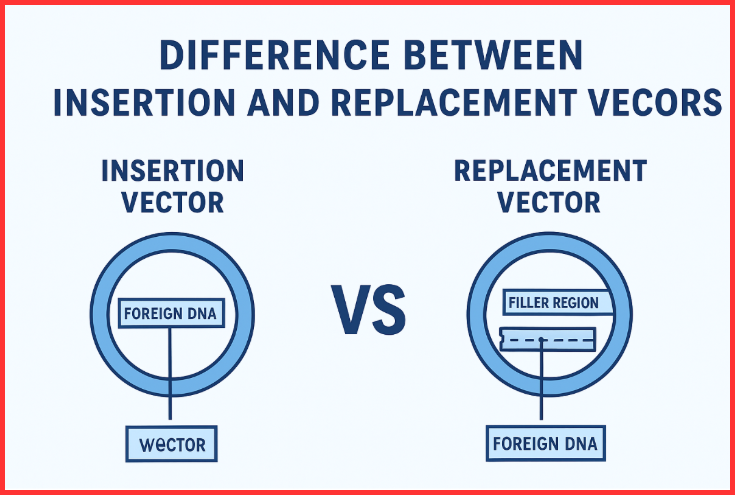
The difference between insertion and replacement vectors is that insertion vectors can carry moderate-sized foreign DNA inserts (about 5–11 kb), while replacement vectors can carry much larger DNA inserts (about 8–24 kb) by replacing a removable filler region in the phage genome.
Bacteriophage λ (lambda) vectors play a crucial role in molecular cloning. These vectors are engineered by removing non-essential regions of the phage genome to introduce foreign DNA. Among them, insertion vectors and replacement vectors are two widely used types, each suitable for different insert sizes and cloning purposes.
Overview of Insertion and Replacement Vectors
Both vectors belong to the lambda phage cloning system but differ in structure, capacity, and function. While insertion vectors introduce a new restriction site without removing phage DNA, replacement vectors eliminate a central “filler fragment” to make space for larger inserts.
What Are Insertion Vectors?
Insertion vectors are the simplest type of lambda phage vectors. They contain a unique restriction site engineered into a non-essential region of the phage genome.
Key Features of Insertion Vectors
- No phage DNA is removed; instead, a restriction site is added.
- Because the original DNA remains, these vectors can only accept moderate insert sizes (5–11 kb).
- Widely used for:
- cDNA library construction
- Expression cloning
- Popular examples include GT10, GT11, and Zap.
How They Work
When foreign DNA is inserted at the unique restriction site, it disrupts non-essential regions while preserving the phage’s ability to infect and propagate.
What Are Replacement Vectors?
Replacement vectors, also called substitution vectors, contain a central “filler fragment” that is intentionally removed to make room for foreign DNA inserts.
Key Features of Replacement Vectors
- The filler fragment is removed and replaced with the foreign DNA.
- Can accommodate larger insert sizes (8–24 kb).
- Often used for:
- Genomic library construction
- Common examples include EMBL4 and Charon40.
Why the Filler Fragment Matters
The filler region often contains genes that make the phage non-viable. Once removed and replaced by the foreign insert, the vector becomes functional again—making accurate insertion easy to select.
Similarities Between Insertion and Replacement Vectors
Both vector types share essential characteristics:
- Both are lambda phage-based cloning vectors.
- Each includes restriction sites to introduce foreign DNA.
- Both are used for building DNA libraries.
- Both enable high-efficiency cloning in bacterial hosts.
Insertion vs Replacement Vectors (Comparison Table)
| Feature | Insertion Vectors | Replacement Vectors |
| Definition | Phage vectors containing a unique restriction site inserted into non-essential DNA | Phage vectors where a central filler region is removed and replaced by foreign DNA |
| Insert Size Capacity | 5–11 kb | 8–24 kb |
| Filler Fragment | Not present | Present and replaced during cloning |
| Primary Function | Creating cDNA libraries | Creating genomic libraries |
| Examples | GT10, GT11, Zap | EMBL4, Charon40 |
| Cleavage Site Characteristics | Contains a single unique restriction site | Cleavage site contains non-essential genes in the filler fragment |
Summary – Difference Between Insertion and Replacement Vectors
The difference between insertion and replacement vectors lies mainly in their capacity and structure. Insertion vectors carry moderate-sized DNA inserts because the phage genome remains intact, making them ideal for cDNA library construction. In contrast, replacement vectors remove a filler fragment and replace it with larger DNA inserts, making them suitable for genomic library creation. Understanding this distinction helps researchers select the right vector based on insert size and cloning goals.
Reference:
1. Hasty, P, et al. “Efficiency of Insertion versus Replacement Vector Targeting Varies at Different Chromosomal Loci.” Molecular and Cellular Biology, U.S. National Library of Medicine, Dec. 1994,
2. “Lambda Insertion Vectors.” Biology 335 Lecture Notes – Lambda Vectors,
3. “Replacement Vector.” Replacement Vector – Terminology of Molecular Biology for Replacement Vector – GenScript,
Read Next: