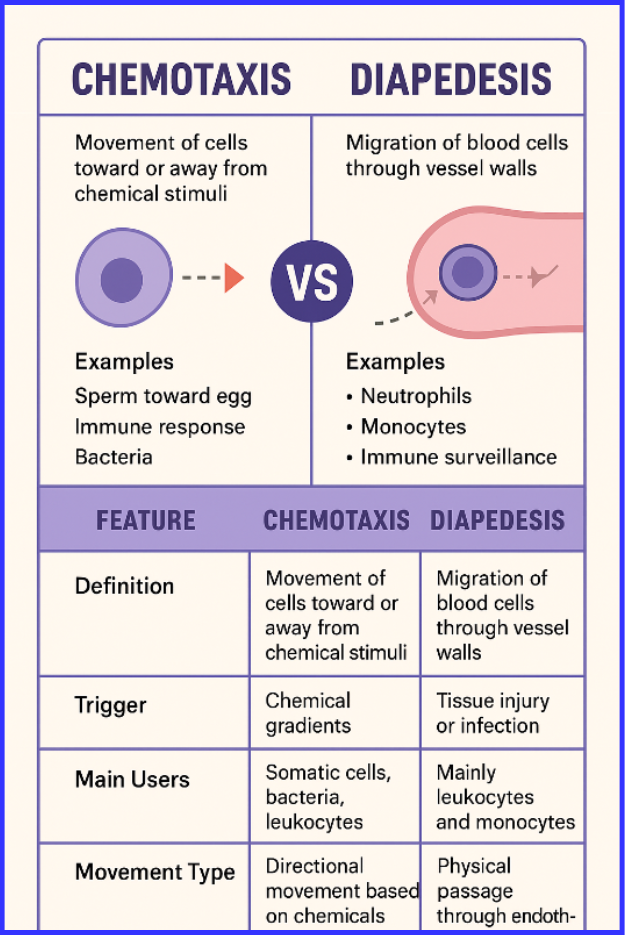
The difference between chemotaxis and diapedesis is that chemotaxis refers to the movement of cells toward or away from chemical signals, whereas diapedesis refers to the migration of blood cells through blood vessel walls into surrounding tissues during injury or infection. Both processes support the immune response, but they operate through different mechanisms and occur at different stages of inflammation.
Understanding the difference between chemotaxis and diapedesis is essential in cell biology, immunology, pathology, and disease research because these movements influence how the body detects and fights infections.
What Is Chemotaxis?
Chemotaxis is the active movement of a cell or organism in response to a chemical stimulant. Cells sense chemical gradients in their environment and move accordingly.
How Chemotaxis Works
- Cells detect increasing or decreasing concentrations of certain chemicals.
- They move toward attractants (positive chemotaxis) or away from harmful chemicals (negative chemotaxis).
Examples of Chemotaxis
- Fertilization: Sperm move toward chemical signals released by the egg.
- Immune response: Leukocytes migrate toward chemicals released from injured tissues.
- Bacteria: E. coli moves toward nutrients and away from toxic substances such as phenol.
- Development: Neuronal cells migrate using chemotactic cues during embryonic development.
Types of Chemotaxis
- Positive Chemotaxis – Movement toward a higher chemical concentration
Example: Neutrophils moving toward infection sites. - Negative Chemotaxis – Movement away from a chemical
Example: Motile microbes escaping toxins.
Clinical Relevance
- Abnormal chemotaxis contributes to diseases like asthma, arthritis, and atherosclerosis.
- Cancer cells often hijack chemotactic signaling for metastasis.
What Is Diapedesis?
Diapedesis is the movement of blood cells, especially leukocytes, through the walls of blood vessels into surrounding tissues during an immune response.
How Diapedesis Occurs
Leukocytes exit the bloodstream via a highly coordinated process called leukocyte extravasation, which includes four steps:
- Chemoattraction – Leukocytes detect chemokines from damaged tissue.
- Rolling Adhesion – Cells slow down and roll along vessel walls.
- Tight Adhesion – Cells firmly attach to endothelial cells.
- Transmigration (Diapedesis) – Cells squeeze between endothelial cells and enter tissues.
Examples of Diapedesis
- Neutrophils infiltrating a wound to fight bacterial infection
- Monocytes migrating into tissues to mature into macrophages
- Immune surveillance even when infection is absent
Medical Significance
A defect in the diapedesis process leads to Leukocyte Adhesion Deficiency (LAD), characterized by:
- Recurrent bacterial infections
- Poor wound healing
- High neutrophil count (neutrophilia)
Similarities Between Chemotaxis and Diapedesis
- Both involve cellular movement.
- They occur during inflammation.
- Leukocytes use both processes to reach infection sites.
- Defects in either mechanism contribute to immune disorders.
Difference Between Chemotaxis and Diapedesis (Table)
| Feature | Chemotaxis | Diapedesis |
| Definition | Movement of cells toward or away from chemical stimuli | Migration of blood cells through vessel walls |
| Trigger | Chemical gradients | Tissue injury or infection |
| Main Users | Somatic cells, bacteria, leukocytes | Mainly leukocytes and monocytes |
| Movement Type | Directional movement based on chemicals | Physical passage through endothelium |
| Role in Immunity | Guides immune cells toward infections | Allows immune cells to enter tissues |
| Examples | Sperm toward egg; bacteria toward nutrients | Neutrophils entering a wound |
| Types | Positive & Negative | Includes adhesion, rolling, transmigration |
Summary – Chemotaxis vs Diapedesis
Chemotaxis and diapedesis are two essential processes in the immune response. Chemotaxis directs cells to move toward chemical signals, while diapedesis helps blood cells pass through blood vessel walls to reach damaged tissues. The difference between chemotaxis and diapedesis becomes clear through their triggers, mechanisms, and roles in cellular migration. Both support inflammation and host defense.
Reference:
1. Jin, Tian, et al. “Chemotaxis, Chemokine Receptors and Human Disease.” U.S. National Library of Medicine, Oct. 2008.
2. Filippi, Marie-Dominique. “Mechanism of Diapedesis: Importance of the Transcellular Route.” Advances in Immunology, U.S. National Library of Medicine, 2016.
Read Next: