The difference between phosphorylase and phosphatase is that phosphorylase adds a phosphate group to a molecule using inorganic phosphate, while phosphatase removes a phosphate group using water, producing a phosphate ion and an alcohol. Both enzymes act on phosphate-related reactions, but they perform opposite biochemical functions.
Understanding the difference between phosphorylase and phosphatase is essential in biochemistry because these enzymes control phosphorylation and dephosphorylation—two processes that regulate energy metabolism, signaling pathways, gene expression, and many cellular functions.
What Is Phosphorylase?
Phosphorylase is an enzyme that adds a phosphate group to a substrate using inorganic phosphate (Pi) rather than ATP. This reaction is called phosphorolysis.
Key Characteristics of Phosphorylase
- Belongs to the transferase enzyme class
- Transfers phosphate groups from one compound to another
- Often regulated allosterically
- Plays a major role in metabolic pathways
Common Example
- Glycogen phosphorylase breaks down glycogen and produces glucose-1-phosphate, which cells use for energy.
Types of Phosphorylase
- Phosphorylase a – more active form
- Phosphorylase b – less active form
- Glycosyltransferases
- Nucleotidyltransferases
What Is Phosphatase?
Phosphatase is an enzyme that removes a phosphate group from a molecule through hydrolysis. This process is known as dephosphorylation.
Key Characteristics of Phosphatase
- Belongs to the hydrolase class
- Uses water to break phosphoester bonds
- Produces phosphate ion + alcohol group
- Plays a key role in regulating cellular pathways
Common Examples
- Alkaline phosphatase (ALP) – used in diagnostics
- Protein phosphatase 1 (PP1) – regulates metabolism and cell division
- Acid phosphatase – involved in lysosomal activity
Role in Cells
Phosphatases balance the actions of:
- Phosphorylases – transfer phosphate groups
- Kinases – transfer phosphate from ATP to substrates
Together, they maintain phosphorylation balance in protein signaling networks.
Detailed Mechanism of Phosphatase
Phosphatases catalyze the hydrolysis of phosphomonoesters.
Steps in the Reaction
- Water splits into –OH and H⁺
- –OH attaches to the phosphate group
- H⁺ protonates the alcohol residue
- The phosphoester bond breaks
- Products: phosphate ion + alcohol with a free –OH group
Classification
Phosphatases are categorized based on:
- Substrate specificity
- Catalytic domain sequence homology
- pH preference (e.g., acid vs. alkaline phosphatase)
More than 100+ enzyme families fall under phosphatases.
Phosphorylase vs Phosphatase: Key Differences in Tabular Form
| Feature | Phosphorylase | Phosphatase |
| Primary Function | Adds a phosphate group (phosphorolysis) | Removes a phosphate group (dephosphorylation) |
| Mechanism | Uses inorganic phosphate (Pi) | Uses water (H₂O) |
| Enzyme Class | Transferase | Hydrolase |
| Byproducts | Phosphorylated compound | Phosphate ion + alcohol |
| Examples | Glycogen phosphorylase | Alkaline phosphatase, protein phosphatases |
| Role in Metabolism | Energy release from glycogen | Regulation of protein function and signaling |
| Opposing Enzyme | Phosphatase | Kinase |
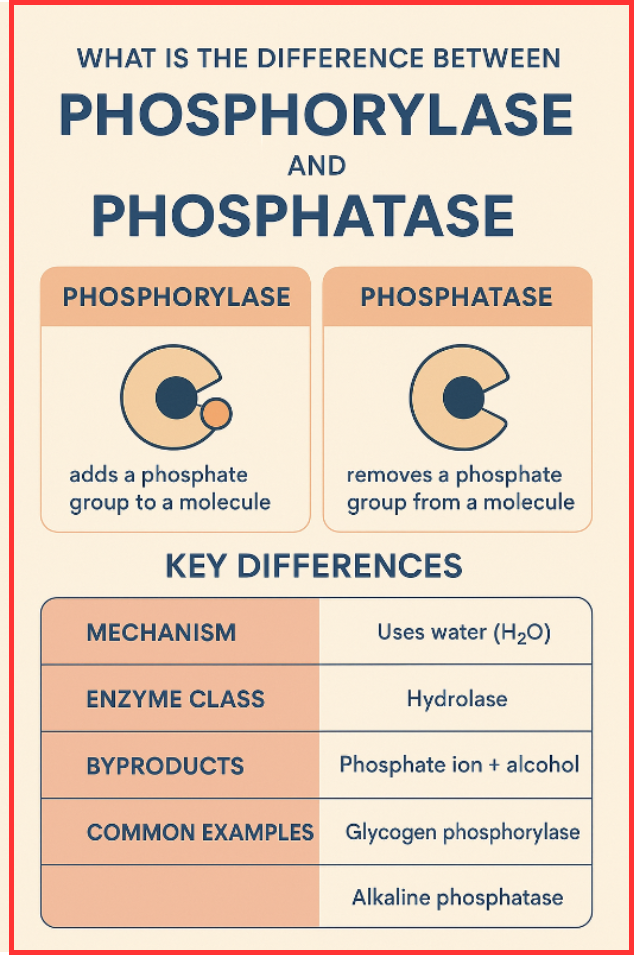
Summary: Difference Between Phosphorylase and Phosphatase
The difference between phosphorylase and phosphatase lies in their opposite biochemical roles.
- Phosphorylase → adds phosphate using inorganic phosphate
- Phosphatase → removes phosphate using water
Both are essential in metabolic control, energy release, and cell signaling.
Conclusion
The main difference between phosphorylase and phosphatase is that phosphorylase transfers and adds phosphate groups, while phosphatase removes them. These opposite actions make them crucial regulators of metabolism, signaling pathways, and energy balance. Understanding this difference between phosphorylase and phosphatase helps decode how cells maintain homeostasis through phosphorylation and dephosphorylation cycles.
Reference:
1. “Phosphorylase.” Encyclopædia Britannica, Encyclopædia Britannica, Inc.
Read Next: