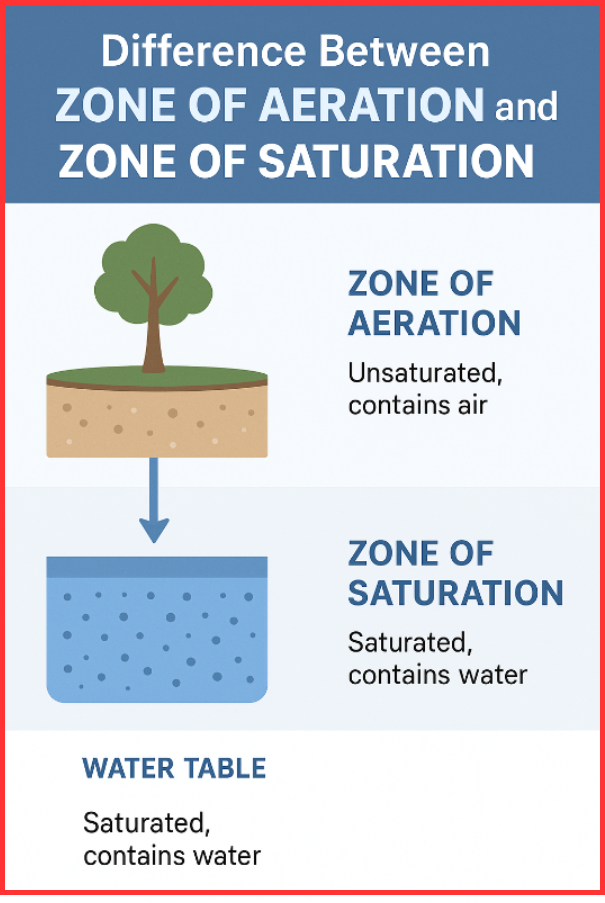
The key difference between zone of aeration and zone of saturation is that the zone of aeration lies above the water table and contains air-filled pores, while the zone of saturation lies below the water table and has water-filled pores. This difference decides how groundwater moves, how soil stores moisture, and how corrosion affects buried objects.
Understanding the difference between zone of aeration and zone of saturation is important for groundwater studies, agriculture, soil science, and environmental management.
What is the Zone of Aeration (Unsaturated Zone)?
The zone of aeration, also called the unsaturated zone, is the layer between the Earth’s surface and the water table. The pores and spaces in this zone contain a mixture of air and water.
Characteristics of the Zone of Aeration
- Found above the water table
- Contains air-filled and partially water-filled pores
- Consists of soil, sand, sediments, and rocks
- Supports plant roots, soil organisms, and vegetation
- Influenced by rainfall, climate, soil type, and altitude
Sources of Water in the Zone of Aeration
Water in this zone mostly comes from:
- Rainwater infiltration
- River and stream seepage
- Irrigation water
- Capillary rise from the saturation zone below
Corrosion Effect
Because it contains high oxygen levels, this zone increases the corrosion rate of metal pipes, underground storage tanks, and other buried objects.
Example
In agricultural fields, the top layer where plant roots absorb water but pockets of air are still present is a classic example of the zone of aeration.
What is the Zone of Saturation (Phreatic Zone)?
The zone of saturation, also called the phreatic zone, lies below the water table. Here, all the pores, cracks, and spaces in the soil and rock are completely filled with water.
Characteristics of the Zone of Saturation
- Located beneath the water table
- Pores are fully saturated with water
- Supplies drinking water through wells and springs
- Less oxygen, making it less corrosive than the aeration zone
Seasonal Influence
The depth and size of this zone change based on:
- Rainfall
- Water extraction from wells
- Wet and dry seasons
Pollution Sources
This zone can be polluted by:
- Fertilizers and pesticides
- Septic tank leakage
- Landfills and industrial waste
Example
Water in wells drawn from aquifers is obtained from the zone of saturation.
Zone of Aeration vs Zone of Saturation (Tabular Comparison)
| Feature | Zone of Aeration | Zone of Saturation |
| Position | Above the water table | Below the water table |
| Pore Content | Air + water | Fully water saturated |
| Oxygen Level | High | Low |
| Corrosion Tendency | High due to oxygen | Low due to lack of oxygen |
| Water Availability | Limited moisture | Major source of groundwater |
| Examples | Soil layer supporting plant roots | Water in wells, springs, aquifers |
| Alternate Name | Unsaturated zone | Phreatic zone |
Similarities Between Zone of Aeration and Zone of Saturation
Both zones share several characteristics:
- Found within the Earth’s subsurface
- Composed of soil, sediments, and rocks
- Contain water in varying amounts
- Affected by climate, human activities, and seasons
Summary – Difference Between Zone of Aeration and Zone of Saturation
The difference between zone of aeration and zone of saturation mainly depends on their water content and position.
- The zone of aeration lies above the water table and contains air along with some moisture, making it more prone to corrosion.
- The zone of saturation lies below the water table, where pores are fully filled with groundwater that supplies wells, springs, and aquifers.
In simple terms, one zone holds air + water, while the other holds only water. This fundamental difference explains groundwater movement, soil moisture availability, and underground corrosion patterns.
In conclusion, understanding the difference between zone of aeration and zone of saturation helps in groundwater conservation, irrigation planning, environmental protection, and civil engineering applications.
Reference:
1. “What Is the Zone of Saturation?” Corrosionpedia,
2. “What Is the Zone of Aeration?” Corrosionpedia,
Read Next: