The Difference Between Mandrill and Baboon is that a mandrill is a single species of colorful Old World monkey belonging to the genus Mandrillus, whereas a baboon refers to any of the five species in the genus Papio. Mandrills are famous for their brightly colored faces and rumps, while baboons are recognized by their dog-like muzzles and brownish fur. Although both belong to the Old World monkey family, they differ in appearance, habitat, behavior, and distribution.
What Are Old World Monkeys?
Before comparing mandrills and baboons, it is helpful to understand Old World monkeys.
Old World monkeys belong to the family Cercopithecidae and are native to Africa and Asia. They are generally larger than New World monkeys and have downward-facing nostrils, non-prehensile tails, and well-developed cheek pouches.
Both mandrills and baboons belong to this family but represent different genera.
What is a Mandrill?
A mandrill (Mandrillus sphinx) is the largest species of monkey in the world. It is easily recognized by its brightly colored blue and red face, colorful rump, and long canine teeth.
Mandrills mainly inhabit the tropical rainforests of Central and West Africa. They spend much of their time on the ground but also climb trees to feed and rest.
Key Characteristics of Mandrill
- Largest monkey species
- Bright blue and red facial markings
- Colorful rump with blue, red, and purple shades
- Olive-green body fur
- Strong sexual dimorphism, with males much larger than females
- Highly social and live in large groups called hordes
Habitat and Diet of Mandrill
Mandrills are primarily found in:
- Cameroon
- Gabon
- Equatorial Guinea
- Republic of the Congo
Their diet includes:
- Fruits
- Seeds
- Leaves
- Roots
- Insects
- Small reptiles
- Eggs
- Small mammals
Mandrills are omnivores and forage mainly on the forest floor.
What is a Baboon?
A baboon is a large Old World monkey belonging to the genus Papio. Unlike mandrills, baboons include five different species distributed across Africa and parts of the Arabian Peninsula.
Baboons are known for their long dog-like muzzle, powerful jaws, and adaptability to different environments. They are highly intelligent, social animals that live in organized troops.
Types of Baboons
There are five recognized species of baboons:
- Olive baboon
- Yellow baboon
- Chacma baboon
- Guinea baboon
- Hamadryas baboon
Each species occupies different habitats and has slight differences in size, behavior, and appearance.
Habitat and Diet of Baboons
Baboons live in a wide variety of habitats, including:
- Savannah grasslands
- Open woodlands
- Rocky hills
- Semi-deserts
- Mountain regions
Their diet consists of:
- Fruits
- Seeds
- Grass
- Roots
- Insects
- Birds
- Eggs
- Small mammals
Because they are opportunistic omnivores, baboons can adapt to changing food availability.
Difference Between Mandrill and Baboon (Tabular Form)
| Feature | Mandrill | Baboon |
| Scientific Genus | Mandrillus | Papio |
| Number of Species | One species | Five species |
| Size | Largest monkey species | Smaller than mandrill (varies by species) |
| Face | Bright blue and red facial markings | Hairless pink or dark dog-like muzzle |
| Fur Color | Olive green with yellow highlights | Brown, gray, or olive fur |
| Rump | Bright blue, red, and purple | Pink or red |
| Habitat | Tropical rainforests | Savannahs, grasslands, forests, and mountains |
| Distribution | Central and West Africa | Africa and the Arabian Peninsula |
| Social Group | Horde | Troop |
| Climbing Ability | Climbs trees but spends most of its time on the ground | Mostly terrestrial with limited tree climbing |
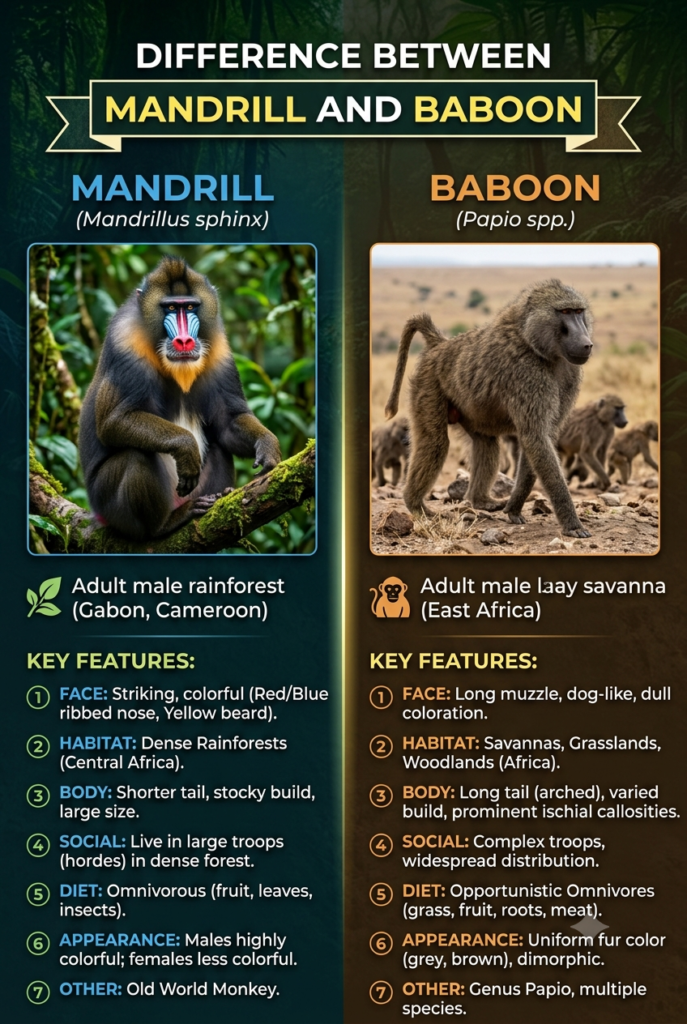
Examples of Mandrill vs Baboon
1. If you see a monkey with a brightly colored blue and red face in a rainforest, it is most likely a mandrill.
2. If you observe a large brown monkey with a long dog-like muzzle walking across an African savannah, it is probably a baboon.
3. Mandrills usually inhabit dense tropical forests, whereas baboons can survive in open grasslands, rocky mountains, and even semi-desert regions.
Conclusion – Mandrill vs Baboon
The Difference Between Mandrill and Baboon lies mainly in their classification, appearance, and habitat. A mandrill is a single species of brightly colored monkey that inhabits the rainforests of Central and West Africa. In contrast, baboons include five different species that occupy a wide range of habitats across Africa and parts of Arabia.
Mandrills stand out because of their vivid facial colors, larger body size, and colorful rump, whereas baboons are recognized by their dog-like muzzle, brownish fur, and remarkable adaptability to different environments. Understanding these differences makes it easier to identify these fascinating primates in the wild or in zoological collections.
Frequently Asked Questions (FAQs)
No. Although they are closely related Old World monkeys, mandrills belong to the genus Mandrillus, while baboons belong to the genus Papio.
Mandrills are generally larger and heavier than most baboon species, making them the largest monkeys in the world.
The bright facial and rump colors help attract mates and communicate social status within the group.
Mandrills are generally shy in the wild but can become aggressive when threatened or defending their group.
Baboons naturally occur across much of Africa, with the Hamadryas baboon also found in parts of the Arabian Peninsula.
Read Next:
- Difference Between Ingroup and Outgroup in Biology
- Difference Between Wormwood and Sweet Wormwood
- Difference Between Cyst and Oocyst
- Difference Between Kelpie and Cattle Dog
- Sphynx vs Donskoy: What’s the Difference?
- Ox vs. Bull: What’s the Difference?
- Deer vs. Gazelles: What’s the Difference?
- Husky vs. Wolf
- Mammals vs. Reptiles