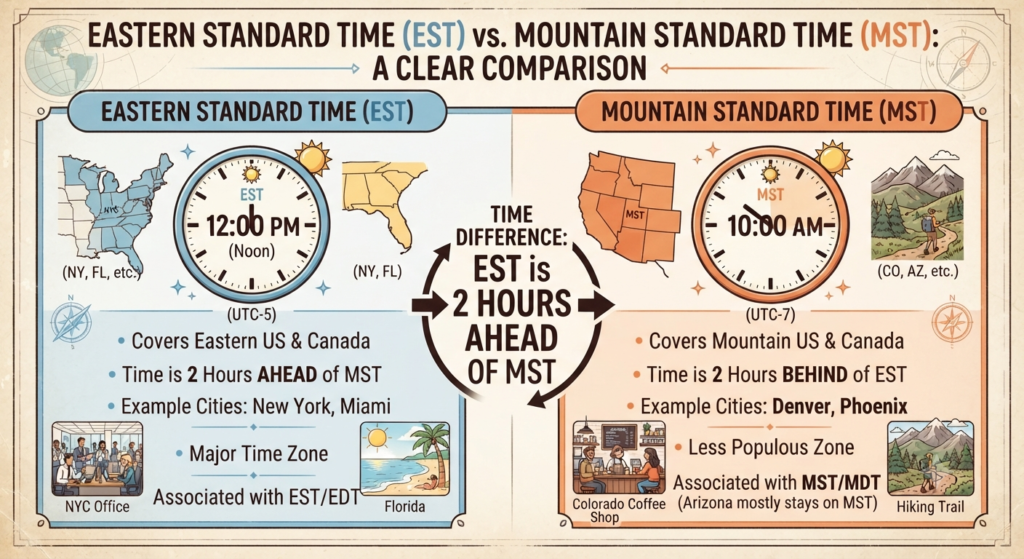
The main difference between EST vs. MST is that Eastern Standard Time (EST) is 2 hours ahead of Mountain Standard Time (MST). EST operates at UTC−5, while MST operates at UTC−7 during standard time. EST is observed in the eastern part of North America, including major cities like New York, Washington, D.C., and Toronto, whereas MST is used in the mountainous regions of the United States, Canada, and parts of Mexico, including cities such as Denver, Calgary, and Phoenix (year-round).
Understanding the difference between EST vs. MST is essential for travelers, remote workers, businesses, students, broadcasters, and organizations that schedule meetings or events across North America. Knowing the two-hour time difference helps avoid missed appointments, travel confusion, and communication delays.
EST vs. MST Comparison Table
The table below highlights the major differences between EST vs. MST.
| Feature | EST (Eastern Standard Time) | MST (Mountain Standard Time) |
|---|---|---|
| Full Form | Eastern Standard Time | Mountain Standard Time |
| UTC Offset | UTC−5 | UTC−7 |
| Time Difference | 2 hours ahead of MST | 2 hours behind EST |
| Standard Time | UTC−5 | UTC−7 |
| Daylight Saving Equivalent | EDT (UTC−4) | MDT (UTC−6) |
| Geographic Region | Eastern North America | Mountain region of North America |
| Major U.S. States | New York, Florida, Pennsylvania, Georgia | Colorado, Utah, Montana, Wyoming |
| Major Canadian Provinces | Ontario, Quebec | Alberta, parts of British Columbia |
| Largest Cities | New York City, Toronto, Miami | Denver, Calgary, Phoenix* |
| Financial Importance | Home to NYSE and NASDAQ | Important for energy, mining, and tourism |
| Population Covered | Larger | Smaller |
| Business Hours | Earlier than MST | Later than EST |
| Common Abbreviations | EST | MST |
| Typical Usage | Finance, government, media | Tourism, energy, agriculture |
What Is EST?
Eastern Standard Time (EST) is one of the principal time zones in North America. During the standard time period, EST operates at UTC−5, meaning it is five hours behind Coordinated Universal Time (UTC). It is observed across much of the eastern United States, eastern Canada, parts of the Caribbean, and portions of Central America.
EST is the standard time used by many of North America’s largest cities, including New York City, Washington, D.C., Miami, Atlanta, and Toronto. Because it serves major financial centers, government institutions, media organizations, and corporate headquarters, EST is often considered the primary business time zone in North America.
During the Daylight Saving Time period, most regions observing EST switch to Eastern Daylight Time (EDT), which operates at UTC−4.
Characteristics of EST
- Operates at UTC−5 during standard time.
- Changes to UTC−4 during Daylight Saving Time (EDT).
- Used throughout much of eastern North America.
- Covers the largest population among U.S. time zones.
- Home to major financial markets.
- Used by federal government agencies.
- Common reference time for television broadcasts.
- Supports international business with Europe.
- Widely used in aviation and transportation.
- Important for banking, commerce, and communications.
What Is MST?
Mountain Standard Time (MST) is the standard time observed in parts of the western United States, Canada, and Mexico. It operates at UTC−7, making it seven hours behind Coordinated Universal Time (UTC).
MST is commonly used in states such as Colorado, Utah, Montana, Wyoming, and New Mexico, as well as the Canadian province of Alberta. Most regions observing Mountain Time switch to Mountain Daylight Time (MDT) during Daylight Saving Time, which operates at UTC−6. However, most of Arizona remains on MST throughout the year, except for the Navajo Nation.
Mountain Standard Time is widely used in industries such as energy production, mining, tourism, agriculture, transportation, and outdoor recreation. Its location between Pacific and Central Time also makes it important for businesses coordinating operations across multiple North American time zones.
Characteristics of MST
- Operates at UTC−7 during standard time.
- Changes to UTC−6 during Daylight Saving Time (MDT) in most regions.
- Two hours behind EST.
- Used across the mountainous regions of North America.
- Supports energy, mining, agriculture, and tourism industries.
- Important for national parks and outdoor recreation.
- Used by several U.S. states and Canadian provinces.
- Arizona remains on MST year-round (except the Navajo Nation).
- Important for regional transportation and logistics.
- Facilitates coordination between western and central North America.
EST vs. MST: Key Differences
1. UTC Offset
The most fundamental difference between EST vs. MST is their offset from Coordinated Universal Time (UTC).
Eastern Standard Time (EST) operates at UTC−5, meaning it is five hours behind UTC during standard time.
Mountain Standard Time (MST) operates at UTC−7, making it seven hours behind UTC during standard time.
Therefore, EST is consistently two hours ahead of MST during the standard time period.
2. Time Difference
One of the easiest ways to distinguish EST vs. MST is by their time difference.
EST is always 2 hours ahead of MST during standard time.
For example:
| Mountain Standard Time (MST) | Eastern Standard Time (EST) |
|---|---|
| 6:00 AM | 8:00 AM |
| 8:00 AM | 10:00 AM |
| 10:00 AM | 12:00 PM |
| 12:00 PM | 2:00 PM |
| 3:00 PM | 5:00 PM |
| 6:00 PM | 8:00 PM |
| 9:00 PM | 11:00 PM |
This two-hour difference is essential for scheduling meetings, flights, online classes, webinars, and business operations.
3. Geographic Coverage
Another significant difference between EST vs. MST is the geographic region where each time zone is observed.
EST is primarily used in the eastern part of North America, covering much of the eastern United States, eastern Canada, parts of the Caribbean, and portions of Central America.
MST is observed across the mountainous regions of North America, including several western U.S. states, the Canadian province of Alberta, and parts of northern Mexico.
Because EST covers more densely populated regions, it serves a much larger population than MST.
4. Major Cities
Both time zones include important cities, but they serve different economic and geographic regions.
Major cities using EST include:
- New York City
- Washington, D.C.
- Miami
- Atlanta
- Toronto
- Boston
Major cities using MST include:
- Denver
- Calgary
- Edmonton
- Salt Lake City
- Phoenix (MST year-round)
Many of the world’s leading financial institutions operate in EST, while MST includes important centers for tourism, energy, and natural resources.
5. Daylight Saving Time
Daylight Saving Time is another important distinction in EST vs. MST.
Most regions observing EST switch to Eastern Daylight Time (EDT) during the summer, changing from UTC−5 to UTC−4.
Similarly, most regions using MST switch to Mountain Daylight Time (MDT), changing from UTC−7 to UTC−6.
An important exception is most of Arizona, which remains on Mountain Standard Time (MST) throughout the year and does not observe Daylight Saving Time (except the Navajo Nation).
Since both time zones generally advance by one hour during Daylight Saving Time, the difference between them usually remains two hours.
6. Business Hours
Business operations differ because EST is two hours ahead of MST.
Organizations operating in EST begin their workday earlier than businesses in MST.
For example:
- 9:00 AM EST = 7:00 AM MST
- 5:00 PM EST = 3:00 PM MST
Companies with offices in both regions often coordinate working hours to maximize collaboration across time zones.
7. Financial Importance
Financial significance is another major difference between EST vs. MST.
EST serves as the primary financial time zone of North America because it includes major stock exchanges and banking centers.
Major financial institutions operating on EST include:
- New York Stock Exchange (NYSE)
- NASDAQ
- Numerous international banks
Businesses located in MST adjust their schedules according to EST because most financial markets, earnings announcements, and economic reports follow Eastern Time.
8. Transportation and Travel
Time zones are essential for transportation planning.
Flights between EST and MST destinations involve a two-hour time difference, which affects departure and arrival schedules.
Airlines, railways, and interstate bus services publish schedules according to the local time at each destination, making it important for travelers to verify the applicable time zone.
Understanding the difference between EST and MST helps reduce travel confusion and missed connections.
9. Television and Broadcasting
National television schedules are generally announced using Eastern Time.
Many television networks advertise programs using formats such as:
- 8 PM EST / 6 PM MST
This means viewers in MST usually watch live broadcasts two hours earlier than viewers in EST.
Streaming services and sporting events also provide schedules for multiple time zones to accommodate audiences across North America.
10. Communication and Remote Work
Modern businesses frequently operate across multiple time zones.
When scheduling meetings between EST and MST, participants must account for the two-hour difference.
For example:
- 10:00 AM MST = 12:00 PM EST
- 2:00 PM EST = 12:00 PM MST
Proper time zone conversion helps remote teams avoid scheduling conflicts and improves collaboration.
11. Population and Economic Influence
EST serves a significantly larger population than MST.
The Eastern Time Zone includes many of North America’s largest metropolitan areas, government offices, universities, financial institutions, and multinational corporations.
MST covers fewer states and provinces but remains economically important due to industries such as:
- Energy production
- Mining
- Agriculture
- Tourism
- Outdoor recreation
- Aerospace
Both time zones contribute substantially to North America’s economy, although EST has broader commercial influence.
12. International Importance
Another difference between EST vs. MST is their role in global communication.
EST is widely recognized as the standard business time zone for North America because it overlaps more effectively with business hours in Europe and is used by many multinational organizations.
MST primarily supports regional operations in western North America and is especially important for industries operating in mountainous and western regions.
Although both time zones are internationally recognized, EST has greater influence on global finance, commerce, media, and international business scheduling.
Similarities Between EST and MST
Although EST vs. MST differ in their UTC offsets and geographic coverage, they also share many common characteristics because both are official standard time zones used across North America.
Some major similarities include:
- Both are official North American time zones.
- Both are based on Coordinated Universal Time (UTC).
- Both are used in the United States and Canada.
- Both have Daylight Saving Time equivalents (EDT and MDT) in most regions.
- Both are recognized internationally for business and travel.
- Both are used by airlines, railways, and shipping companies.
- Both are supported by digital clocks, smartphones, and computer operating systems.
- Both are important for business communication and virtual meetings.
- Both help standardize scheduling across different regions.
- Both play significant roles in transportation, broadcasting, and commerce.
Advantages of EST
Eastern Standard Time offers numerous advantages because it covers some of North America’s most populated and economically important regions.
Major advantages include:
- Home to major financial markets like NYSE and NASDAQ.
- Covers the largest population among North American time zones.
- Convenient for international business with Europe.
- Used by many multinational corporations.
- Supports federal government operations.
- Standard reference time for national television broadcasts.
- Ideal for banking and financial services.
- Facilitates global communication.
- Widely used for conferences and webinars.
- Strong overlap with business hours in Europe and South America.
Advantages of MST
Mountain Standard Time provides several benefits for businesses and individuals in western North America.
Major advantages include:
- Ideal for western U.S. and Canadian businesses.
- Supports energy, mining, and agricultural industries.
- Well suited for tourism and outdoor recreation.
- Convenient coordination between Pacific and Central Time zones.
- Less urban congestion compared to many EST regions.
- Important for transportation and logistics.
- Used by major national parks and tourism destinations.
- Supports remote work across multiple time zones.
- Better alignment with western business operations.
- Important for regional commerce and infrastructure.
Which Is Better—EST or MST?
Neither EST nor MST is universally better because each serves different geographic regions and business needs.
EST is the preferred time zone for finance, government, media, and international business. Since it includes major cities such as New York, Washington, D.C., Toronto, and Miami, it serves as the primary reference time zone for many national organizations and global companies.
MST, on the other hand, is ideal for businesses and individuals located in the mountainous regions of North America. It supports industries such as energy production, mining, agriculture, tourism, transportation, and outdoor recreation while providing convenient coordination between western and central North America.
The better time zone ultimately depends on where you live, work, or conduct business.
Conclusion
The comparison of EST vs. MST highlights the key differences between two important North American time zones. Eastern Standard Time (EST) operates at UTC−5, while Mountain Standard Time (MST) operates at UTC−7, making EST two hours ahead of MST during standard time.
Although they differ in geographic coverage, business hours, financial importance, and population served, both time zones are essential for transportation, communication, broadcasting, commerce, and international coordination. Understanding EST vs. MST enables travelers, businesses, students, and remote workers to schedule meetings accurately, avoid confusion, and improve collaboration across different regions.
Frequently Asked Questions (FAQs)
The main difference between EST vs. MST is that EST is two hours ahead of MST. EST operates at UTC−5, whereas MST operates at UTC−7 during standard time.
EST is 2 hours ahead of MST during the standard time period.
EST stands for Eastern Standard Time, which operates at UTC−5.
MST stands for Mountain Standard Time, which operates at UTC−7.
Yes. Most regions observing EST switch to Eastern Daylight Time (EDT) during Daylight Saving Time.
Major cities using EST include New York City, Washington, D.C., Miami, Atlanta, Boston, and Toronto.
Major cities using MST include Denver, Calgary, Edmonton, Salt Lake City, and Phoenix (which remains on MST year-round).
Read Next: