The main difference between Integral Peripheral vs. Surface Proteins is their location and relationship with the cell membrane. Integral proteins are embedded within the lipid bilayer and often extend across the membrane, whereas peripheral proteins are attached to the membrane surface without penetrating its hydrophobic core. Surface proteins are proteins exposed at the surface of a cell or membrane and may include proteins that are either embedded in the membrane or attached to it.
Understanding Integral Peripheral vs. Surface Proteins is important in cell biology, histology, biochemistry, and molecular biology. These proteins help cells transport substances, receive signals, communicate with neighboring cells, maintain their structure, and interact with the surrounding environment.
Integral Peripheral vs. Surface Proteins Comparison Table
The table below highlights the major differences between Integral Peripheral vs. Surface Proteins.
| Feature | Integral Proteins | Peripheral Proteins | Surface Proteins |
| Definition | Proteins embedded within the lipid bilayer | Proteins associated with the membrane surface without penetrating the bilayer | Proteins exposed at the surface of a cell or membrane |
| Location | Within or across the lipid bilayer | On the inner or outer surface of the membrane | At the cell or membrane surface |
| Membrane Penetration | Penetrate the lipid bilayer | Do not penetrate the hydrophobic core | Depends on the individual protein |
| Transmembrane Region | Often present | Absent | May be present |
| Membrane Association | Strongly associated with membrane lipids | Usually associated through non-covalent interactions or other proteins | May be directly or indirectly associated with the membrane |
| Main Functions | Transport, signaling, receptors, and enzymatic activity | Signaling, structural support, and regulation | Cell recognition, adhesion, signaling, and communication |
| Extraction | Usually requires detergents | Often removed by relatively mild treatments | Depends on the type of attachment |
| Examples | Ion channels and membrane transporters | Cytoskeletal and signaling-associated proteins | Cell adhesion molecules and surface receptors |
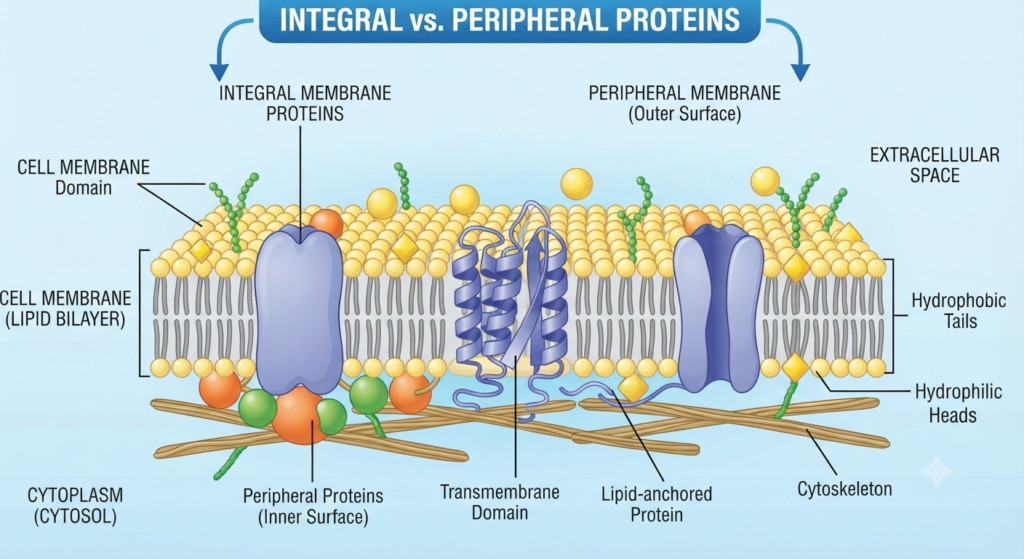
What Are Integral Proteins?
Integral proteins, also called integral membrane proteins, are proteins that are firmly associated with the lipid bilayer of a biological membrane. Some are partially embedded in the membrane, while others pass completely through it.
Proteins that cross the entire lipid bilayer are known as transmembrane proteins. They usually contain hydrophobic regions that interact with the interior of the membrane. Other portions of the protein can extend into the watery environment on either side of the membrane.
Integral proteins perform many essential cellular functions. Some form channels that allow ions or other molecules to pass through the membrane. Others act as transporters that bind specific substances and move them across the membrane.
Many cell-surface receptors are also integral proteins. These receptors detect signals outside the cell and transmit information to the inside. This allows cells to respond to hormones, growth factors, neurotransmitters, and other signaling molecules.
Because integral proteins are strongly associated with the lipid bilayer, they are generally difficult to remove from membranes. Detergents are commonly used in laboratory procedures to disrupt lipid-protein interactions and extract them.
Characteristics of Integral Proteins
Some important characteristics of integral proteins include:
- Embedded within the lipid bilayer.
- Often contain hydrophobic regions.
- Many extend across the entire membrane.
- Can function as channels or transporters.
- Can act as membrane receptors.
- Participate in cell signaling.
- Help maintain membrane organization.
- Usually require detergents for extraction.
- Have regions exposed to the extracellular and intracellular environments.
Examples of Integral Proteins
Examples include:
- Ion channels.
- Glucose transporters.
- Sodium-potassium pumps.
- G-protein-coupled receptors.
- Receptor tyrosine kinases.
- Various membrane enzymes.
What Are Peripheral Proteins?
Peripheral proteins are proteins associated with a biological membrane but not embedded within its hydrophobic core. They usually remain on the inner or outer surface of the membrane.
Peripheral proteins can attach to membrane lipids, integral proteins, or other membrane-associated structures. Their association may involve electrostatic interactions, hydrogen bonding, or other non-covalent forces.
Some peripheral proteins are located on the cytoplasmic side of the membrane. These proteins can interact with the cytoskeleton and help maintain cell shape. Others participate in intracellular signaling pathways.
Because peripheral proteins do not normally penetrate the lipid bilayer, they can often be separated from membranes using milder treatments than those required for integral proteins.
Characteristics of Peripheral Proteins
Important characteristics include:
- Located on a membrane surface.
- Do not normally penetrate the lipid bilayer.
- Lack a transmembrane region.
- Can interact with integral membrane proteins.
- Can associate with membrane lipids.
- Often participate in signaling pathways.
- Can contribute to cytoskeletal organization.
- Usually easier to detach from membranes than integral proteins.
Examples of Peripheral Proteins
Examples include:
- Certain cytoskeletal-associated proteins.
- Membrane-associated signaling proteins.
- Some enzymes attached to membrane surfaces.
- Proteins that connect membrane proteins with the cytoskeleton.
What Are Surface Proteins?
Surface proteins are proteins that are exposed at the surface of a cell or biological membrane. They are especially important because they provide a point of contact between the cell and its external environment.
The term “surface protein” describes where a protein is exposed rather than defining one particular type of membrane attachment. Therefore, a surface protein may be an integral membrane protein with an extracellular domain, or it may be associated with the membrane in another way.
Surface proteins have many functions. They can act as receptors, allowing cells to detect chemical signals. They can also help cells attach to one another or interact with the extracellular matrix.
Surface proteins are particularly important in immune responses. Proteins located on immune cells help recognize antigens, communicate with other cells, and regulate immune activity.
Characteristics of Surface Proteins
Some important characteristics include:
- Exposed at the cell or membrane surface.
- Interact with the extracellular environment.
- Can participate in cell signaling.
- May contribute to cell adhesion.
- Help cells recognize surrounding molecules.
- Can participate in immune responses.
- May be integral or associated with the membrane through other mechanisms.
Examples of Surface Proteins
Examples include:
- Cell-surface receptors.
- Cell adhesion molecules.
- Major histocompatibility complex proteins.
- Some immune-cell receptors.
- Proteins involved in cell recognition.
Integral vs. Peripheral Proteins: Key Differences
1. Location
The most important difference between integral and peripheral proteins is their position relative to the lipid bilayer.
Integral proteins are embedded within the membrane. Some extend from one side of the membrane to the other.
Peripheral proteins remain on the membrane surface and do not enter the hydrophobic interior of the bilayer.
2. Membrane Association
Integral proteins have a strong structural association with membrane lipids. Their hydrophobic regions interact with the interior of the lipid bilayer.
Peripheral proteins are attached more superficially. They may interact with membrane lipids, integral proteins, or other cellular structures.
3. Transmembrane Region
Many integral proteins contain one or more transmembrane regions. These regions allow the protein to remain stable within the lipid bilayer.
Peripheral proteins do not have transmembrane regions because they do not cross the membrane.
4. Extraction From the Membrane
Integral proteins are generally difficult to remove because they are deeply associated with the lipid bilayer. Detergents are commonly required to disrupt these interactions.
Peripheral proteins can often be removed using relatively mild chemical treatments because they are attached through weaker interactions.
5. Functions
Integral proteins are frequently involved in transport, signal reception, and communication across the membrane.
Peripheral proteins often participate in intracellular signaling, enzyme regulation, cytoskeletal organization, and membrane structure.
Integral vs. Surface Proteins: Key Differences
Integral and surface proteins can sometimes overlap.
An integral membrane protein may have a large portion exposed outside the cell. In such a case, it can be considered a surface-exposed protein as well as an integral protein.
For example, a membrane receptor may cross the lipid bilayer while presenting its binding site to molecules outside the cell. Its membrane-spanning structure makes it integral, while its extracellular domain makes it surface-exposed.
Therefore, integral describes the protein’s relationship with the membrane, while surface mainly describes its exposure and location.
Peripheral vs. Surface Proteins: Key Differences
Peripheral and surface proteins are closely related concepts, but they are not identical.
A peripheral protein is defined by its association with the membrane without penetrating the lipid bilayer. It can be located on either the cytoplasmic or extracellular side.
A surface protein is generally identified by its exposure at the cell or membrane surface. Some surface proteins may be integral membrane proteins, while others may be associated with the membrane through different mechanisms.
Thus, a protein can be both peripheral and surface-associated, but the two terms describe different characteristics.
Functions of Integral, Peripheral, and Surface Proteins
These proteins perform complementary roles in cellular organization.
Transport
Integral proteins are particularly important for transporting substances across the membrane. Channels and transporters allow selected ions and molecules to cross the otherwise hydrophobic membrane barrier.
Cell Signaling
Integral and surface-exposed proteins often act as receptors. They detect extracellular signals and initiate signaling pathways inside the cell.
Peripheral proteins can also participate in these pathways by interacting with receptors and other signaling molecules.
Cell Adhesion
Surface proteins help cells attach to neighboring cells or to the extracellular matrix. This function is important for tissue formation, organization, and repair.
Cell Recognition
Surface proteins allow cells to identify and interact with their surroundings. This is particularly important in the immune system.
Structural Support
Peripheral proteins can connect membrane components with the cytoskeleton. These interactions help maintain cell shape and organize membrane-associated structures.
Integral Peripheral vs. Surface Proteins in the Cell Membrane
The cell membrane contains a mixture of proteins with different structures and functions. Integral proteins are embedded within the lipid bilayer, while peripheral proteins are associated with its surfaces.
Surface-exposed proteins interact directly with the external environment. Some are integral proteins with extracellular portions, while others may be attached to the membrane indirectly.
This arrangement allows the cell membrane to perform several functions simultaneously. It can control the movement of substances, detect signals, support cell structure, and communicate with neighboring cells.
Importance in Cell Biology
Understanding Integral Peripheral vs. Surface Proteins helps explain how cells interact with their environment.
For example, a cell needs integral proteins to transport ions and nutrients across its membrane. It also needs surface-exposed receptors to detect signals outside the cell. Peripheral proteins can then help relay or regulate some of the signals inside the cell.
These proteins therefore work as part of an interconnected membrane system rather than as isolated components.
Their classification is also useful in laboratory studies. Scientists can study how proteins interact with membranes by examining their location, chemical properties, and response to different extraction methods.
Similarities Between Integral, Peripheral, and Surface Proteins
Although Integral Peripheral vs. Surface Proteins focuses on their differences, these proteins also share several characteristics:
- All are associated with cellular membranes or membrane surfaces.
- They contribute to important cellular processes.
- They can participate in cell signaling.
- They interact with other proteins or membrane components.
- They help cells communicate with their surroundings.
- They contribute to membrane organization and cellular function.
- Their location is closely related to their biological role.
Conclusion
The comparison of Integral Peripheral vs. Surface Proteins shows that these terms describe different aspects of protein organization around biological membranes. Integral proteins are embedded within the lipid bilayer and often span the membrane. Peripheral proteins are attached to the membrane surface without penetrating its hydrophobic core. Surface proteins are characterized mainly by their exposure at the cell or membrane surface.
Integral proteins are especially important for transport, membrane signaling, and receptor activity. Peripheral proteins contribute to signaling, structural support, and regulation. Surface proteins help cells communicate, recognize molecules, attach to other cells, and interact with the extracellular environment.
Understanding these differences is important in cell biology, biochemistry, anatomy, and molecular biology. The location and membrane association of a protein provide valuable clues about its structure and function.
Frequently Asked Questions (FAQs)
Integral proteins are embedded within the lipid bilayer, whereas peripheral proteins are attached to the membrane surface without penetrating the hydrophobic core.
No. Surface proteins are defined mainly by their exposure at the cell or membrane surface. Some surface proteins are integral membrane proteins, while others may have different forms of membrane association.
No. Peripheral proteins do not normally cross the lipid bilayer. They remain associated with one of its surfaces or with other membrane components.
Integral proteins commonly function in membrane transport, signal reception, cell communication, and other membrane-associated processes.
Peripheral proteins generally attach to membranes through relatively weaker interactions and do not penetrate the hydrophobic core. As a result, many can be separated using milder treatments than those needed for integral proteins.
Reference:
1. “Integral Membrane Protein – An Overview.” Science Direct.
2. “Peripheral Membrane Protein – An Overview.” Science Direct.
3. “Cell Surface Protein – An Overview.” Science Direct.
Read Next:
- Difference Between Etiology and Pathophysiology
- Difference Between DNA Fingerprinting and DNA Profiling
- Difference Between Detritivores and Saprotrophs
- Difference Between Glenoid Cavity and Acetabulum
- Difference Between Mycoplasma and Mycobacterium
- Pinnatifid vs. Pinnatisect: Key Differences Explained
- Phosphodiester Bond vs. Phosphoester Bond