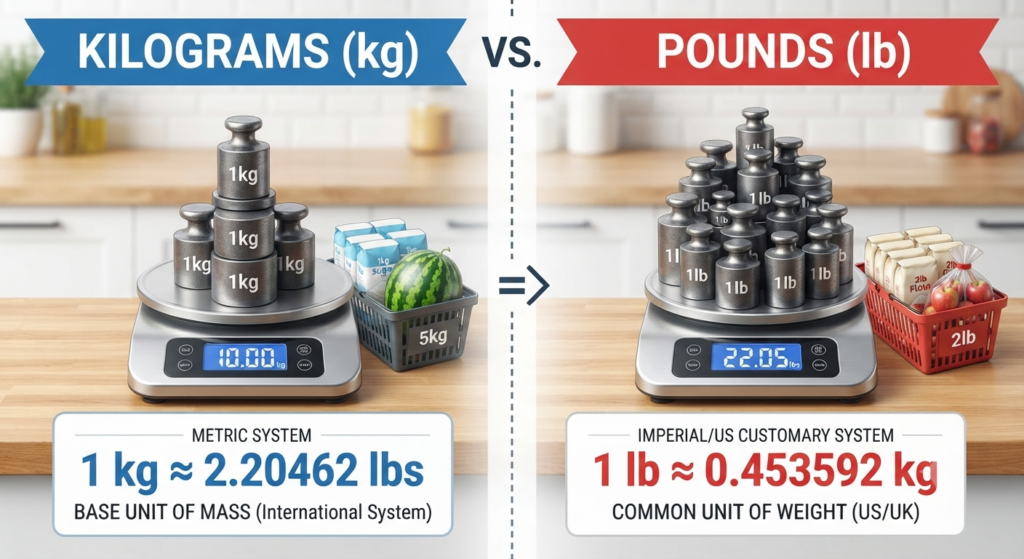
The main difference between Kilos vs. Pounds is the unit of measurement used to express weight or mass. A kilogram (kg), commonly called a kilo, is a metric unit, whereas a pound (lb) is a unit commonly used in the United States and several other countries. 1 kilogram is approximately equal to 2.20462 pounds, while 1 pound is approximately equal to 0.453592 kilograms.
Understanding Kilos vs. Pounds is important when comparing body weight, luggage limits, food quantities, product specifications, shipping weights, and measurements between metric and imperial systems.
Kilos vs. Pounds Comparison Table
The table below highlights the major differences between Kilos vs. Pounds.
| Feature | Kilo (Kilogram) | Pound |
| Full Name | Kilogram | Pound |
| Symbol | kg | lb |
| Measurement System | Metric system | Imperial/US customary system |
| Definition | SI unit of mass | Unit of mass commonly used in the US |
| Conversion | 1 kg = 2.20462 lb | 1 lb = 0.453592 kg |
| Common Use | Most countries worldwide | Mainly United States and some other countries |
| Body Weight | Commonly used in most countries | Commonly used in the US |
| Luggage Weight | Common in international travel | Common in US travel |
| Food Measurement | Commonly used in metric countries | Commonly used in the US |
| Relative Size | Larger than one pound | Smaller than one kilogram |
What Is a Kilo?
A kilo is the common short form of kilogram (kg), which is the SI base unit of mass. The kilogram is widely used around the world to measure the mass of people, objects, food, materials, and other substances.
One kilogram is equal to:
1 kg = 1,000 grams
When converting between kilograms and pounds:
1 kg ≈ 2.20462 lb
For everyday calculations, 1 kilogram is often rounded to approximately 2.2 pounds.
Kilograms are widely used in countries that follow the metric system. For example, a person’s body weight may be expressed as 70 kg, while a bag of rice may weigh 5 kg.
Characteristics of Kilos
Important characteristics of kilograms include:
- The symbol is kg.
- It is the SI base unit of mass.
- It belongs to the metric system.
- One kilogram equals 1,000 grams.
- One kilogram is approximately 2.20462 pounds.
- It is widely used internationally.
- Commonly used for measuring body mass.
- Used for food and grocery products.
- Used for luggage and cargo.
- Used in science, engineering, and industry.
Examples of Kilos
Examples of quantities commonly expressed in kilograms include:
- A person’s body mass.
- Bags of rice or flour.
- Fruits and vegetables.
- Luggage.
- Industrial materials.
- Packages and shipments.
- Weights used in fitness equipment.
- Household objects.
- Agricultural products.
For example, if a person’s mass is 70 kg, it is approximately equivalent to 154.3 pounds.
What Is a Pound?
A pound is a unit of mass commonly used in the United States and in some other countries. Its standard abbreviation is lb, which comes from the Latin word libra.
One pound is defined as approximately:
1 lb = 0.45359237 kg
Therefore:
1 kg ≈ 2.20462 lb
Pounds are frequently used to express body weight, food quantities, package weights, and other everyday measurements in the United States.
For example, a person may say that they weigh 150 pounds, while someone in a metric country might express the same measurement in kilograms.
Characteristics of Pounds
Important characteristics of pounds include:
- The symbol is lb.
- It is a unit of mass.
- Commonly used in the United States.
- One pound equals approximately 0.453592 kg.
- One kilogram equals approximately 2.20462 pounds.
- Commonly used to measure body weight.
- Used for food and groceries.
- Used for packages and shipping.
- Used in everyday commercial measurements.
- Part of the avoirdupois system commonly used for ordinary weights.
Examples of Pounds
Examples of quantities commonly measured in pounds include:
- Body weight.
- Meat and other food products.
- Packages.
- Luggage.
- Household goods.
- Shipping materials.
- Fitness weights.
- Agricultural products.
For example, a package weighing 10 pounds has a mass of approximately 4.54 kilograms.
Kilos vs. Pounds: Key Differences
1. Measurement System
The most important difference between Kilos vs. Pounds is the measurement system in which they are commonly used.
Kilograms belong to the International System of Units (SI) and are the standard unit of mass in the metric system.
Pounds belong to the traditional imperial/US customary measurement system and are particularly common in the United States.
Therefore:
Kilogram → Metric system
Pound → Imperial/US customary system
2. Size of the Unit
A kilogram is larger than a pound.
The conversion is:
1 kg ≈ 2.20462 lb
Therefore, one kilogram contains approximately 2.2 pounds.
Conversely:
1 lb ≈ 0.453592 kg
This means that a pound represents less mass than a kilogram.
3. Symbol
The symbols are also different.
The kilogram is represented by:
kg
The pound is represented by:
lb
Although people commonly write “lbs” informally for multiple pounds, the standard unit symbol is lb.
4. Body Weight
Both kilograms and pounds are commonly used to express body weight or mass.
Most countries use kilograms.
For example:
70 kg
In the United States, body weight is commonly expressed in pounds:
154.3 lb
Therefore, the preferred unit depends largely on the country and measurement system being used.
5. International Use
Kilograms have much broader international use.
Most countries use the metric system for everyday measurements, scientific work, trade, and industry.
Pounds remain especially common in the United States and continue to appear in certain contexts in other countries.
Thus:
Kilograms → Widely used internationally
Pounds → Primarily associated with US customary measurement
6. Food Measurement
Both units can be used to measure food.
In metric countries, food may be sold by kilogram or gram.
For example:
5 kg of rice
In the United States, food may commonly be sold by the pound.
For example:
5 lb of rice
The actual quantity can be converted using the standard conversion factor.
7. Luggage and Shipping
Kilos and pounds are both used when specifying the weight of luggage and packages.
International airlines commonly provide baggage limits in kilograms, while US-based services may use pounds.
For example:
23 kg ≈ 50.7 lb
This conversion is particularly useful when traveling internationally.
8. Scientific and Engineering Use
The kilogram has a major advantage in scientific and engineering applications because it is an SI base unit.
Scientific calculations involving mass commonly use kilograms.
Pounds can also occur in engineering and industrial contexts, but their use depends on the measurement system being followed.
Therefore, kilograms are generally preferred in SI-based scientific work.
9. Conversion
Conversion between kilos and pounds is straightforward.
To convert kilograms to pounds:
To convert pounds to kilograms:
For example:
And:
10. Everyday Usage
The choice between kilos and pounds is often determined by geographical location and local convention.
A person in India, Europe, or many other countries will generally use kilograms when discussing body weight.
A person in the United States will commonly use pounds.
Therefore, neither unit is inherently better for everyday use; the appropriate choice depends on the measurement system being used.
Similarities Between Kilos and Pounds
Although kilos and pounds belong to different measurement systems, they share several important characteristics.
Some major similarities include:
- Both are units used to measure mass.
- Both can describe the mass of people and objects.
- Both are used for food measurements.
- Both are used for package and shipping weights.
- Both can be converted into other mass units.
- Both are used in commercial applications.
- Both can be used to describe luggage weight.
- Both can be used in fitness and sports.
- Both can represent the same physical quantity using different numerical values.
- Both are commonly encountered in everyday life.
Kilos to Pounds Conversion
To convert kilograms into pounds, multiply the number of kilograms by 2.20462.
The formula is:
Some common conversions are:
| Kilograms (kg) | Pounds (lb), approximately |
| 1 kg | 2.20 lb |
| 2 kg | 4.41 lb |
| 5 kg | 11.02 lb |
| 10 kg | 22.05 lb |
| 20 kg | 44.09 lb |
| 25 kg | 55.12 lb |
| 50 kg | 110.23 lb |
| 60 kg | 132.28 lb |
| 70 kg | 154.32 lb |
| 80 kg | 176.37 lb |
| 90 kg | 198.42 lb |
| 100 kg | 220.46 lb |
These values are rounded to two decimal places.
Pounds to Kilos Conversion
To convert pounds into kilograms, multiply the number of pounds by 0.453592.
The formula is:
Kilograms = Pounds × 0.453592
Some common conversions are:
| Pounds (lb) | Kilograms (kg), approximately |
| 1 lb | 0.45 kg |
| 5 lb | 2.27 kg |
| 10 lb | 4.54 kg |
| 20 lb | 9.07 kg |
| 25 lb | 11.34 kg |
| 50 lb | 22.68 kg |
| 100 lb | 45.36 kg |
| 120 lb | 54.43 kg |
| 150 lb | 68.04 kg |
| 175 lb | 79.38 kg |
| 200 lb | 90.72 kg |
| 220 lb | 99.79 kg |
Which Is Larger—Kilo or Pound?
A kilogram is larger than a pound.
Specifically:
1 kg ≈ 2.20462 lb
Therefore, it takes approximately 2.2 pounds to equal one kilogram.
For example:
1 kg > 1 lb
5 kg > 5 lb
10 kg > 10 lb
However, when comparing actual quantities, the numerical values must be converted first. For example, 10 pounds is approximately 4.54 kilograms.
When to Use—Kilos or Pounds?
The appropriate unit depends on the measurement system, country, and purpose.
Use kilograms when:
- Following the metric or SI system.
- Working with scientific measurements.
- Measuring body mass in most countries.
- Measuring international shipments.
- Using metric-based engineering or industrial specifications.
Use pounds when:
- Following US customary measurements.
- Discussing body weight in the United States.
- Measuring food in US-based contexts.
- Working with specifications provided in pounds.
- Comparing products that use US customary units.
For international communication, converting the measurement into both units can make the information easier to understand.
Conclusion
The comparison of Kilos vs. Pounds shows that both are units used to measure mass, but they belong to different measurement systems. A kilogram is the SI base unit of mass and is widely used around the world, while the pound is commonly used in the United States and some other contexts.
The fundamental conversion is:
1 kilogram = 2.20462 pounds
and:
1 pound = 0.453592 kilograms
Kilograms are commonly used for body mass, food, luggage, industrial materials, and scientific measurements in metric-based countries. Pounds are frequently used for body weight, food, packages, and everyday measurements in the United States.
Understanding Kilos vs. Pounds makes it easier to convert measurements, compare weights, interpret product specifications, and communicate quantities across different measurement systems.
Frequently Asked Questions (FAQs)
The main difference between Kilos vs. Pounds is that a kilogram is a metric unit of mass, while a pound is commonly used in the imperial and US customary systems.
1 kilogram is approximately equal to 2.20462 pounds.
For everyday calculations, you can use approximately 2.2 pounds per kilogram.
1 pound is approximately equal to 0.453592 kilograms.
For quick calculations, 1 pound can be rounded to approximately 0.454 kg.
1 kilogram is heavier than 1 pound. One kilogram is approximately equal to 2.2 pounds.
Multiply the number of kilograms by 2.20462.
For example:
20 kg × 2.20462 = 44.09 lb
Read Next: