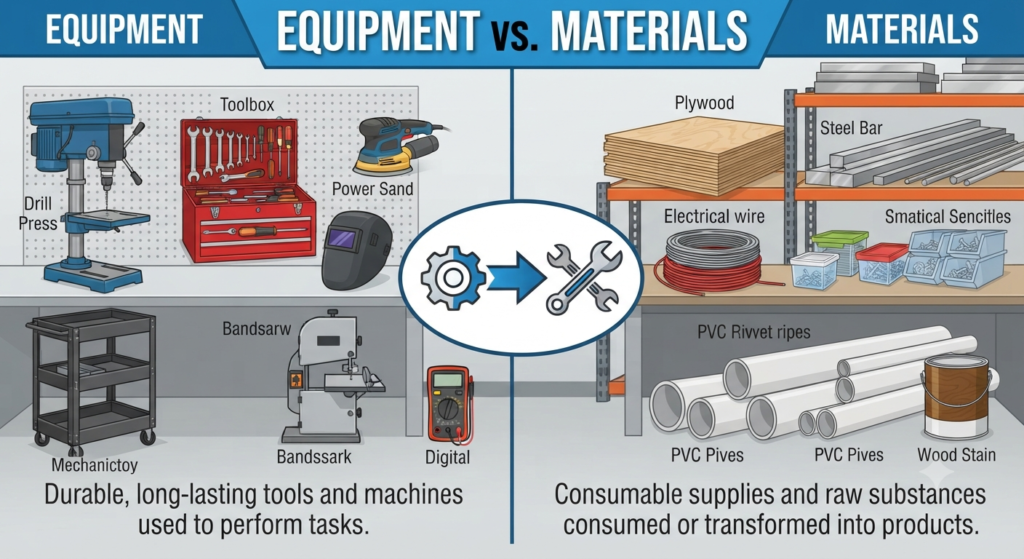
Equipment vs. Materials refers to the difference between the tools and machinery used to perform work and the physical substances consumed, processed, or incorporated into a product or project. Equipment helps people carry out tasks efficiently, while materials become part of the work being produced or are used during the process.
Understanding this distinction is important in manufacturing, construction, engineering, maintenance, healthcare, and many other industries. Equipment is generally purchased as a long-term asset, whereas materials are commonly treated as consumable or production resources.
Equipment vs. Materials Comparison Table
The main difference between equipment and materials is their role in a process. Equipment provides the means to perform work, whereas materials provide the physical resources required to produce or complete that work.
| Feature | Equipment | Materials |
| Meaning | Tools, machines, or devices used to perform work | Substances or components used in production or construction |
| Primary Role | Performs or supports a task | Becomes part of, or is consumed during, the work |
| Examples | Pumps, motors, cranes, machines | Steel, cement, copper, plastic |
| Typical Use | Repeatedly used | Often consumed or transformed |
| Maintenance | Usually requires inspection and maintenance | Usually requires proper storage and handling |
| Useful Life | Often lasts for years | Depends on the application and material type |
| Accounting Treatment | Often treated as a capital asset | Commonly treated as inventory or an operating cost |
| Replacement | Replaced because of wear, failure, or obsolescence | Replenished as it is consumed or required |
| Value Contribution | Helps produce work efficiently | Contributes physical properties to the final product |
What Is Equipment?
Equipment includes tools, machines, instruments, appliances, and other devices designed to perform a particular function. It can range from simple hand tools to sophisticated automated systems.
Examples include:
- Drilling machines
- Welding machines
- Electric motors
- Computers
- Cranes
- Pumps
- Testing instruments
- Construction machinery
The primary purpose of equipment is to perform, support, or simplify a task. For example, a drilling machine creates holes, while a pump moves fluids from one location to another.
Equipment is usually designed for repeated use. Proper operation, inspection, servicing, and repair can extend its useful life and reduce unexpected downtime.
What Are Materials?
Materials are physical substances used to manufacture, construct, repair, or assemble something. They can serve as raw inputs, components, or consumables depending on the application.
Common examples include:
- Steel
- Cement
- Copper
- Aluminum
- Wood
- Plastic
- Glass
- Insulation
- Lubricants
- Fasteners
The properties of a material determine whether it is suitable for a particular application. Strength, hardness, conductivity, corrosion resistance, flexibility, and temperature resistance are some factors engineers and manufacturers may consider.
Unlike equipment, many materials are consumed, transformed, or incorporated into the finished product during use.
Equipment vs.Materials: Key Differences
1. Purpose and Function
Equipment exists primarily to do something. A machine may cut, lift, transport, measure, generate, process, or control a particular operation.
Materials have a different role. They provide the physical substance needed to create a product, structure, or component. For instance, a welding machine performs the welding operation, while steel plates and welding consumables support the fabrication work.
This distinction makes it easier to identify what an organization needs to purchase for an operation.
2. Cost and Investment
Equipment often requires a larger initial investment because it is intended for repeated use over an extended period. Its total cost may include installation, commissioning, training, maintenance, energy consumption, and repairs.
Material costs are generally associated with the quantity required for production or construction. Prices can change according to availability, demand, quality, transportation, and market conditions.
For a construction project, buying a crane represents an equipment investment, while purchasing steel and cement represents material expenditure.
3. Maintenance and Storage
Equipment normally requires preventive maintenance to remain safe and reliable. Depending on its type, this can include lubrication, inspection, calibration, cleaning, component replacement, and periodic testing.
Materials require a different type of management. Correct storage conditions can prevent corrosion, contamination, moisture damage, deterioration, or physical deformation. Sensitive materials may require temperature-controlled or protected storage.
Effective management of both categories can reduce waste and improve operational efficiency.
4. Lifespan and Reuse
A major characteristic of equipment is its potential for repeated use. A properly maintained machine can remain operational for many years and may be transferred between projects or departments.
Materials have more varied life cycles. Some are incorporated permanently into a structure, while others are consumed during production. For example, structural steel may remain in a building for decades, whereas welding electrodes are consumed during fabrication.
Therefore, lifespan alone does not determine whether an item is equipment or material. Its function and role in the operation are also important.
5. Equipment and Materials in Construction
The distinction is particularly useful in construction projects.
Equipment may include:
- Excavators
- Cranes
- Concrete mixers
- Compactors
- Generators
- Drilling machines
Materials may include:
- Cement
- Sand
- Aggregate
- Reinforcement steel
- Bricks
- Pipes
- Electrical cables
Construction equipment helps workers complete activities efficiently, while materials form the actual structure or installation.
6. Equipment and Materials in Manufacturing
Manufacturing operations depend on both categories. Production equipment may include CNC machines, conveyors, presses, motors, pumps, and automated systems.
Materials can include metals, polymers, chemicals, electronic components, packaging materials, and other production inputs.
A manufacturing process therefore depends on the availability and reliability of both. Equipment failure can stop production, while material shortages can prevent the equipment from being used effectively.
Why the Difference Matters
Therefore, understanding the difference between equipment and materials helps organizations manage purchasing, inventory, maintenance, budgeting, and project planning more effectively.
Equipment management focuses on areas such as:
- Preventive maintenance
- Equipment utilization
- Depreciation
- Repairs
- Safety inspections
- Replacement planning
Material management focuses more on:
- Inventory levels
- Quality inspection
- Storage
- Consumption
- Procurement
- Waste reduction
Clear classification also helps departments communicate requirements accurately when preparing purchase requests or project budgets.
Are Equipment and Materials Related?
Yes. Equipment and materials often work together in the same operation.
Consider a fabrication workshop. A cutting machine is equipment, while steel sheets are materials. The machine performs the cutting operation and transforms the steel into the required component.
Neither category works alone. Reliable equipment processes materials efficiently, while suitable materials enable the equipment to produce the desired result.
Equipment vs. Materials: Which Is More Important?
Neither is universally more important. Their importance depends on the task and industry.
A manufacturing plant may depend heavily on specialized equipment, while a construction project may have a large material requirement. In both cases, poor management of one category can affect productivity, cost, quality, and safety.
The best approach is to manage equipment and materials as complementary resources.
Conclusion
Equipment vs. Materials can be understood by looking at the role each plays in an operation. Equipment provides the tools, machines, and devices needed to perform work, while materials supply the physical substances used, processed, or incorporated into the final result.
Materials are often consumed, transformed, or permanently incorporated into a product or structure , whereas Equipment is generally intended for repeated use and requires maintenance.
Understanding these differences helps businesses and project teams improve procurement, cost control, inventory management, productivity, and overall resource planning.
Frequently Asked Questions
Equipment consists of tools, machines, or devices used to perform work. Materials are substances or components used to create, repair, manufacture, or complete something.
Yes. Most equipment is designed for repeated use. Its useful life depends on factors such as design, operating conditions, maintenance, and frequency of use.
No. Many materials are consumed during production, but some become permanent parts of a product or structure. Steel used in a building is an example of a material that remains in place.
A tool is generally considered equipment when it is intended for repeated use to perform a task. Examples include drills, wrenches, and measuring instruments.
The distinction helps organizations manage purchasing, budgeting, inventory, maintenance, storage, and project costs. It also makes procurement and resource planning more accurate.
Read Next: