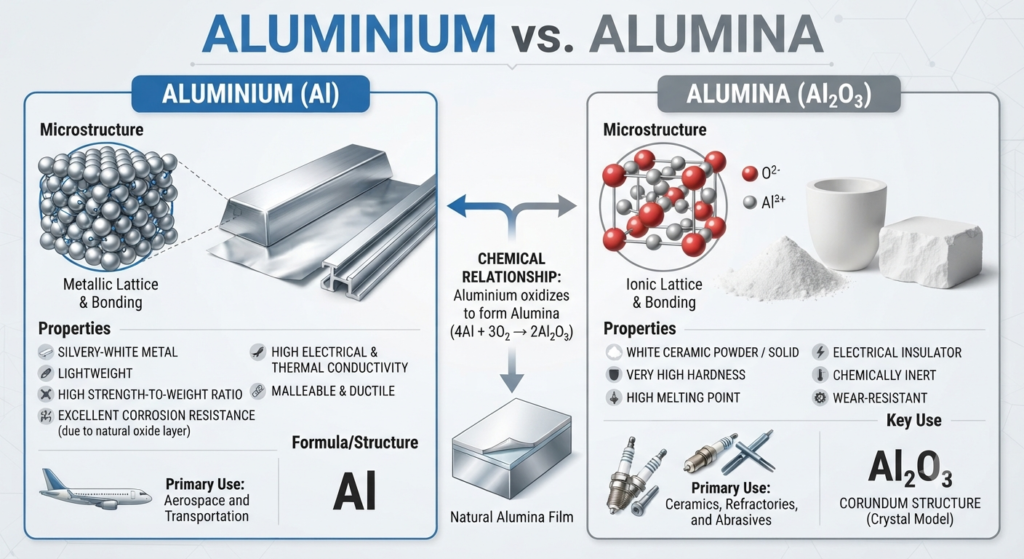
The main difference between Aluminium vs. Alumina is their chemical composition and properties. Aluminium is a chemical element and lightweight metal represented by the symbol Al, whereas alumina is a chemical compound consisting of aluminium and oxygen, with the formula Al₂O₃. Aluminium is widely used where low weight, electrical conductivity, ductility, and corrosion resistance are required, while alumina is valued for its hardness, high-temperature stability, wear resistance, and electrical insulating properties.
Understanding Aluminium vs. Alumina is important because the two materials are closely related but serve very different industrial purposes. Alumina is also an important intermediate material in the production of primary aluminium, while aluminium itself is used extensively in electrical, construction, transportation, packaging, and manufacturing applications.
Aluminium vs. Alumina Comparison Table
The table below highlights the major differences between Aluminium and Alumina.
| Feature | Aluminium | Alumina |
| Nature | Chemical element and metal | Chemical compound |
| Chemical Symbol/Formula | Al | Al₂O₃ |
| Atomic Number | 13 | Not applicable |
| Molar Mass | 26.98 g/mol | 101.96 g/mol |
| Main Elements | Aluminium | Aluminium and oxygen |
| Appearance | Silvery-white metal | Usually white or off-white solid |
| Electrical Conductivity | Good conductor | Electrical insulator |
| Thermal Conductivity | High | Relatively low compared with aluminium |
| Density | About 2.70 g/cm³ | About 3.9–4.0 g/cm³ |
| Melting Point | About 660°C | About 2,050–2,070°C |
| Hardness | Relatively soft compared with alumina | Very hard |
| Ductility | High | Brittle ceramic |
| Corrosion Resistance | Good due to protective oxide layer | Excellent chemical and corrosion resistance |
| Major Uses | Electrical conductors, construction, transportation, packaging | Ceramics, refractories, abrasives, electrical insulation |
| Relationship | Produced from alumina during aluminium extraction | Main oxide feedstock for producing aluminium |
What Is Aluminium?
Aluminium is a chemical element with the symbol Al and atomic number 13. It is a lightweight, silvery-white metal that is widely used because of its low density, good conductivity, corrosion resistance, and excellent formability.
Aluminium does not usually occur as a free metal in nature because it readily combines with oxygen and other elements. Most primary aluminium production begins with bauxite, an ore containing aluminium-bearing minerals.
Bauxite is first refined to produce alumina. The alumina is then processed through electrolytic reduction to produce metallic aluminium.
One of the most useful characteristics of aluminium is its low density. At approximately 2.70 g/cm³, it is considerably lighter than many commonly used structural metals. This makes aluminium especially valuable where reducing weight is important.
Aluminium also develops a thin, adherent oxide film when exposed to air. This natural oxide layer helps protect the underlying metal from further corrosion.
Characteristics of Aluminium
Important characteristics of aluminium include:
- It is a chemical element.
- Its chemical symbol is Al.
- Its atomic number is 13.
- It is a lightweight metal.
- It has good electrical conductivity.
- It has good thermal conductivity.
- It is ductile and malleable.
- It can be rolled, extruded, drawn, and cast.
- It has good corrosion resistance.
- It can be alloyed with other elements to improve its properties.
- It is highly recyclable.
- It is widely used in engineering and manufacturing.
Uses of Aluminium
Aluminium has a broad range of applications across different industries.
Common uses include:
- Electrical conductors.
- Overhead power transmission lines.
- Electrical busbars.
- Aircraft structures.
- Automobile components.
- Railway vehicles.
- Window and door frames.
- Roofing and building components.
- Cans and packaging materials.
- Heat exchangers.
- Heat sinks.
- Kitchen utensils.
- Machinery components.
- Consumer products.
Aluminium alloys can provide significantly higher strength than pure aluminium, making them useful for demanding engineering applications.
What Is Alumina?
Alumina is aluminium oxide, a chemical compound with the formula Al₂O₃. It consists of aluminium and oxygen and is generally produced industrially by refining bauxite.
Alumina is commonly obtained through the Bayer process, in which aluminium-bearing minerals in bauxite are chemically processed to separate alumina from impurities.
The resulting alumina is a hard, stable ceramic material. It has a much higher melting point than aluminium and is capable of maintaining its properties at elevated temperatures.
Alumina is also an excellent electrical insulator. This makes it valuable in electrical and electronic applications where components must withstand high temperatures while preventing unwanted current flow.
Naturally occurring aluminium oxide occurs in mineral forms such as corundum. Gemstones such as ruby and sapphire are varieties of corundum containing small amounts of other elements that produce their characteristic colors.
Characteristics of Alumina
Important characteristics of alumina include:
- Its chemical formula is Al₂O₃.
- It is a compound rather than an element.
- It is generally white or off-white.
- It has very high hardness.
- It has a high melting point.
- It is resistant to wear and abrasion.
- It is electrically insulating.
- It has good chemical stability.
- It withstands high temperatures.
- It is used extensively in ceramic applications.
- It is an important raw material for aluminium production.
Uses of Alumina
Alumina is used in applications where hardness, thermal stability, electrical insulation, and chemical resistance are important.
Common applications include:
- Technical ceramics.
- Refractory materials.
- Abrasives.
- Grinding materials.
- Electrical insulators.
- Ceramic substrates.
- Spark-plug insulators.
- Wear-resistant components.
- Furnace linings.
- Laboratory equipment.
- Biomedical ceramics.
- Catalyst supports.
- Aluminium production.
Aluminium vs. Alumina: Key Differences
1. Chemical Composition
The most fundamental difference between Aluminium and Alumina is their chemical nature.
Aluminium is an element consisting of aluminium atoms.
Alumina is a compound formed when aluminium combines chemically with oxygen. Its formula is Al₂O₃.
Therefore, aluminium represents the metallic element itself, whereas alumina represents one of its most important oxide compounds.
2. Physical Form
Aluminium is a metallic solid at room temperature. It has a characteristic silvery appearance and can be shaped relatively easily.
Alumina is a ceramic material and is generally encountered as a powder, granular material, or manufactured ceramic component. It is much harder and more brittle than aluminium.
This difference in physical behavior determines many of their applications.
3. Electrical Conductivity
Electrical conductivity is another major difference between Aluminium and Alumina.
Aluminium is a good electrical conductor. Its combination of relatively low density and useful electrical conductivity makes it particularly important for overhead power transmission and distribution conductors.
Alumina, in contrast, is an electrical insulator. It does not readily allow electric current to pass through it.
Consequently, aluminium is used for carrying electrical current, while alumina is often used for electrical insulation.
4. Melting Point
Aluminium has a relatively low melting point of approximately 660°C.
Alumina has an extremely high melting point, generally around 2,050–2,070°C, depending on its form and purity.
This large difference makes alumina much more suitable for high-temperature applications such as refractory and furnace components.
5. Hardness
Alumina is substantially harder than aluminium.
Aluminium is a relatively soft and ductile metal, although its alloys can have much greater hardness and strength.
Alumina is a hard ceramic with excellent resistance to abrasion and wear. Its hardness makes it useful for abrasive products and wear-resistant components.
6. Ductility and Malleability
Aluminium is highly ductile and malleable. It can be rolled into thin sheets, drawn into wire, and formed into complex shapes.
Alumina is comparatively brittle. It does not exhibit the same degree of plastic deformation as aluminium.
Therefore, aluminium is generally easier to manufacture into structural and formed products, while alumina is commonly shaped through ceramic processing techniques.
7. Corrosion Resistance
Both materials have strong resistance to corrosion, but for different reasons.
Aluminium reacts with oxygen and quickly develops a thin protective oxide layer on its surface. This oxide film helps prevent continued oxidation of the underlying metal.
Alumina is already an oxide and is chemically stable under many operating conditions. It therefore provides excellent resistance to corrosion and chemical attack.
8. Density
Aluminium has a density of approximately 2.70 g/cm³.
Alumina has a density of roughly 3.9–4.0 g/cm³.
Thus, alumina is denser than aluminium even though aluminium is the lighter material commonly associated with the production process.
This difference is important when selecting materials for lightweight engineering applications.
9. Thermal Properties
Aluminium has relatively high thermal conductivity and transfers heat efficiently. This makes it useful in heat sinks, heat exchangers, cookware, and other thermal-management applications.
Alumina has much lower thermal conductivity than aluminium, although certain high-purity alumina ceramics can conduct heat reasonably well compared with many other electrical insulators.
Its ability to withstand very high temperatures is one of its major advantages.
10. Role in Aluminium Production
Alumina and aluminium have a direct industrial relationship.
Bauxite is refined to produce alumina, and alumina is subsequently used as the feedstock for electrolytic aluminium production.
The overall pathway can be summarized as:
Bauxite → Alumina → Aluminium
The first stage is primarily a refining operation, while the conversion of alumina into aluminium involves an electrolytic reduction process.
This makes alumina a critical intermediate material in the global aluminium industry.
Aluminium and Alumina in Electrical Applications
The difference between Aluminium and Alumina is particularly important in electrical engineering.
Aluminium is widely used as an electrical conductor because it combines useful conductivity with low weight. Overhead transmission conductors frequently use aluminium, often in combination with reinforcing materials or other conductor components.
Alumina has almost the opposite electrical role. It is used as an insulating ceramic in applications requiring electrical isolation and resistance to elevated temperatures.
Examples include:
- Electrical insulators.
- Ceramic substrates.
- High-temperature insulating components.
- Electronic packaging.
- Insulating supports.
- Spark-plug components.
Therefore, the choice between aluminium and alumina depends strongly on whether electrical conduction or electrical insulation is required.
Aluminium and Alumina in Manufacturing
Aluminium is particularly suitable for manufacturing processes that require forming and machining. It can be cast, forged, rolled, extruded, and machined.
Alumina requires different manufacturing techniques because it is a ceramic material. It may be shaped from powders and then sintered at high temperatures to produce dense ceramic components.
Alumina’s high hardness can make machining difficult after sintering, so component geometry and manufacturing methods must often be carefully planned.
The contrasting manufacturing behavior explains why aluminium is common in structural products while alumina is common in specialized ceramic components.
Aluminium and Alumina: Which Is Better?
There is no universal answer to which material is better because Aluminium and Alumina are designed for different purposes.
Aluminium is generally preferable when an application requires:
- Low weight.
- Electrical conductivity.
- Thermal conductivity.
- Ductility.
- Easy forming.
- Machinability.
- Structural applications.
Alumina is generally preferable when an application requires:
- Very high hardness.
- High-temperature resistance.
- Electrical insulation.
- Wear resistance.
- Chemical stability.
- Refractory performance.
The correct choice depends on the operating temperature, mechanical requirements, electrical properties, chemical environment, weight limitations, and manufacturing process.
Similarities Between Aluminium and Alumina
Although Aluminium and Alumina are very different materials, they share several characteristics because alumina is an oxide of aluminium.
Some important similarities include:
- Both contain aluminium.
- Both are widely used in industry.
- Both have good resistance to corrosion or chemical degradation in many environments.
- Both are important materials in engineering.
- Both can be used in electrical applications.
- Both can be processed into products for specialized applications.
- Both are associated with the aluminium production industry.
- Both can be used in high-value industrial applications.
- Both occur naturally or are derived from naturally occurring minerals.
- Both have significant importance in modern manufacturing.
Environmental Considerations
The production of both aluminium and alumina has environmental implications.
Bauxite mining can disturb land and ecosystems if it is not properly managed. The refining of bauxite into alumina also produces bauxite residue, commonly called red mud, which requires appropriate storage and management.
Primary aluminium production requires substantial electrical energy because alumina must be reduced electrolytically to obtain aluminium metal.
Recycling provides an important environmental advantage for aluminium. Recycled aluminium can be remelted and reused without repeating the energy-intensive primary reduction process.
Alumina itself can also be recovered or reused in certain industrial processes, depending on contamination and application requirements.
Responsible mining, efficient refining, renewable electricity, improved process technology, waste management, and increased recycling can all help reduce the environmental impact associated with the aluminium value chain.
Aluminium and Alumina: Relationship Between the Two
The relationship between Aluminium and Alumina can be understood through their position in the aluminium production chain.
Bauxite is the primary ore from which aluminium is commercially produced. Through refining, aluminium-containing minerals are converted into alumina.
The alumina is then dissolved in molten cryolite and subjected to electrolysis in the Hall–Héroult process. Aluminium metal is produced at the cathode while oxygen combines with carbon anodes, producing carbon dioxide and other gases.
Thus, alumina is not simply another form of aluminium metal. It is an intermediate compound that must undergo chemical reduction before metallic aluminium is obtained.
Conclusion
The comparison of Aluminium and Alumina shows that these two closely related materials have substantially different chemical, physical, electrical, and mechanical properties. Aluminium combines low weight with high conductivity, ductility, corrosion resistance, and easy fabrication. These properties make it widely useful in electrical systems, transportation, construction, packaging, and manufacturing.
Alumina, or aluminium oxide (Al₂O₃), is a hard ceramic compound with a high melting point, excellent wear resistance, chemical stability, and strong electrical insulating properties. It is widely used in ceramics, refractories, abrasives, electrical insulation, and as the principal intermediate feedstock for producing primary aluminium.
The simplest way to understand Aluminium and Alumina is that aluminium is the metallic element, while alumina is its stable oxide compound. Their different properties make each material valuable for applications where the other may not be suitable.
Frequently Asked Questions (FAQs)
The main difference between Aluminium and Alumina is their chemical nature. Aluminium is a metallic chemical element with the symbol Al, whereas alumina is aluminium oxide, a compound with the formula Al₂O₃.
Yes. Alumina is the primary intermediate material used to produce aluminium metal. Bauxite is first refined into alumina, which is then electrolytically reduced to produce aluminium.
Alumina is much harder than aluminium. Its high hardness and wear resistance make it useful for abrasives, ceramics, and wear-resistant components, while aluminium is comparatively soft and ductile.
No. Alumina is generally an electrical insulator. Aluminium, by comparison, is a good electrical conductor and is widely used in power transmission and other electrical applications.
Aluminium is used for electrical wires and conductors because it has good electrical conductivity, low density, and excellent ductility. Alumina does not conduct electricity effectively, so it is generally used for insulation and ceramic components rather than current-carrying wires.
Read Next:
- Chloride vs. Chlorite: What’s the Difference?
- 1-Butene vs. 2-Butene: What’s the Difference?
- Phosphodiester Bond vs. Phosphoester Bond:
- Difference Between Methyl and Methylene Group (CH3 vs CH2)
- Difference Between Molecular Equation and Ionic Equation
- Olefins vs. Paraffins: What’s the Difference?
- Cetyl Alcohol vs. Stearyl Alcohol: What’s the Difference?
- Equipment vs. Materials