The main difference between Bulk Density vs. Density is that density describes the mass of a material per unit volume of the material itself, while bulk density describes the mass of a collection of particles divided by the total volume occupied by those particles, including the spaces between them. Therefore, bulk density depends not only on the material but also on particle size, shape, arrangement, compaction, and moisture, whereas the density of a homogeneous substance is generally an intrinsic property under specified conditions.
Understanding Bulk Density vs. Density is important in engineering, materials science, soil science, construction, mining, pharmaceuticals, food processing, and powder handling because these two properties are used for different purposes. Density helps characterize the material itself, while bulk density helps determine how a granular or powdered material behaves when stored, transported, compacted, or processed.
Bulk Density vs. Density Comparison Table
The table below highlights the major differences between Bulk Density vs. Density.
| Feature | Bulk Density | Density |
|---|---|---|
| Definition | Mass of a bulk material divided by its total occupied volume, including interparticle spaces | Mass of a substance divided by its volume |
| Formula | Bulk density = Mass / Bulk volume | Density = Mass / Volume |
| Void Spaces | Includes spaces between particles | For material density, the volume definition depends on the material and measurement method; it does not treat interparticle gaps as part of the material itself |
| Nature | A bulk or sample-dependent property | Generally an intrinsic material property for a specified substance and condition |
| Common Materials | Powders, grains, soil, aggregates, pellets | Solids, liquids, and gases |
| Effect of Packing | Strongly affected by particle arrangement and compaction | Not normally affected by how separate particles are arranged when measuring the material itself |
| Effect of Particle Size | Can significantly affect the measured value | Does not ordinarily change the true density of the same homogeneous material |
| Effect of Moisture | Can significantly affect bulk density | Depends on the material and measurement conditions |
| Typical Unit | kg/m³ or g/cm³ | kg/m³ or g/cm³ |
| Main Use | Storage, transportation, packing, soil and powder characterization | Material identification and physical characterization |
| Example | Bulk density of sand or soil | Density of steel or water |
| Main Concept | Mass per total bulk volume | Mass per material volume |
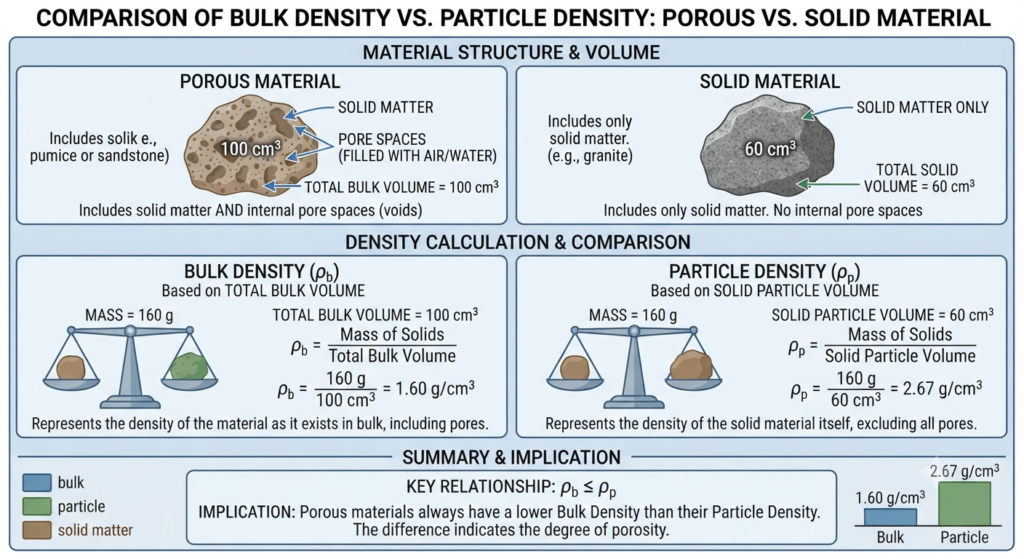
What Is Density?
Density is the mass of a substance per unit volume. It is one of the fundamental physical properties used to characterize materials.
Density is commonly represented by the Greek letter ρ (rho) and is calculated using:
Where:
- ρ = density
- m = mass
- V = volume
For example, if a solid object has a mass of 500 g and occupies a volume of 200 cm³, its density is:
Density is commonly expressed in kg/m³, g/cm³, or g/mL, depending on the material and application.
For a homogeneous substance at a specified temperature and pressure, density is generally independent of the size of the sample.
Characteristics of Density
Important characteristics of density include:
- Represents mass per unit volume.
- Is commonly represented by ρ.
- Is measured in kg/m³ or g/cm³.
- Is useful for characterizing materials.
- Can be used for solids, liquids, and gases.
- Depends on temperature and pressure for many materials.
- Helps identify unknown substances.
- Is important in engineering and materials science.
- Can be used in calculations involving mass and volume.
- Provides information about how much mass occupies a given volume.
Examples of Density
Examples of density include:
- Density of water.
- Density of steel.
- Density of aluminum.
- Density of concrete.
- Density of glass.
- Density of oil.
- Density of gases such as air.
For example, the density of pure water is approximately 1,000 kg/m³ near room temperature, although the exact value varies with temperature.
What Is Bulk Density?
Bulk density is the mass of a bulk material divided by the total volume occupied by the material. For a collection of particles, this volume includes the spaces between the particles.
Bulk density is especially useful for powders, grains, soil, aggregates, pellets, and other particulate materials.
The basic formula is:
The total bulk volume includes:
- Volume occupied by solid particles
- Spaces between particles
For example, consider a container filled with sand. The sand particles occupy part of the container, while small spaces between the particles contain air. Bulk density considers the entire volume of the container occupied by the sand, including those interparticle spaces.
Characteristics of Bulk Density
Important characteristics of bulk density include:
- Applies particularly to granular and powdered materials.
- Includes interparticle spaces in the bulk volume.
- Is commonly expressed in kg/m³ or g/cm³.
- Depends on particle arrangement.
- Can change with compaction.
- Can be affected by particle size and shape.
- Can be affected by moisture content.
- Is important in storage and transportation.
- Helps determine the volume occupied by a given mass of material.
- Is widely used in soil, agricultural, mining, pharmaceutical, and construction applications.
Examples of Bulk Density
Examples of materials for which bulk density is commonly measured include:
- Soil
- Sand
- Gravel
- Cement
- Coal
- Powdered chemicals
- Pharmaceutical powders
- Grain
- Fertilizer
- Wood chips
- Mineral ores
For example, loosely poured sand generally has a lower bulk density than the same sand after significant compaction because compaction reduces the spaces between particles.
Bulk Density vs. Density: Key Differences
1. Definition
The most important difference between Bulk Density vs. Density is their definitions.
Density represents the mass of a substance per unit volume.
Bulk density represents the mass of a bulk collection of particles per unit of its total occupied volume, including spaces between particles.
Therefore, bulk density is particularly relevant when dealing with materials that contain interparticle spaces.
2. Volume Considered
The volume considered in the two measurements is different.
For bulk density, the volume includes the entire space occupied by the bulk material, including the gaps between individual particles.
For density, the volume refers to the volume of the material itself as defined by the measurement.
This difference is especially important for powders and granular materials.
3. Void Spaces
Void spaces are a major factor distinguishing bulk density from density.
Suppose a container contains many particles. There will usually be empty spaces between those particles.
Bulk density includes these interparticle spaces in the measured volume.
The intrinsic density of the material itself does not treat the gaps between separate particles as part of the material.
Therefore:
Bulk density → Includes interparticle voids
Density → Characterizes the material itself
4. Effect of Particle Arrangement
Particle arrangement can have a significant effect on bulk density.
When particles are loosely packed, larger spaces may exist between them. This results in a lower bulk density.
When the same particles are compacted, the spaces between them become smaller, increasing the bulk density.
The density of the solid material itself does not change simply because the particles have been rearranged in a bulk sample.
5. Effect of Compaction
Compaction strongly influences bulk density.
Consider a container of powder. If the powder is gently poured into the container, the particles may form a relatively loose arrangement. If the container is tapped or the powder is mechanically compacted, the particles can move closer together.
As the occupied bulk volume decreases while the mass remains approximately constant, bulk density increases.
The density of the individual material does not normally change because of this packing process.
6. Particle Size
Particle size can influence bulk density.
A collection of large particles may have a different packing arrangement from a collection of smaller particles. Smaller particles can sometimes fill spaces between larger particles, changing the overall packing and bulk density.
The true density of a homogeneous material is generally not changed simply by dividing it into smaller particles.
Thus, particle size is particularly important when measuring bulk density.
7. Particle Shape
Particle shape also affects bulk density.
Spherical, angular, elongated, flaky, and irregular particles can pack differently.
For example, spherical particles may arrange differently from irregular particles, resulting in different amounts of empty space between them.
As a result, two samples made from the same material can have different bulk densities if their particle shapes or packing conditions differ.
8. Moisture Content
Moisture can influence bulk density, particularly in porous or granular materials.
Water may occupy spaces between particles or be absorbed by the particles themselves. Consequently, the measured mass and volume can change.
The effect of moisture on bulk density depends on the material and the measurement method.
For this reason, bulk-density testing often requires controlled moisture conditions.
9. Applications
Density and bulk density are used in different applications.
Density is commonly used for:
- Material identification
- Fluid calculations
- Materials engineering
- Physics
- Chemistry
- Mechanical engineering
- Quality control
Bulk density is commonly used for:
- Soil analysis
- Powder processing
- Grain storage
- Pharmaceutical manufacturing
- Mining
- Cement and construction materials
- Material transportation
- Storage-bin and silo design
10. Measurement
The measurement procedures can also differ.
Density may be determined by measuring the mass and volume of a material.
Bulk density is commonly determined by placing a known mass of particulate material into a container of known volume under specified conditions and calculating the ratio.
Because packing conditions affect bulk density, standardized procedures are important for obtaining comparable results.
11. Material Types
Density applies broadly to different states of matter.
It can be determined for:
- Solids
- Liquids
- Gases
Bulk density is most commonly associated with particulate or porous bulk materials, including powders, grains, soil, and aggregates.
Therefore, density has a broader application, while bulk density is particularly useful for collections of particles.
12. Relationship Between the Two
Bulk density and density are related but are not necessarily equal.
For a particulate material, the bulk density is generally lower than the density of the solid particles because the bulk volume contains spaces between particles.
The relationship can be expressed using porosity:
This relationship assumes that the relevant densities and porosity are defined consistently.
If the porosity increases, the bulk density generally decreases.
If the particles become more tightly packed and porosity decreases, the bulk density generally increases.
Similarities Between Bulk Density and Density
Although Bulk Density vs. Density describes two different measurements, they share several important characteristics.
Some major similarities include:
- Both relate mass to volume.
- Both are commonly expressed in kg/m³ or g/cm³.
- Both are physical properties used to characterize materials.
- Both require measurements of mass and volume.
- Both are useful in engineering and scientific calculations.
- Both can help determine how much mass is contained within a given volume.
- Both can be affected by temperature under appropriate conditions.
- Both are useful in material selection and quality control.
- Both can be used to convert between mass and volume when their definitions are properly applied.
- Both provide information about the physical characteristics of materials.
Factors Affecting Bulk Density and Density
Several factors can affect measured density and bulk density.
1. Temperature
Temperature can change the volume of many materials. As a result, density may change with temperature.
Bulk density can also change because temperature may affect moisture, particle behavior, or the volume occupied by the bulk material.
2. Pressure
Pressure can significantly affect the density of gases and can also influence some liquids and solids under extreme conditions.
For bulk materials, pressure or mechanical loading can compact particles and increase bulk density.
3. Particle Size
Particle size is particularly important for bulk density because it influences how particles arrange themselves.
4. Particle Shape
Irregular particles can create different packing structures compared with spherical or regularly shaped particles.
5. Compaction
Compaction reduces the volume of spaces between particles and can therefore increase bulk density.
6. Moisture
Moisture can change both mass and volume and may occupy interparticle spaces or become associated with particles.
7. Porosity
Porosity represents the fraction of a material or bulk system occupied by voids.
Higher porosity generally corresponds to lower bulk density when particle density remains constant.
Bulk Density vs. Density in Different Applications
Bulk density is particularly important in soil science.
Soil bulk density provides information about how closely soil particles are packed. It is related to soil porosity, root penetration, water movement, and air movement.
A highly compacted soil generally has a higher bulk density and lower pore space.
Density measurements can also be relevant when studying the composition and properties of soil minerals.
Construction
Bulk density is widely used for materials such as sand, aggregates, cement, and other construction products.
It helps engineers determine:
- Storage requirements
- Transportation loads
- Material quantities
- Mix proportions
- Handling characteristics
Density is also important when selecting and characterizing construction materials.
Pharmaceutical Industry
Bulk density is important for pharmaceutical powders and granules.
It can affect:
- Powder handling
- Tablet manufacturing
- Capsule filling
- Packaging
- Storage
- Flow behavior
Density measurements can also be used to characterize the materials used in pharmaceutical formulations.
Mining
Bulk density is important for estimating the mass of ore occupying a particular volume.
It can be used in:
- Ore reserve estimation
- Material handling
- Transportation
- Stockpile calculations
- Mine planning
The density of individual minerals can also help identify and characterize geological materials.
Food and Agriculture
Bulk density is important for grains, seeds, flour, powders, and other agricultural products.
It helps determine storage capacity and transportation requirements.
For example, the amount of grain that can fit inside a silo depends on the bulk density of the grain and its packing condition.
Which Is More Useful—Bulk Density or Density?
Neither property is universally more useful because each serves a different purpose.
Density is more useful when the objective is to characterize a substance itself or compare materials based on their mass-to-volume relationship.
Bulk density is more useful when dealing with collections of particles and when storage, transportation, compaction, packing, or handling is important.
Choose density when studying:
- Material properties
- Liquids
- Gases
- Solid materials
- Material identification
- Engineering calculations
Choose bulk density when studying:
- Powders
- Soil
- Sand
- Aggregates
- Grain
- Pharmaceutical granules
- Bulk storage
- Material handling
Therefore, the appropriate measurement depends on whether the focus is on the material itself or the material in its bulk form.
Conclusion
The comparison of Bulk Density vs. Density demonstrates that both properties describe the relationship between mass and volume but are used in different ways. Density generally represents the mass of a substance per unit volume of the material, while bulk density represents the mass of a collection of particles divided by its total occupied volume, including the spaces between particles.
Bulk density is strongly influenced by particle size, particle shape, packing arrangement, compaction, porosity, and moisture content. Density, particularly for a homogeneous material at a specified temperature and pressure, is generally an intrinsic property and is not changed simply by rearranging separate particles.
Understanding Bulk Density vs. Density is important in soil science, agriculture, construction, mining, pharmaceuticals, food processing, materials science, and engineering. The simplest distinction is that density describes the material itself, whereas bulk density describes the material together with the spaces present within its bulk arrangement.
Frequently Asked Questions (FAQs)
The main difference between Bulk Density vs. Density is that bulk density considers the total volume occupied by a bulk material, including spaces between particles, while density describes the mass per unit volume of the material itself.
The formula for density is:
ρ = Mass / Volume
where ρ represents density.
The basic formula for bulk density is:
Bulk Density = Mass of Material / Total Bulk Volume
The bulk volume includes the spaces between particles.
For a particulate material, bulk density is generally lower than the density of the solid particles because the bulk volume includes interparticle spaces. However, comparisons must use consistent definitions and measurement conditions.
Yes. Compaction generally decreases the spaces between particles, reducing bulk volume and increasing bulk density when the mass remains essentially constant.
Read Next: