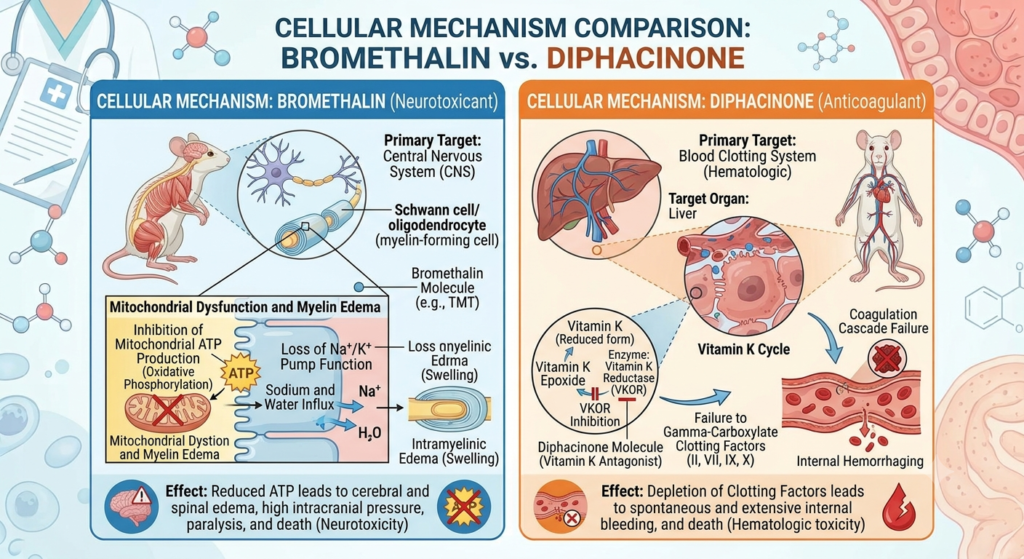
The main difference between Bromethalin vs. Diphacinone is how these rodenticides affect the bodies of rodents. Bromethalin is a non-anticoagulant rodenticide that disrupts cellular energy production in the nervous system, whereas Diphacinone is an anticoagulant rodenticide that interferes with the body’s ability to produce vitamin K-dependent clotting factors.
Both compounds are used in rodent control products, particularly for rats and mice, but they belong to different chemical and toxicological groups. Their mechanisms of action, onset of toxic effects, risks to non-target animals, and environmental considerations are therefore different.
Understanding Bromethalin vs. Diphacinone is important when studying rodenticides, pest management, toxicology, environmental science, and animal safety. Because both substances can be harmful if misused, rodenticide products should always be handled according to their approved product labels and applicable regulations.
Bromethalin vs. Diphacinone Comparison Table
The table below summarizes the major differences between Bromethalin vs. Diphacinone.
| Feature | Bromethalin | Diphacinone |
| Rodenticide Type | Non-anticoagulant rodenticide | Anticoagulant rodenticide |
| Primary Target | Central nervous system | Blood-clotting system |
| Main Mechanism | Disrupts cellular energy production | Interferes with vitamin K-dependent clotting factor production |
| Chemical Class | Neurotoxic rodenticide | Indandione anticoagulant |
| Primary Target Pests | Rats and mice | Rats and mice |
| Effect on the Body | Causes neurological dysfunction | Causes impaired blood clotting |
| Onset of Toxic Effects | Generally faster | Generally slower |
| Repeated Feeding | Some formulations can be effective after a single feeding | Traditionally associated with repeated feeding |
| Anticoagulant | No | Yes |
| Vitamin K Pathway | Not its primary mechanism | Disrupts vitamin K recycling |
| Primary Toxicological Concern | Neurological effects | Hemorrhage caused by impaired clotting |
| Non-Target Risk | Can be hazardous to pets and wildlife | Can be hazardous to pets and wildlife |
| Secondary Exposure Concern | Possible | Possible |
| Use | Rodent population control | Rodent population control |
What Is Bromethalin?
Bromethalin is a non-anticoagulant rodenticide used to control rodents such as rats and mice. Unlike anticoagulant rodenticides, it does not primarily interfere with blood clotting.
Its toxic effects are associated with the central nervous system. Bromethalin affects cellular energy metabolism and can interfere with the normal function of nervous tissue.
Bromethalin is used in certain commercial rodenticide formulations. Because the active ingredient can be hazardous to animals and humans, products containing bromethalin should be used only according to their registered labels and safety instructions.
Characteristics of Bromethalin
Important characteristics of bromethalin include:
- It is a non-anticoagulant rodenticide.
- It primarily affects the nervous system.
- It is used for rodent control.
- It can be effective against rats and mice.
- Its mechanism differs from anticoagulant rodenticides.
- It interferes with cellular energy production.
- It can cause serious poisoning if ingested.
- It may pose risks to pets and wildlife.
- It does not work by preventing blood clotting.
- Proper handling and storage are important.
How Does Bromethalin Work?
Bromethalin interferes with the production and utilization of cellular energy, particularly in nervous tissue. Its toxic action ultimately disrupts normal neurological function.
The mechanism involves impairment of mitochondrial energy production, which contributes to an increase in sodium and fluid within cells. In the central nervous system, this can produce swelling and neurological dysfunction.
Because its mechanism is different from anticoagulants, vitamin K treatment is not an antidote for bromethalin poisoning. Suspected exposure requires prompt professional assessment rather than attempting home treatment.
What Is Diphacinone?
Diphacinone is an anticoagulant rodenticide belonging to the indandione group. It is used in products designed to control rats and mice.
Unlike bromethalin, diphacinone affects the body’s blood-clotting system. It interferes with the recycling of vitamin K, which is necessary for producing several clotting factors in the liver.
As clotting factors become depleted, the ability of the blood to clot normally is reduced. This can result in internal bleeding and other serious consequences following significant exposure.
Characteristics of Diphacinone
Important characteristics of diphacinone include:
- It is an anticoagulant rodenticide.
- It belongs to the indandione group.
- It interferes with vitamin K-dependent clotting processes.
- It is used to control rats and mice.
- Its toxic effects generally develop more slowly than those of some non-anticoagulant rodenticides.
- Repeated feeding has traditionally been important for its rodenticide action.
- It can cause serious poisoning in non-target animals.
- Secondary exposure can be an environmental concern.
- It requires careful handling and storage.
- Product label instructions should always be followed.
How Does Diphacinone Work?
Diphacinone interferes with the normal recycling of vitamin K in the body. Vitamin K is necessary for the liver to produce several clotting factors required for normal blood coagulation.
As existing clotting factors are gradually used up, the blood becomes less capable of forming stable clots. This mechanism explains why poisoning can have a delayed onset compared with some other rodenticides.
Bromethalin vs. Diphacinone: Key Differences
1. Mechanism of Action
The most important difference between Bromethalin vs. Diphacinone is their mechanism of action.
Bromethalin acts primarily on the central nervous system by interfering with cellular energy metabolism.
Diphacinone acts on the blood-clotting system by disrupting vitamin K-dependent clotting factor production.
2. Rodenticide Classification
Bromethalin belongs to the non-anticoagulant category of rodenticides.
Diphacinone belongs to the anticoagulant category and is classified within the indandione group.
This distinction is important because the two compounds produce toxicity through fundamentally different biological pathways.
3. Primary Target in the Body
Bromethalin primarily affects nervous tissue. Its toxic effects are associated with disruption of normal neurological function.
Diphacinone primarily affects the coagulation system. Its effects become apparent as clotting factors are depleted and normal blood coagulation is impaired.
4. Effect on Blood Clotting
Bromethalin does not primarily interfere with blood clotting.
Diphacinone directly affects the body’s ability to maintain normal coagulation by interfering with vitamin K recycling.
Therefore, the two rodenticides should not be considered interchangeable from a toxicological perspective.
5. Onset of Toxic Effects
Bromethalin can produce toxic effects relatively quickly compared with anticoagulant rodenticides, although the timing depends on the dose, formulation, and individual animal.
Diphacinone generally has a delayed toxic effect because existing clotting factors must be depleted before severe coagulation problems develop.
The actual onset and severity can vary considerably, so a suspected exposure should be treated as a potential poisoning emergency.
6. Repeated Feeding
Bromethalin and diphacinone differ in their traditional feeding characteristics.
Some bromethalin formulations are designed to produce a toxic effect after a limited amount of bait is consumed. Diphacinone, as a first-generation anticoagulant, generally requires repeated ingestion over several days for effective rodent control.
The exact feeding requirements depend on the product formulation and its registered label.
7. Primary Toxicological Effect
Bromethalin poisoning is associated with neurological dysfunction resulting from its effects on cellular energy metabolism.
Diphacinone poisoning is associated with impaired blood clotting and hemorrhage caused by depletion of vitamin K-dependent clotting factors.
These different toxicological effects are important when identifying and managing suspected exposure.
8. Antidote Considerations
The difference in mechanism also affects treatment considerations.
Anticoagulant rodenticides such as diphacinone may be managed medically using vitamin K therapy under professional supervision.
Bromethalin has a different mechanism and does not have the same vitamin K-based treatment approach. Suspected exposure should therefore be evaluated promptly by a veterinarian, poison-control service, or medical professional, depending on who was exposed.
9. Risk to Pets
Both compounds can be hazardous to pets if they consume rodenticide bait or, in some circumstances, poisoned rodents.
Bromethalin can cause serious neurological toxicity.
Diphacinone can cause potentially severe bleeding because of impaired coagulation.
Keeping rodenticide products inaccessible to pets is therefore an important safety measure.
10. Risk to Wildlife
Both rodenticides can pose risks to non-target wildlife.
Wild animals may be exposed directly by consuming bait or indirectly through interactions with poisoned rodents. The magnitude of this risk depends on the active ingredient, formulation, use pattern, environmental conditions, and species involved.
Responsible rodent control therefore requires minimizing access to bait by non-target animals and following product-specific requirements.
11. Environmental Concerns
Bromethalin and diphacinone have different environmental characteristics, but both require responsible use.
Diphacinone can be a concern for predators and scavengers that consume poisoned rodents because anticoagulant residues may remain in rodent tissues.
Bromethalin can also pose risks to non-target animals through direct or secondary exposure. Proper placement, storage, and disposal are therefore important for both compounds.
12. Medical Significance
The two substances are also different from a medical perspective.
Exposure to bromethalin is primarily concerning because of potential neurological effects.
Exposure to diphacinone is concerning because of its effects on blood coagulation and the potential for bleeding.
Anyone who suspects human exposure should contact an appropriate poison-control or medical service promptly rather than waiting for symptoms to develop.
Similarities Between Bromethalin and Diphacinone
Although Bromethalin vs. Diphacinone involves two chemically and toxicologically different compounds, they have several similarities.
Both:
- Are rodenticides.
- Are used to control rodent populations.
- Can be found in commercial pest-control products.
- May be used against rats and mice.
- Can be hazardous to non-target animals.
- Can cause serious poisoning if improperly handled or ingested.
- Require careful storage.
- Require compliance with product labels and applicable regulations.
- May create risks through improper bait placement.
- Can have environmental consequences if used irresponsibly.
Toxicity of Bromethalin and Diphacinone
Both bromethalin and diphacinone are potentially hazardous substances, but their toxic effects differ significantly.
Bromethalin primarily affects the nervous system. Significant exposure can result in serious neurological toxicity, making accidental ingestion by pets or people a medical concern.
Diphacinone affects blood coagulation. Because the toxic effect can be delayed, an animal or person may not show obvious signs immediately after exposure.
The severity of poisoning depends on factors such as the amount consumed, concentration of the active ingredient, species, body size, exposure route, and time since exposure.
Environmental Considerations
Responsible use of rodenticides is important because bait can be accessible to animals other than the intended pest species.
Both bromethalin and diphacinone can create risks for wildlife and pets when bait is placed where non-target animals can reach it. Secondary exposure can also occur when predators or scavengers consume rodents that have ingested rodenticide.
Using tamper-resistant bait stations where required, removing accessible bait, preventing unnecessary exposure, and disposing of rodent carcasses according to applicable guidance can help reduce these risks.
Always follow the specific product label because permitted uses, placement requirements, disposal instructions, and restrictions vary among formulations and jurisdictions.
Which Is Faster: Bromethalin or Diphacinone?
Bromethalin generally has a faster toxicological action than diphacinone, although the actual time to onset of effects depends on the amount consumed, formulation, species, and other factors.
Diphacinone has a delayed mechanism because the body’s existing clotting factors must become depleted before severe anticoagulant effects develop.
The timing should not be used to judge whether an exposure is safe. Delayed symptoms can occur with anticoagulant poisoning, so suspected exposure warrants prompt professional advice.
Which Type of Rodenticide Is Bromethalin?
Bromethalin is a non-anticoagulant rodenticide. Its primary toxicological action involves disruption of cellular energy metabolism in the central nervous system rather than interference with blood clotting.
Which Type of Rodenticide Is Diphacinone?
Diphacinone is an anticoagulant rodenticide in the indandione group. It interferes with vitamin K-dependent clotting processes and can cause serious bleeding following significant exposure.
Bromethalin vs. Diphacinone: Simple Comparison
The easiest way to distinguish the two is to remember their primary mechanisms.
Bromethalin is associated with neurological toxicity and disruption of cellular energy production.
Diphacinone is associated with anticoagulant toxicity and impaired blood clotting.
This distinction makes it easier to understand why their effects, timing, and medical management considerations differ.
Conclusion
The comparison of Bromethalin vs. Diphacinone shows that these rodenticides control rodents through fundamentally different mechanisms. Bromethalin is a non-anticoagulant rodenticide that primarily affects cellular energy metabolism and the nervous system, while diphacinone is an anticoagulant rodenticide that interferes with vitamin K-dependent blood-clotting processes.
Bromethalin generally produces toxic effects through neurological dysfunction, whereas diphacinone can cause impaired coagulation and potentially severe bleeding. Their different mechanisms also mean that the appropriate response to exposure is not the same.
Both compounds can pose risks to people, pets, and wildlife when used improperly. For this reason, rodenticide products should always be stored securely, used according to their approved labels, and kept away from children and non-target animals.
The simplest distinction is that bromethalin is a non-anticoagulant neurotoxic rodenticide, while diphacinone is an anticoagulant rodenticide that disrupts normal blood clotting.
Frequently Asked Questions (FAQs)
The main difference between Bromethalin vs. Diphacinone is their mechanism of action. Bromethalin primarily affects the nervous system and cellular energy metabolism, while diphacinone interferes with vitamin K-dependent blood clotting.
No. Bromethalin is a non-anticoagulant rodenticide. Its primary toxic effects involve disruption of cellular energy metabolism and neurological function.
Yes. Diphacinone is an anticoagulant rodenticide belonging to the indandione group. It interferes with vitamin K-dependent clotting processes.
Bromethalin generally has a faster toxicological action than diphacinone. However, the timing of toxic effects varies according to the exposure, formulation, species, and amount consumed.
Bromethalin does not primarily affect blood clotting. Its main toxicological action involves disruption of cellular energy metabolism and the central nervous system.
Reference:
1. “Bromethalin.” An Overview | ScienceDirect Topics.
2. “Diphacinone.” Solutions Pest & Lawn.
3. “Rodenticides.” National Pesticide Information Center.
Read Next: