The main difference between Democracy vs. Oligarchy is who holds political power. Democracy is a system of government in which citizens have a role in choosing leaders and influencing public decisions, while oligarchy is a system in which political power is concentrated among a small group of people. Democracy emphasizes broad participation, political equality, and accountability, whereas oligarchy places greater control in the hands of an elite group.
Understanding Democracy vs. Oligarchy is important when studying political science, government, history, and civics. Although both systems involve organized leadership and decision-making, they differ considerably in participation, representation, distribution of power, accountability, and protection of individual rights.
Democracy vs. Oligarchy Comparison Table
The following table highlights the major differences between Democracy vs. Oligarchy.
| Feature | Democracy | Oligarchy |
| Definition | Government in which political authority ultimately comes from the people | Government in which power is controlled by a small group |
| Power | Broadly distributed among citizens through political institutions | Concentrated among a limited number of people |
| Leadership | Leaders are generally selected through elections | Leaders may emerge from an influential or privileged group |
| Citizen Participation | Citizens can participate through voting and other civic activities | Public participation is generally more limited |
| Representation | Multiple groups and interests can be represented | Representation tends to favor the ruling group |
| Accountability | Leaders can be held accountable through elections and legal institutions | Accountability may be concentrated within the ruling group |
| Decision-Making | Often involves elected representatives and established procedures | Major decisions are generally controlled by the elite |
| Political Equality | Emphasizes equal political rights | Political influence may vary significantly among groups |
| Individual Rights | Typically protected through laws and constitutional institutions | Rights may depend more heavily on the governing structure |
| Power Transfer | Usually occurs through established electoral or constitutional processes | May remain within a small group or elite network |
| Main Strength | Broad participation and representation | Potentially faster and more centralized decision-making |
| Main Risk | Political polarization or slow decision-making | Concentration of power and limited representation |
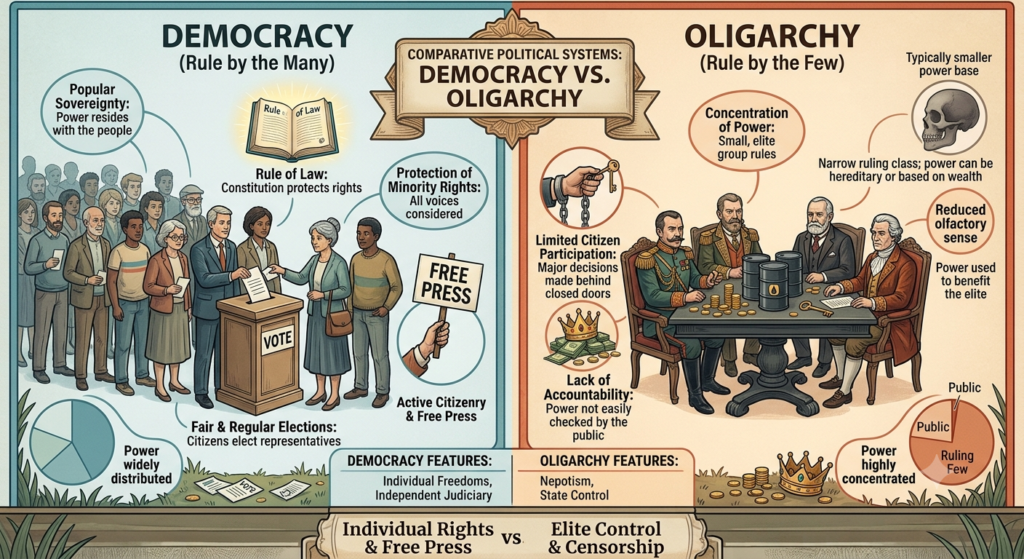
What Is Democracy?
Democracy is a form of government in which political authority is based on the participation and consent of the people. Citizens can influence government through voting, elections, public discussion, political organizations, and other forms of civic participation.
The word democracy comes from the Greek terms demos, meaning people, and kratos, meaning rule or power. In modern democratic systems, citizens commonly elect representatives who make laws and public policies on their behalf.
Democracy can take different forms. In a direct democracy, citizens participate more directly in making particular decisions. In a representative democracy, people elect officials to exercise governmental authority.
Characteristics of Democracy
Important characteristics of democracy include:
- Regular elections.
- Citizen participation.
- Political competition.
- Representation of different interests.
- Equality before the law.
- Protection of fundamental rights.
- Freedom of political expression.
- Government accountability.
- Constitutional or legal limits on government power.
- Peaceful transfer of political authority.
A democratic system does not simply mean that every decision is made by majority vote. Modern democracies commonly combine majority decision-making with legal protections for individual and minority rights.
What Is Oligarchy?
Oligarchy is a form of government in which political power is controlled by a relatively small group of individuals. This group may gain influence through wealth, military authority, family connections, social status, political position, or control over important institutions.
The term oligarchy comes from the Greek word oligos, meaning few, and refers to rule by a limited number of people.
An oligarchic system can take different forms. The ruling group may consist of wealthy individuals, military leaders, influential families, political elites, or other powerful groups.
Characteristics of Oligarchy
Common characteristics of oligarchy include:
- Political power concentrated in a small group.
- Limited participation by the wider population.
- Strong influence of elites.
- Unequal access to political power.
- Limited competition for leadership in some systems.
- Decision-making dominated by a select group.
- Potential concentration of economic and political influence.
- Reduced influence of ordinary citizens.
Oligarchy does not necessarily mean that only a few people hold formal government positions. A society may also display oligarchic characteristics when a small group has disproportionate influence over major political decisions.
Democracy vs. Oligarchy: Key Differences
1. Distribution of Political Power
The most important difference in Democracy vs. Oligarchy is how political power is distributed.
In a democracy, political authority is ultimately connected to the citizens. People exercise this authority directly or through elected representatives.
In an oligarchy, substantial political influence is concentrated within a small group. The broader population may have considerably less influence over important decisions.
2. Citizen Participation
Democracy encourages citizens to participate in political life. Voting, campaigning, public debate, petitions, and civic organizations can provide opportunities for people to influence government.
Oligarchic systems generally provide fewer meaningful opportunities for the wider population to influence major decisions. Political participation may remain concentrated among members of the ruling group.
3. Leadership Selection
Democratic governments generally use elections or other participatory procedures to select political leaders. Citizens have an opportunity to choose between candidates or political parties.
In an oligarchy, leadership may be determined primarily within the powerful group. Wealth, family background, military authority, or political connections can influence access to leadership.
4. Representation
Democracy aims to provide representation for different sections of society. Political parties, elected representatives, and civic organizations can bring competing interests into the political process.
Oligarchy tends to give greater political influence to the interests of the ruling minority. As a result, the concerns of less powerful groups may receive less attention.
5. Accountability
Accountability is an important feature of democratic government. Citizens can evaluate elected leaders through elections, while courts, legislatures, constitutions, and other institutions can place limits on government authority.
In an oligarchy, accountability may be weaker when the same small group controls important political institutions. The ability of ordinary citizens to challenge those in power can therefore be more limited.
6. Political Equality
Democracy is generally based on the principle that citizens should have equal political rights. In electoral systems, this commonly includes equal voting rights subject to the applicable laws.
Oligarchy can produce greater differences in political influence. A small group may have substantially more power than the majority of the population.
7. Decision-Making
Democratic decision-making can take more time because it may involve elections, legislative debate, public consultation, judicial review, and negotiation among different political interests.
An oligarchy can sometimes make decisions more quickly because fewer people are involved in the process. However, faster decision-making does not necessarily mean that decisions represent the interests of the wider population.
8. Protection of Rights
Democratic systems commonly use constitutions, laws, courts, and independent institutions to protect individual rights and limit government power.
In an oligarchic system, the protection of rights can depend heavily on the institutions and practices established by the ruling group. Concentrated power can create a greater risk of political exclusion or suppression of opposition.
9. Transfer of Power
Democracy generally provides established mechanisms for changing leaders. Elections allow citizens to replace representatives without requiring a complete change in the political system.
In an oligarchy, power can remain within the same group for long periods. Leadership changes may occur internally rather than through broad public participation.
10. Influence of Wealth and Social Status
Democratic principles emphasize political equality even when citizens differ in income, occupation, or social position.
Oligarchic systems can develop when economic wealth, social status, family connections, or control of important resources translates into political influence. This can create a close relationship between economic and political power.
Similarities Between Democracy and Oligarchy
Although Democracy vs. Oligarchy focuses on contrasting forms of government, the two systems also share some characteristics.
Both:
- Involve organized political authority.
- Have institutions responsible for making and enforcing decisions.
- Establish rules for governing society.
- Require leadership and administration.
- Can create laws and public policies.
- May contain different political factions or interest groups.
- Can exist in different historical and cultural settings.
- Can change over time because of political, social, or economic developments.
The major distinction is not whether power exists, but who has the greatest influence over that power and how that influence is exercised.
Advantages and Disadvantages of Democracy
Advantages of Democracy
Democracy can provide several important benefits:
- Encourages citizen participation.
- Provides mechanisms for choosing leaders.
- Promotes political representation.
- Allows peaceful changes in government.
- Supports political competition.
- Can strengthen government accountability.
- Provides institutional protections for rights and freedoms.
- Allows different social interests to be represented.
Disadvantages of Democracy
Democratic government can also face challenges:
- Decision-making may be slower.
- Political disagreements can create gridlock.
- Elections can encourage short-term political strategies.
- Voters may have limited information about complex issues.
- Political polarization can make compromise difficult.
- Majority preferences can create tensions with minority interests if legal safeguards are weak.
Advantages and Disadvantages of Oligarchy
Advantages of Oligarchy
A highly centralized political structure can sometimes provide:
- Faster decision-making.
- Consistent policies when leadership remains stable.
- Greater control over government administration.
- Less political competition within the ruling group.
- A relatively streamlined decision-making process.
These potential advantages depend heavily on how the ruling group exercises its authority.
Disadvantages of Oligarchy
Oligarchy can also create significant problems:
- Political participation may be restricted.
- Power can become concentrated.
- Ordinary citizens may have limited influence.
- Wealth and political authority can reinforce each other.
- Opposition may face greater barriers.
- Government policies may favor elite interests.
- Leadership can become resistant to political change.
- Social and economic inequalities may increase.
Democracy vs. Oligarchy in Political Science
In political science, Democracy vs. Oligarchy can be understood primarily as a comparison of how political power is distributed.
Democracy emphasizes the participation of the broader citizenry, usually through institutions such as elections and representative government. Oligarchy focuses on the concentration of effective political power within a relatively small group.
It is also important to recognize that real-world political systems do not always fit perfectly into one category. A country may have democratic institutions while certain wealthy, political, military, or business groups exercise disproportionate influence.
Therefore, political systems are often studied by examining both their formal institutions and the actual distribution of power.
Democracy vs. Oligarchy: Which Is Better?
There is no single answer that applies to every historical or political situation, but democracy is generally associated with broader political participation, representative government, accountability, and political equality.
Oligarchy can make decisions more quickly because authority is concentrated among fewer people. However, concentrating political power can reduce public participation and create opportunities for elite interests to dominate government decisions.
The comparison therefore depends on the values being considered. If broad participation, political equality, representation, and accountability are priorities, democratic government generally aligns more closely with those principles.
Conclusion
The main difference in Democracy vs. Oligarchy is the distribution of political power. Democracy gives citizens a meaningful role in selecting leaders and influencing government, while oligarchy concentrates substantial authority within a small group.
Democratic systems emphasize participation, representation, political equality, and accountability. Oligarchic systems, by contrast, are characterized by concentrated political influence and limited control by the wider population.
Both forms of government involve leadership, institutions, rules, and decision-making. The key distinction is whether political power is broadly connected to the population or primarily controlled by a small group.
Frequently Asked Questions
The main difference is who controls political power. Democracy gives citizens a significant role in government, usually through voting and representation, while oligarchy concentrates political power within a small group.
Democracy is a system of government in which people have a role in choosing leaders and influencing public decisions. Representative democracy commonly allows citizens to elect officials who govern on their behalf.
An oligarchy is a system in which political power is controlled by a small group of people. The group may gain influence through wealth, family connections, military authority, social status, or political power.
They represent contrasting approaches to the distribution of political power, but the relationship is more nuanced than simply being exact opposites. Democracy emphasizes broad citizen participation, while oligarchy emphasizes concentrated control by a small group.
Yes. A country can maintain democratic institutions such as elections while a relatively small group of wealthy, political, or influential individuals has disproportionate influence over public policy. Political scientists may examine this concentration of influence when assessing the quality of democratic participation.
Read Next: