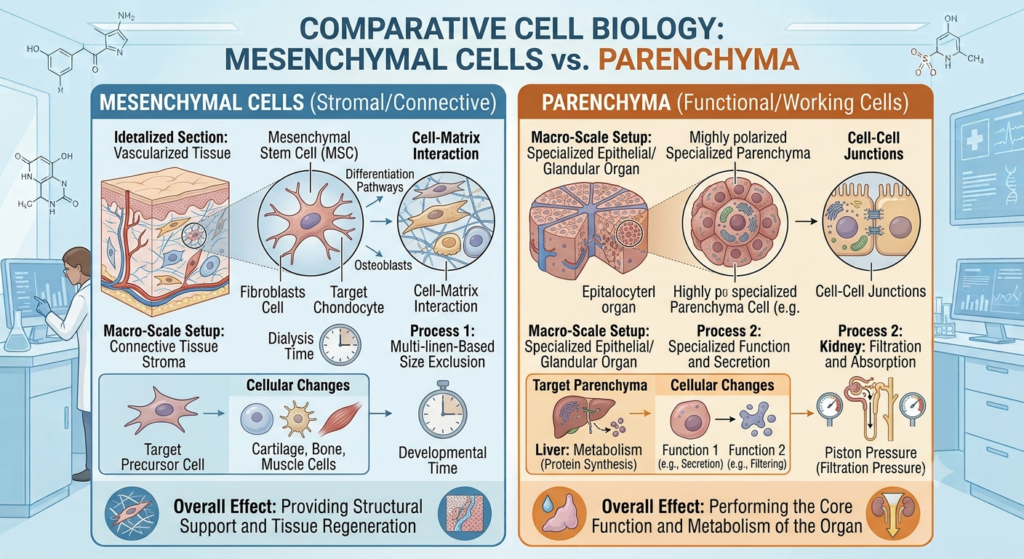
The main difference between Mesenchymal Cells vs. Parenchyma is their biological role and organization within tissues. Mesenchymal cells are cells associated with connective tissues and stromal compartments, where they can contribute to tissue support, extracellular-matrix organization, repair, and remodeling. Parenchyma, on the other hand, refers to the functional tissue of an organ, consisting of cells that perform the organ’s primary physiological functions.
Understanding Mesenchymal Cells vs. Parenchyma is important in histology, anatomy, cell biology, pathology, regenerative medicine, and developmental biology. Mesenchymal cells contribute to connective-tissue organization and tissue maintenance, while parenchymal cells carry out specialized functions such as metabolism in the liver, gas exchange in the lungs, and secretion in glandular tissues.
Mesenchymal Cells vs. Parenchyma Comparison Table
The table below highlights the major differences between Mesenchymal Cells vs. Parenchyma.
| Feature | Mesenchymal Cells | Parenchyma |
| Definition | Cells associated with mesenchymal connective tissue and stromal compartments | Functional cells or tissue of an organ |
| Basic Role | Structural support, tissue maintenance, repair, and stromal functions | Performs the primary function of an organ |
| Cell Type | Includes stromal cells and, in some contexts, mesenchymal stem/stromal cells | Usually differentiated, organ-specific cells |
| Differentiation Potential | Some mesenchymal stromal cells have multipotent differentiation potential | Generally specialized for a particular organ function |
| Typical Location | Connective tissues, bone marrow stroma, adipose tissue, and other stromal environments | Functional regions of organs |
| Morphology | Often spindle-shaped or fibroblast-like | Varies according to the organ |
| Main Function | Support, repair, matrix production, and regulation of the tissue environment | Carries out the organ’s principal physiological function |
| Extracellular Matrix | Closely associated with and can contribute to extracellular matrix | Relationship with matrix varies according to the organ |
| Examples | Fibroblasts, mesenchymal stromal cells, and other stromal cells | Hepatocytes, renal tubular cells, alveolar epithelial cells, and acinar cells |
| Tissue Relationship | Often associated with supporting or stromal components | Forms the functional component of an organ |
| Regenerative Role | Can contribute to repair and tissue remodeling | Regenerative ability varies among organs and cell types |
| Primary Concept | Connective-tissue or stromal cell population | Functional organ tissue |
What Are Mesenchymal Cells?
Mesenchymal cells are cells associated with mesenchymal connective tissues and stromal compartments. The term can refer broadly to cells of mesenchymal origin, while mesenchymal stromal cells (MSCs) describe a more specific population studied for their supportive, immunomodulatory, and tissue-repair properties.
Mesenchymal cells are commonly associated with connective tissues and the extracellular matrix. Depending on the specific cell population, they can contribute to tissues such as bone, cartilage, adipose tissue, and fibrous connective tissue.
Some mesenchymal stromal cells have the ability to differentiate toward several connective-tissue lineages under appropriate experimental or physiological conditions. This property has made them important subjects in regenerative medicine and tissue engineering.
Characteristics of Mesenchymal Cells
Some important characteristics of mesenchymal cells include:
- They are associated with connective tissues and stromal compartments.
- They often have a spindle-shaped or fibroblast-like appearance.
- They interact extensively with the extracellular matrix.
- They participate in tissue support and remodeling.
- Some mesenchymal stromal cells have multipotent differentiation potential.
- They can contribute to tissue repair processes.
- They produce or modify components of the extracellular matrix.
- They communicate with neighboring cells through signaling molecules.
- Some populations can influence local inflammatory and immune responses.
- They are widely studied in regenerative medicine.
Examples of Mesenchymal Cells
Examples of cells associated with the mesenchymal compartment include:
- Fibroblasts.
- Mesenchymal stromal cells.
- Osteoblast-lineage cells.
- Chondrocyte-lineage cells.
- Adipocyte-lineage cells.
- Other connective-tissue stromal cells.
It is important to distinguish mesenchymal cells as a broad biological category from mesenchymal stem/stromal cells, which represent a particular population with defined experimental characteristics.
What Is Parenchyma?
Parenchyma refers to the functional tissue of an organ. Parenchymal cells are the cells that perform the organ’s principal specialized functions.
The meaning of parenchyma depends on the organ being discussed. For example, hepatocytes are the major functional parenchymal cells of the liver, where they perform metabolic, synthetic, and detoxification functions.
In the kidney, specialized cells of the nephron form part of the functional tissue responsible for filtration and regulation of water and solute balance. In the lungs, alveolar epithelial cells are part of the parenchyma involved in gas exchange.
Parenchyma is generally distinguished from the stroma, which provides structural support through connective tissue, blood vessels, nerves, extracellular matrix, and associated supporting cells.
Characteristics of Parenchyma
Important characteristics of parenchyma include:
- It represents the functional component of an organ.
- It contains specialized cells.
- It performs organ-specific physiological functions.
- Its structure varies depending on the organ.
- It is supported by stromal tissue and blood vessels.
- It can consist of different specialized cell types depending on the organ.
- Its structure is adapted to its particular function.
- It participates directly in the primary activity of the organ.
- Its regenerative capacity varies among different organs.
- It is an important concept in anatomy, histology, and pathology.
Examples of Parenchyma
Examples of parenchymal cells or tissues include:
- Hepatocytes in the liver.
- Alveolar epithelial cells in the lungs.
- Renal tubular epithelial cells in the kidneys.
- Pancreatic acinar cells.
- Endocrine cells of pancreatic islets.
- Specialized functional cells in other organs.
Mesenchymal Cells vs. Parenchyma: Key Differences
1. Basic Definition
The most important difference between Mesenchymal Cells vs. Parenchyma is what each term describes.
Mesenchymal cells are cells associated with mesenchymal connective tissue and stromal environments.
Parenchyma refers to the functional tissue of an organ.
Thus, mesenchymal cells are generally discussed as a cellular population, whereas parenchyma describes the functional component of an organ.
2. Biological Role
Mesenchymal cells generally contribute to tissue support, extracellular-matrix production, repair, remodeling, and communication within the tissue environment.
Parenchymal cells perform the primary physiological function of the organ.
For example, hepatocytes carry out many of the liver’s metabolic functions, while stromal cells help provide the supporting environment around the functional tissue.
Thus, mesenchymal cells are commonly associated with support and tissue organization, while parenchymal cells are associated with specialized organ function.
3. Differentiation Potential
Some mesenchymal stromal cell populations can differentiate toward multiple connective-tissue lineages under appropriate conditions.
For example, certain mesenchymal stromal cells can be induced to develop osteogenic, chondrogenic, or adipogenic characteristics.
Parenchymal cells are generally more specialized and differentiated.
However, this does not mean that all parenchymal cells lack regenerative capacity. Certain organs contain mature cells that can proliferate and participate in tissue repair.
4. Location
Mesenchymal cells are commonly found in connective tissues and stromal compartments.
They may be present in:
- Bone marrow.
- Adipose tissue.
- Fibrous connective tissue.
- Perivascular environments.
- Other connective-tissue compartments.
Parenchymal cells are located in the functional regions of organs.
For example, hepatocytes form much of the functional parenchyma of the liver, while alveolar epithelial cells form an important part of the lung parenchyma.
5. Morphology
Mesenchymal cells, particularly fibroblast-like stromal cells, commonly have an elongated, spindle-shaped morphology.
Their shape allows them to interact with the extracellular matrix and surrounding cells.
Parenchymal cell morphology varies considerably because it is adapted to the specific function of each organ.
For example, hepatocytes are generally polygonal, whereas alveolar epithelial cells can be extremely thin to facilitate gas exchange.
Therefore, mesenchymal cells often have a fibroblast-like appearance, while parenchymal cells have organ-specific shapes.
6. Relationship With Extracellular Matrix
Mesenchymal cells have a close relationship with the extracellular matrix (ECM).
Fibroblasts, for example, synthesize important components of connective tissue matrix, including collagen and other matrix molecules.
Parenchymal cells can also interact with and produce extracellular matrix components, but their defining feature is their specialized organ function rather than their role in forming connective-tissue stroma.
7. Role in Tissue Repair
Mesenchymal cells can participate in tissue repair by producing signaling molecules, modifying the extracellular matrix, and interacting with immune and neighboring cells.
Some mesenchymal stromal cells are being investigated for their potential applications in regenerative medicine.
Parenchymal cells are also important in tissue repair because they may proliferate or regenerate functional tissue after injury, depending on the organ.
Therefore, both cell populations can contribute to tissue repair, but their mechanisms and roles are different.
8. Relationship With Stroma
Mesenchymal cells are often associated with stromal tissue.
Stroma provides structural and biochemical support for the functional tissue of an organ.
Parenchyma, in contrast, represents the functional component that performs the organ’s main activities.
For example, an organ can broadly be understood as having:
- Functional parenchymal tissue.
- Supporting stromal tissue.
- Blood vessels and nerves.
- Extracellular matrix.
Mesenchymal-type cells can form part of the stromal environment.
9. Organ-Specific Function
Mesenchymal cells generally do not define the primary function of an organ. Instead, they contribute to tissue organization, matrix maintenance, repair, and signaling.
Parenchymal cells are specifically adapted to the function of the organ.
Examples include:
- Liver: Hepatocytes perform metabolic and synthetic functions.
- Lung: Alveolar cells participate in gas exchange.
- Pancreas: Acinar cells produce digestive enzymes.
- Kidney: Nephron cells participate in filtration and solute handling.
This organ-specific specialization is a defining characteristic of parenchyma.
10. Terminology
Another important difference is that mesenchymal cells and parenchyma are not equivalent classifications.
Mesenchymal cells describe a cellular category associated with mesenchymal tissue and stromal environments.
Parenchyma describes a functional component of an organ or tissue.
Therefore, the comparison involves two different biological concepts rather than two directly equivalent cell types.
Mesenchymal Cells vs. Parenchyma in an Organ
The relationship becomes easier to understand when considering an organ containing both parenchymal and stromal components.
For example, the liver contains functional parenchymal cells such as hepatocytes as well as supporting stromal components that include connective tissue, extracellular matrix, blood vessels, and associated stromal cells.
Mesenchymal-type stromal cells can contribute to the supporting environment, while hepatocytes perform many of the liver’s primary functions.
This organization is common throughout the body. Functional cells carry out the main activities of an organ, while supporting cells and tissues create an environment that helps those cells function properly.
Mesenchymal Cells vs. Parenchyma in Regenerative Medicine
Mesenchymal cells, particularly mesenchymal stromal cells, have received considerable attention in regenerative medicine.
Researchers study them because of their ability to interact with damaged tissues, release signaling molecules, influence immune responses, and, under appropriate conditions, differentiate toward connective-tissue lineages.
Parenchymal cells are also central to regenerative medicine because successful tissue repair ultimately requires restoration of the organ’s functional cells.
For example, repairing damaged liver tissue requires restoration or replacement of functional hepatocytes, while repairing connective tissue may involve cells associated with mesenchymal lineages.
Therefore, regenerative medicine often considers both the functional parenchyma and the supporting stromal environment.
Similarities Between Mesenchymal Cells and Parenchyma
Although Mesenchymal Cells vs. Parenchyma refers to different biological concepts, they share several similarities.
Some major similarities include:
- Both are components of living tissues.
- Both contribute to tissue homeostasis.
- Both interact with neighboring cells.
- Both can respond to tissue injury.
- Both communicate through cellular signaling.
- Both depend on an appropriate extracellular environment.
- Both can participate in tissue remodeling.
- Both are important subjects in histology and pathology.
- Both can be involved in regenerative processes.
- Both contribute to normal tissue function.
Mesenchymal Cells vs. Parenchyma: Functional Comparison
| Function | Mesenchymal Cells | Parenchymal Cells |
| Tissue support | Often an important role | Usually not the primary role |
| Extracellular matrix production | Often important | Varies by cell type |
| Organ-specific function | Generally not the primary role | Primary role |
| Tissue repair | Can support repair and remodeling | May directly regenerate functional tissue |
| Cell signaling | Important | Important |
| Differentiation | Some populations have multipotent potential | Generally specialized |
| Immune interaction | Some stromal populations have important immunomodulatory effects | Depends on organ and cell type |
| Structural organization | Often contributes to stromal organization | Organized according to organ function |
| Regenerative medicine | Widely studied | Essential for restoring organ function |
Are Mesenchymal Cells the Same as Parenchymal Cells?
No. Mesenchymal cells and parenchymal cells are not the same.
Mesenchymal cells are associated with connective tissue and stromal environments, whereas parenchymal cells are the functional cells of an organ.
For example, fibroblast-like stromal cells can be part of the supporting mesenchymal environment, while hepatocytes represent the functional parenchyma of the liver.
The two populations can interact closely, but they have different biological roles.
Mesenchymal Cells vs. Parenchyma: Easy Way to Remember
A simple way to remember the distinction is to think of an organ as a workplace.
The parenchyma consists of the functional cells that perform the main work of the organ.
The mesenchymal and stromal components contribute to the supporting environment, extracellular matrix, tissue organization, and repair processes.
For example, in the liver, hepatocytes perform many of the organ’s primary functions, while stromal cells and connective-tissue components provide structural and biochemical support.
Why Are Mesenchymal Cells and Parenchyma Important?
Understanding the distinction between mesenchymal cells and parenchyma is useful for studying:
- Histology.
- Anatomy.
- Cell biology.
- Developmental biology.
- Pathology.
- Tissue repair.
- Regenerative medicine.
- Cancer biology.
- Organ transplantation.
- Tissue engineering.
Many diseases involve interactions between functional parenchymal cells and their surrounding stromal environment. Understanding both components therefore provides a more complete picture of normal tissue function and disease.
Mesenchymal Cells vs. Parenchyma: Summary
| Mesenchymal Cells | Parenchyma |
| Associated with mesenchymal connective tissue and stromal compartments | Represents the functional tissue of an organ |
| Often involved in tissue support and remodeling | Performs the primary function of the organ |
| Some populations have multipotent differentiation potential | Generally specialized and differentiated |
| Often fibroblast-like in appearance | Morphology varies according to the organ |
| Closely associated with extracellular matrix | Organized according to organ-specific function |
| Can contribute to tissue repair | Can restore or perform organ function |
| Includes stromal cell populations | Includes specialized organ cells |
| Important in regenerative medicine | Essential for functional organ regeneration |
Conclusion
The main difference between Mesenchymal Cells vs. Parenchyma is their biological role and organization within tissues. Mesenchymal cells are associated with connective-tissue and stromal compartments and can contribute to extracellular-matrix organization, tissue support, repair, remodeling, and cellular signaling. Some mesenchymal stromal cell populations also have multipotent differentiation potential.
Parenchyma, in contrast, refers to the functional tissue of an organ. Its cells are specialized to perform the organ’s primary physiological functions. Hepatocytes in the liver, alveolar epithelial cells in the lungs, and pancreatic acinar cells are examples of cells that form or contribute to organ parenchyma.
The simplest distinction is that mesenchymal cells are primarily associated with connective-tissue and stromal functions, whereas parenchyma represents the functional component of an organ. Understanding this relationship is important in histology, pathology, regenerative medicine, and the study of normal and diseased tissues.
Frequently Asked Questions (FAQs)
The main difference between Mesenchymal Cells vs. Parenchyma is their role. Mesenchymal cells are associated with connective tissue and stromal environments, while parenchyma refers to the functional tissue that performs the primary functions of an organ.
Some cells referred to as mesenchymal stem/stromal cells (MSCs) have multipotent differentiation potential. However, the broader term “mesenchymal cells” can refer to several types of connective-tissue-associated cells and should not automatically be treated as synonymous with stem cells.
The liver parenchyma, which is largely composed of hepatocytes, is a common example. Hepatocytes perform many of the liver’s major metabolic and synthetic functions.
Mesenchymal-type cells can form an important part of the stromal compartment of many tissues. The stroma provides structural and biochemical support for the functional parenchyma.
Yes. Mesenchymal stromal cells and other mesenchymal cells can participate in tissue repair through extracellular-matrix remodeling, cellular signaling, and interactions with immune and neighboring cells. Their regenerative properties continue to be studied in tissue engineering and regenerative medicine.
Reference:
1.Editors. “Parenchyma Cells (Plant): Definition, Function, Structure.” Biology Dictionary, Biology Dictionary, 20 June 2018
2.“Eurostemcell.” Mesenchymal Stem Cells: The ‘Other’ Bone Marrow Stem Cells, 5 Nov. 2015
Read Next: