The main difference between Haplorhini vs. Strepsirhini is their anatomy, sensory adaptations, and major groups. Haplorhini includes tarsiers, monkeys, apes, and humans, while Strepsirhini includes lemurs, lorises, and galagos.
Both groups belong to the order Primates and share several important features, such as grasping hands, forward-facing eyes, and relatively large brains. However, they differ in characteristics such as nose structure, dental adaptations, brain development, and reliance on smell and vision.
Understanding Haplorhini vs. Strepsirhini is useful in zoology, biology, anthropology, anatomy, and evolutionary studies. These two groups demonstrate how different adaptations have developed within the primate lineage.
Haplorhini vs. Strepsirhini Comparison Table
The following table summarizes the major differences between Haplorhini vs. Strepsirhini.
| Feature | Haplorhini | Strepsirrhini |
| Common Name | Dry-nosed primates | Wet-nosed primates |
| Major Groups | Tarsiers, monkeys, apes, humans | Lemurs, lorises, galagos |
| Nose | Usually dry and covered with skin or hair | Usually has a moist rhinarium |
| Sense of Smell | Generally less dominant | Generally more important |
| Vision | Highly developed | Well developed, with many nocturnal adaptations |
| Brain | Relatively larger | Generally smaller relative to body size |
| Activity Pattern | Many species are diurnal | Many species are nocturnal |
| Toothcomb | Generally absent | Present in many members |
| Grooming Claw | Generally absent | Present in many strepsirrhines |
| Habitat | Arboreal and terrestrial | Mostly arboreal |
| Examples | Humans, chimpanzees, macaques, marmosets, tarsiers | Lemurs, lorises, galagos |
| Main Sensory Emphasis | Vision | Smell and vision |
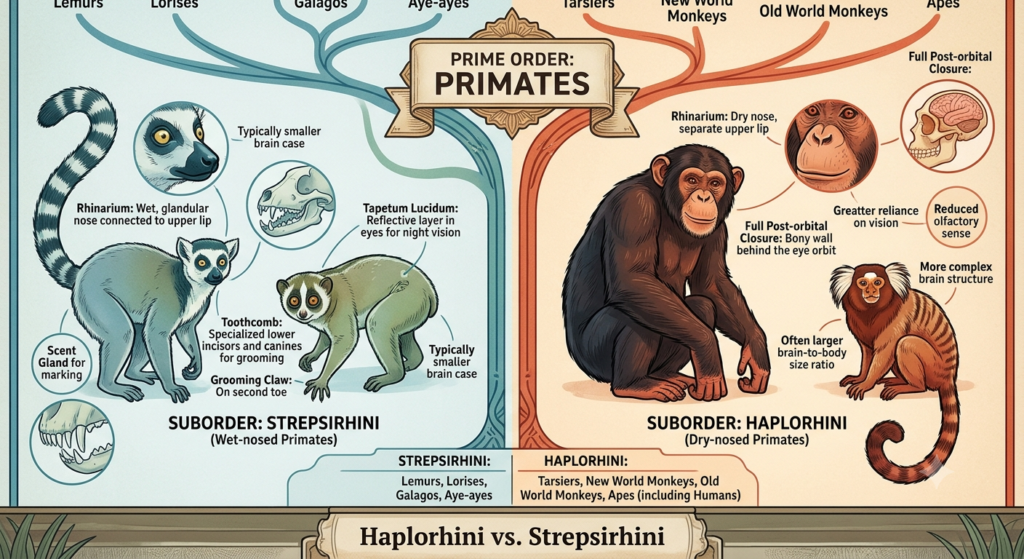
What Is Haplorhini?
Haplorhini is a major primate group that includes tarsiers, monkeys, apes, and humans. The name is associated with the characteristic dry appearance of the nose compared with the moist rhinarium found in strepsirrhines.
Haplorhines generally depend strongly on vision. Their eyes are positioned toward the front of the head, which provides substantial overlap between the visual fields of both eyes.
This arrangement supports binocular vision and depth perception. These abilities are particularly useful for animals that move through complex environments such as trees.
Characteristics of Haplorhini
Important characteristics of haplorhines include:
- Include tarsiers, monkeys, apes, and humans.
- Generally have a dry nose.
- Depend strongly on visual information.
- Usually have forward-facing eyes.
- Have well-developed binocular vision.
- Generally have relatively large brains.
- Do not typically possess a toothcomb.
- Many species have complex social behavior.
- Some species are primarily arboreal.
- Others, including humans, are strongly terrestrial.
- Many species are active during the daytime.
Examples of Haplorhini
Examples of haplorhines include:
- Humans
- Chimpanzees
- Gorillas
- Orangutans
- Gibbons
- Macaques
- Baboons
- Marmosets
- Capuchin monkeys
- Tarsiers
These animals represent considerable diversity in body size, habitat, diet, locomotion, and social behavior.
What Is Strepsirhini?
Strepsirhini, more commonly written Strepsirrhini, is the primate group that includes lemurs, lorises, and galagos. Many members are characterized by a moist area around the nostrils called the rhinarium.
Strepsirrhines generally have a stronger reliance on their sense of smell than haplorhines. Chemical signals and scent marking are important forms of communication in many species.
Many strepsirrhines are also adapted to nocturnal activity. Their eyes and other sensory systems can help them locate food and navigate during periods of low light.
Characteristics of Strepsirhini
Important characteristics of strepsirrhines include:
- Include lemurs, lorises, and galagos.
- Usually have a moist rhinarium.
- Often rely strongly on their sense of smell.
- Many species are nocturnal.
- Many species are adapted for life in trees.
- Often have relatively smaller brains than haplorhines.
- Many possess a specialized toothcomb.
- Some have a grooming claw on the hind foot.
- Use scent marking for communication.
- Have adaptations for climbing and leaping.
- Often depend on both smell and vision.
Examples of Strepsirhini
Common examples include:
- Ring-tailed lemurs
- Mouse lemurs
- Sifakas
- Slow lorises
- Slender lorises
- Galagos
- Bushbabies
Most living strepsirrhine diversity is associated with Africa, Madagascar, and parts of Asia.
Haplorhini vs. Strepsirhini: Key Differences
1. Nose Structure
One of the easiest ways to distinguish Haplorhini vs. Strepsirhini is by examining the nose.
Haplorhines generally have a dry nose without a prominent rhinarium. Strepsirrhines typically have a moist rhinarium surrounding the nostrils.
This difference is also reflected in the common descriptions dry-nosed and wet-nosed primates.
2. Sense of Smell
The two groups differ in their reliance on olfactory information.
Haplorhines generally have a reduced dependence on smell and place greater emphasis on vision. Strepsirrhines often have a more developed olfactory system and use scent for communication and environmental information.
This does not mean that haplorhines cannot smell or that strepsirrhines have poor vision. Instead, the relative importance of these senses differs between the two groups.
3. Vision
Vision is particularly important among haplorhines.
Their forward-facing eyes provide overlapping visual fields that support binocular vision and depth perception. Strepsirrhines also have good vision, and many nocturnal species possess adaptations that improve their ability to see in low-light conditions.
4. Brain Size
Brain structure and relative brain size are another distinction in Haplorhini vs. Strepsirhini.
Haplorhines generally have larger brains relative to body size than strepsirrhines. This is especially evident in apes and humans, which have highly developed brains associated with complex learning and behavior.
However, brain size alone does not determine intelligence or behavioral complexity across all species.
5. Activity Pattern
Many haplorhines are diurnal, meaning they are primarily active during daylight hours.
A large number of strepsirrhines are nocturnal. However, this is not an absolute distinction because some strepsirrhine species are active during the day or have flexible activity patterns.
6. Toothcomb
A specialized dental structure called a toothcomb is characteristic of many strepsirrhines.
It is formed by closely positioned lower incisors and canine teeth and has important roles in grooming and food-related activities. Haplorhines generally lack this specialized toothcomb.
7. Grooming Claw
Many strepsirrhines possess a specialized claw on the second toe of the hind foot. This structure is commonly called a grooming claw and helps with personal grooming.
Haplorhines generally do not have this same specialized grooming adaptation.
8. Habitat
Both groups contain species that spend substantial time in trees.
Strepsirrhines are predominantly associated with arboreal environments, particularly forests. Haplorhines are more diverse in their habitat use and include arboreal species as well as terrestrial animals.
Humans are an especially clear example of a highly terrestrial haplorhine.
9. Communication
Communication also differs between the two groups.
Many strepsirrhines make extensive use of scent marking and other chemical signals. Haplorhines generally rely more heavily on visual signals, vocalizations, facial expressions, and social interactions.
The exact communication system varies considerably among species.
10. Social Behavior
Haplorhines often display complex social behavior. Many monkeys and apes live in groups with sophisticated social relationships and communication systems.
Strepsirrhine social organization is more varied. Some species live in relatively solitary patterns, while others form stable social groups.
Therefore, neither group can be described as uniformly social or solitary.
Haplorhini vs. Strepsirhini: Evolutionary Difference
Haplorhini and Strepsirhini represent two major branches of living primates. Their evolutionary histories reflect different adaptations to environmental conditions and ecological lifestyles.
Strepsirrhines retain several ancestral primate characteristics, including a strong reliance on olfaction and specialized structures associated with grooming. Haplorhines show greater emphasis on visual processing and include the lineage leading to monkeys, apes, and humans.
The distinction is useful for understanding primate evolution, although modern primate classification is based on evolutionary relationships rather than simply dividing species into “lower” and “higher” primates.
Similarities Between Haplorhini and Strepsirhini
Despite their differences, both groups share many important primate characteristics.
Both Haplorhini and Strepsirhini:
- Belong to the order Primates.
- Are mammals.
- Have relatively flexible hands and feet.
- Possess five digits on the hands and feet.
- Generally have nails rather than claws.
- Have forward-oriented eyes.
- Possess binocular vision.
- Have relatively large brains compared with many other mammals.
- Can grasp objects with their hands and feet.
- Include many arboreal species.
- Have complex sensory systems.
- Show extended periods of development compared with many other mammals.
These similarities reflect their shared evolutionary history as primates.
Haplorhini vs. Strepsirhini in Primates
The distinction between these two groups is especially useful when studying primate classification.
Haplorhini contains tarsiers, monkeys, apes, and humans. It therefore includes some of the most familiar primates and encompasses both New World and Old World monkeys.
Strepsirhini includes lemurs, lorises, and galagos. Many of these animals are adapted to nocturnal life and have sensory characteristics associated with increased olfactory communication.
Together, these groups demonstrate the broad diversity found within the primate order.
Why Are Haplorhini and Strepsirhini Important?
Studying Haplorhini vs. Strepsirhini helps explain how primates evolved different anatomical and behavioral adaptations.
Haplorhines demonstrate strong visual specialization, complex social behavior, and diverse forms of locomotion. Strepsirrhines demonstrate the importance of olfaction, nocturnal adaptations, grooming structures, and specialized ecological strategies.
Comparing the two groups also helps students understand the relationship between anatomy, behavior, habitat, and evolution.
Conclusion
The comparison of Haplorhini vs. Strepsirhini highlights two major groups within the primate order. Haplorhini includes tarsiers, monkeys, apes, and humans, while Strepsirhini includes lemurs, lorises, and galagos.
Haplorhines generally have dry noses, strong visual adaptations, relatively larger brains, and greater reliance on visual communication. Strepsirrhines typically have moist rhinariums, stronger olfactory adaptations, and several specialized features such as the toothcomb and grooming claw.
Both groups share important primate characteristics, including grasping abilities, binocular vision, relatively large brains, and complex sensory systems. Their differences provide valuable insight into primate evolution and adaptation.
The easiest distinction to remember is that Haplorhini are generally dry-nosed primates with greater emphasis on vision, while Strepsirhini are generally wet-nosed primates with a stronger reliance on smell.
Frequently Asked Questions (FAQs)
The main difference between Haplorhini vs. Strepsirhini is their anatomical and sensory adaptations. Haplorhines generally have dry noses and rely more heavily on vision, while strepsirrhines usually have moist rhinariums and stronger olfactory adaptations.
Haplorhini includes tarsiers, New World monkeys, Old World monkeys, apes, and humans. These groups represent a large and diverse branch of the primate order.
Strepsirhini includes lemurs, lorises, and galagos. Most living members are associated with arboreal habitats, although their lifestyles vary among species.
Many strepsirrhines have a specialized toothcomb formed by modified lower front teeth. It is associated with grooming and can also have roles in food processing.
Yes. Both Haplorhini and Strepsirhini are major groups within the order Primates. They share a common evolutionary history but have developed different anatomical, sensory, and behavioral adaptations.
Reference:
1.“Order Primates.” Hylobatidae : Gibbons and Siamangs
Read Next: