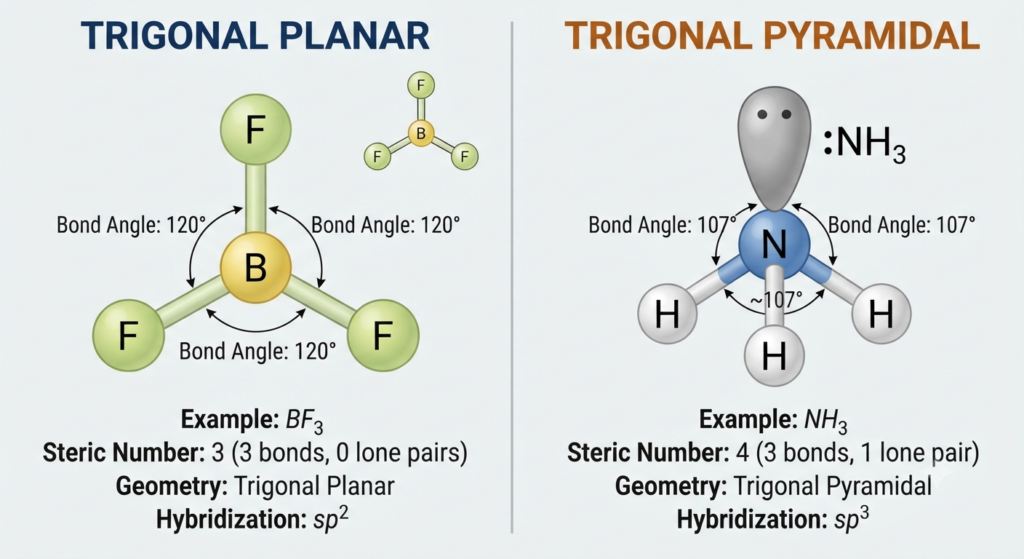
The main difference between Trigonal Planar vs. Trigonal Pyramidal is that trigonal planar geometry consists of three bonding pairs and no lone pair on the central atom, producing a flat, symmetrical molecular shape with 120° bond angles. In contrast, trigonal pyramidal geometry contains three bonding pairs and one lone pair, resulting in a three-dimensional pyramid-shaped molecule with bond angles of approximately 107°.
Understanding Trigonal Planar vs. Trigonal Pyramidal is essential in chemistry because molecular geometry determines a compound’s polarity, chemical reactivity, intermolecular forces, and physical properties. These geometries are predicted using the Valence Shell Electron Pair Repulsion (VSEPR) theory, which explains how electron pairs arrange themselves to minimize repulsion.
Trigonal Planar vs. Trigonal Pyramidal Comparison Table
The table below summarizes the major differences between Trigonal Planar vs. Trigonal Pyramidal.
| Feature | Trigonal Planar | Trigonal Pyramidal |
|---|---|---|
| Molecular Shape | Flat triangular | Pyramid-shaped |
| Geometry | Two-dimensional | Three-dimensional |
| Electron Geometry | Trigonal planar | Tetrahedral |
| Bonding Pairs | 3 | 3 |
| Lone Pairs | None | One |
| Bond Angle | 120° | Approximately 107° |
| Hybridization | sp² | sp³ |
| Molecular Symmetry | Highly symmetrical | Less symmetrical |
| Polarity | Usually nonpolar | Usually polar |
| Dipole Moment | Usually zero | Non-zero |
| Central Atom Examples | Boron, Carbon | Nitrogen, Phosphorus |
| Common Examples | BF₃, SO₃, CO₃²⁻ | NH₃, PCl₃, AsH₃ |
| VSEPR Notation | AX₃ | AX₃E |
What Is Trigonal Planar?
Trigonal planar is a molecular geometry in which a central atom forms three covalent bonds with surrounding atoms while having no lone pairs of electrons. According to the VSEPR theory, the three bonding electron pairs repel one another equally and arrange themselves 120° apart, producing a perfectly flat triangular structure.
Since there are no lone pairs on the central atom, the molecule remains highly symmetrical. This symmetry often causes the individual bond dipoles to cancel each other, making many trigonal planar molecules nonpolar.
This geometry is commonly observed in compounds where the central atom is sp² hybridized.
Characteristics of Trigonal Planar
- Flat two-dimensional geometry
- Three bonding electron pairs
- No lone pair on the central atom
- Bond angle of 120°
- sp² hybridization
- High molecular symmetry
- Usually nonpolar
- Equal bond angles
- Stable electron arrangement
- Predicted by VSEPR theory
Examples of Trigonal Planar Molecules
- Boron trifluoride (BF₃)
- Sulfur trioxide (SO₃)
- Carbonate ion (CO₃²⁻)
- Nitrate ion (NO₃⁻)
- Formaldehyde (around the carbon atom)
What Is Trigonal Pyramidal?
Trigonal pyramidal is a molecular geometry in which the central atom is bonded to three surrounding atoms while also containing one lone pair of electrons. Although four electron groups surround the central atom, only three participate in bonding.
The lone pair occupies more space than bonding pairs and exerts stronger repulsive forces. As a result, the bonded atoms are pushed slightly closer together, reducing the bond angle from the ideal tetrahedral angle of 109.5° to about 107°.
Because of the lone pair, trigonal pyramidal molecules are generally asymmetrical and possess a permanent dipole moment, making them polar.
The central atom in this geometry is typically sp³ hybridized.
Characteristics of Trigonal Pyramidal
- Three-dimensional geometry
- Three bonding pairs
- One lone pair
- Approximately 107° bond angle
- sp³ hybridization
- Polar molecules
- Lower symmetry
- Lone pair-bond pair repulsion
- Tetrahedral electron geometry
- Common among Group 15 compounds
Examples of Trigonal Pyramidal Molecules
- Ammonia (NH₃)
- Phosphorus trichloride (PCl₃)
- Arsine (AsH₃)
- Antimony trihydride (SbH₃)
Trigonal Planar vs. Trigonal Pyramidal: Key Differences
1. Molecular Geometry
A trigonal planar molecule has three atoms bonded to a central atom in the same plane. Since there are no lone pairs on the central atom, the three bonding electron pairs repel each other equally and arrange themselves 120° apart. This creates a flat, triangular structure with perfect symmetry, making the molecule stable and, in many cases, nonpolar.
In contrast, a trigonal pyramidal molecule has three bonded atoms and one lone pair on the central atom. The lone pair occupies more space than bonding pairs and exerts stronger repulsive forces, pushing the bonded atoms downward. As a result, the molecule adopts a three-dimensional pyramid-like shape instead of a flat structure.
2. Lone Pair of Electrons
A trigonal planar molecule contains no lone pair on the central atom. All the valence electrons are involved in bonding, resulting in an even distribution of electron density. Because there is no additional electron repulsion from lone pairs, the molecule retains its ideal geometry and bond angles.
A trigonal pyramidal molecule contains one lone pair on the central atom in addition to three bonding pairs. This lone pair is not shared with another atom and therefore occupies more space. Its stronger repulsive effect compresses the bond angles and distorts the molecular geometry from the ideal arrangement.
3. Electron Geometry
A trigonal planar molecule has three electron groups surrounding the central atom. Since all three groups are bonding pairs, both the electron geometry and molecular geometry are trigonal planar.
A trigonal pyramidal molecule has four electron groups, consisting of three bonding pairs and one lone pair. According to the VSEPR theory, these four electron groups adopt a tetrahedral arrangement. However, because one of them is a lone pair, the observed molecular geometry becomes trigonal pyramidal.
4. Bond Angle
A trigonal planar molecule has an ideal bond angle of 120° because the three bonding electron pairs are equally spaced around the central atom. The absence of lone pairs ensures that the bond angles remain uniform.
A trigonal pyramidal molecule has a bond angle of approximately 107°. The lone pair exerts greater repulsion than bonding pairs, forcing the bonded atoms closer together and reducing the bond angle below the ideal tetrahedral angle of 109.5°.
5. Hybridization
A trigonal planar molecule typically exhibits sp² hybridization. In this arrangement, one s orbital and two p orbitals combine to form three equivalent hybrid orbitals oriented 120° apart in a single plane.
A trigonal pyramidal molecule usually exhibits sp³ hybridization. Four hybrid orbitals are formed, three of which participate in covalent bonding, while the remaining orbital accommodates the lone pair of electrons.
6. Molecular Symmetry
A trigonal planar molecule is highly symmetrical because its three surrounding atoms are evenly distributed around the central atom in a flat plane. This symmetry often results in balanced electron distribution and cancellation of bond dipoles.
A trigonal pyramidal molecule is less symmetrical because the lone pair disrupts the uniform arrangement of atoms. The asymmetrical distribution of electron density gives the molecule distinct physical and chemical properties.
7. Molecular Polarity
A trigonal planar molecule is generally nonpolar when all three surrounding atoms are identical. The symmetrical arrangement allows the bond dipoles to cancel each other, resulting in no overall molecular dipole moment.
A trigonal pyramidal molecule is generally polar because the lone pair creates an uneven distribution of electron density. Even if the bonded atoms are identical, the bond dipoles do not completely cancel, giving the molecule a permanent dipole moment.
8. Dipole Moment
A trigonal planar molecule usually has a zero dipole moment because the individual bond dipoles are equal in magnitude and symmetrically arranged around the central atom.
A trigonal pyramidal molecule has a non-zero dipole moment since the lone pair disturbs the symmetry of the molecule. This permanent dipole moment influences properties such as solubility, boiling point, and intermolecular interactions.
9. VSEPR Notation
According to the Valence Shell Electron Pair Repulsion (VSEPR) theory, a trigonal planar molecule follows the AX₃ notation, where the central atom is bonded to three atoms and contains no lone pairs.
A trigonal pyramidal molecule follows the AX₃E notation, indicating three bonded atoms and one lone pair on the central atom. This notation helps predict molecular geometry and electron pair arrangement accurately.
10. Chemical Reactivity
A trigonal planar molecule often behaves as a Lewis acid because the central atom may have an incomplete octet or an empty orbital capable of accepting an electron pair. For example, boron trifluoride (BF₃) readily accepts electrons to form coordinate covalent bonds.
A trigonal pyramidal molecule commonly acts as a Lewis base because the lone pair on the central atom can be donated to electron-deficient species. Ammonia (NH₃) is a classic example, using its lone pair to form coordination compounds and participate in acid-base reactions.
11. Applications
Trigonal planar geometry is important in numerous areas of chemistry because its symmetrical arrangement influences molecular stability and reaction mechanisms. It is commonly encountered in:
- Organic chemistry
- Coordination chemistry
- Lewis acid catalysis
- Material science
- Chemical synthesis
- Molecular orbital studies
Trigonal pyramidal geometry is equally significant because its polarity and lone pair make these molecules highly reactive and versatile. It is widely encountered in:
- Fertilizer production
- Pharmaceutical chemistry
- Coordination compounds
- Biological molecules
- Industrial chemical manufacturing
- Environmental chemistry
Similarities Between Trigonal Planar and Trigonal Pyramidal
Although Trigonal Planar vs. Trigonal Pyramidal differ in their molecular geometry, bond angles, and polarity, they also share several important characteristics. Both geometries involve a central atom bonded to three surrounding atoms and are explained using the Valence Shell Electron Pair Repulsion (VSEPR) theory. They play a significant role in predicting the physical and chemical behavior of molecules.
Some major similarities include:
- Both involve a central atom bonded to three surrounding atoms.
- Both molecular shapes are predicted using the VSEPR theory.
- Both form covalent bonds between the central and surrounding atoms.
- Both exhibit definite molecular geometry and bond angles.
- Both influence molecular polarity and chemical reactivity.
- Both are commonly found in inorganic and organic compounds.
- Both help determine intermolecular forces and physical properties.
- Both are important for understanding molecular structure in chemistry.
- Both are studied extensively in chemical bonding and molecular geometry.
- Both affect the stability and behavior of chemical compounds.
Advantages of Trigonal Planar Geometry
Trigonal planar geometry is preferred in molecules that require a symmetrical structure, uniform bond distribution, and minimal electron pair repulsion. Its flat arrangement contributes to molecular stability and predictable chemical behavior.
Major advantages include:
- Highly symmetrical molecular structure.
- Uniform bond angle of 120°.
- Minimal electron pair repulsion due to the absence of lone pairs.
- Usually exhibits low or zero dipole moment.
- Often forms nonpolar molecules when surrounding atoms are identical.
- Provides excellent molecular stability.
- Commonly observed in many organic and inorganic compounds.
- Useful in studying resonance and molecular orbital theory.
- Facilitates efficient overlap of sp² hybrid orbitals.
- Plays an important role in catalytic and coordination chemistry.
Advantages of Trigonal Pyramidal Geometry
Trigonal pyramidal geometry is advantageous because the presence of a lone pair imparts polarity and enhances chemical reactivity. These molecules are widely involved in acid-base reactions, coordination chemistry, and biological processes.
Major advantages include:
- Possesses a permanent dipole moment.
- Generally forms polar molecules.
- Lone pair increases chemical reactivity.
- Can act as an effective Lewis base.
- Readily forms coordinate covalent bonds.
- Strong intermolecular interactions due to polarity.
- Higher solubility in polar solvents.
- Essential in many biological and biochemical molecules.
- Widely used in industrial and pharmaceutical chemistry.
- Important for complex formation and catalysis.
Which Is Better—Trigonal Planar or Trigonal Pyramidal?
Neither trigonal planar nor trigonal pyramidal geometry is universally better because each is suited to different chemical environments and applications.
Trigonal planar geometry is the better choice when molecular symmetry, equal bond angles, and nonpolar behavior are desirable. Its flat structure and absence of lone pairs make it stable and predictable, making it suitable for molecules such as boron trifluoride (BF₃) and sulfur trioxide (SO₃).
Trigonal pyramidal geometry, however, is more suitable when molecular polarity and higher chemical reactivity are required. The presence of a lone pair enables these molecules to participate in hydrogen bonding, coordinate bond formation, and acid-base reactions. Ammonia (NH₃) is a classic example of a trigonal pyramidal molecule with widespread industrial and biological importance.
In summary:
- Choose trigonal planar when a symmetrical, nonpolar, and stable molecular structure is required.
- Choose trigonal pyramidal when polarity, lone-pair chemistry, and higher reactivity are important.
The appropriate molecular geometry depends on the central atom’s electron configuration and the number of bonding and non-bonding electron pairs.
Conclusion
The comparison of Trigonal Planar vs. Trigonal Pyramidal highlights how the presence of a lone pair of electrons can significantly alter a molecule’s shape, bond angles, symmetry, polarity, and chemical properties. A trigonal planar molecule contains three bonding pairs and no lone pairs, resulting in a flat geometry with 120° bond angles and, in many cases, a nonpolar nature. In contrast, a trigonal pyramidal molecule has three bonding pairs and one lone pair, producing a three-dimensional pyramidal shape with bond angles of approximately 107° and a permanent dipole moment.
Understanding Trigonal Planar vs. Trigonal Pyramidal enables students, chemists, and researchers to predict molecular geometry, chemical reactivity, intermolecular forces, and physical properties. Mastering these concepts is essential for studying chemical bonding, molecular structure, coordination chemistry, and reaction mechanisms.
Frequently Asked Questions (FAQs)
The main difference between trigonal planar vs. trigonal pyramidal is that a trigonal planar molecule has three bonding pairs and no lone pair on the central atom, whereas a trigonal pyramidal molecule has three bonding pairs and one lone pair. This lone pair changes the molecule from a flat structure to a three-dimensional pyramidal shape.
The bond angle in trigonal pyramidal molecules is approximately 107° because the lone pair occupies more space and repels the bonding pairs more strongly than bonding pairs repel each other. This extra repulsion compresses the bond angles below the ideal tetrahedral angle of 109.5°.
Trigonal pyramidal geometry is generally more polar because the lone pair creates an uneven distribution of electron density, resulting in a permanent dipole moment. In contrast, trigonal planar molecules are often nonpolar when the surrounding atoms are identical.
A trigonal planar molecule typically exhibits sp² hybridization, while a trigonal pyramidal molecule generally exhibits sp³ hybridization.
Common trigonal planar examples include BF₃, SO₃, CO₃²⁻, and NO₃⁻. Common trigonal pyramidal examples include NH₃, PCl₃, AsH₃, and SbH₃.
Read Next: