The main difference between Red Jasper vs. Carnelian is that Red Jasper is an opaque variety of chalcedony known for its deep brick-red color and earthy appearance, whereas Carnelian is a translucent to semi-transparent variety of chalcedony recognized for its vibrant orange-red to reddish-brown color and glassy luster. While both gemstones belong to the quartz family, they differ in color intensity, transparency, hardness, uses, symbolism, and overall appearance.
Understanding Red Jasper vs. Carnelian is helpful for gemstone collectors, jewelry buyers, crystal enthusiasts, and geology students. Although both stones are colored by iron impurities and share similar mineral compositions, they have unique visual characteristics and practical applications that make each gemstone distinct.
Red Jasper vs. Carnelian Comparison Table
The table below highlights the major differences between Red Jasper vs. Carnelian.
| Feature | Red Jasper | Carnelian |
|---|---|---|
| Mineral Family | Chalcedony (Quartz) | Chalcedony (Quartz) |
| Chemical Formula | SiO₂ | SiO₂ |
| Transparency | Opaque | Translucent to semi-transparent |
| Color | Deep red, brick red, reddish-brown | Orange-red, reddish-orange, reddish-brown |
| Luster | Dull to vitreous | Waxy to vitreous |
| Hardness (Mohs) | 6.5–7 | 6.5–7 |
| Crystal System | Trigonal (microcrystalline) | Trigonal (microcrystalline) |
| Main Coloring Element | Iron oxides | Iron oxides |
| Appearance | Earthy and solid | Bright and glowing |
| Common Uses | Jewelry, carvings, ornaments | Jewelry, beads, decorative objects |
| Symbolic Meaning | Strength, stability, protection | Courage, creativity, vitality |
| Availability | Common | Common |
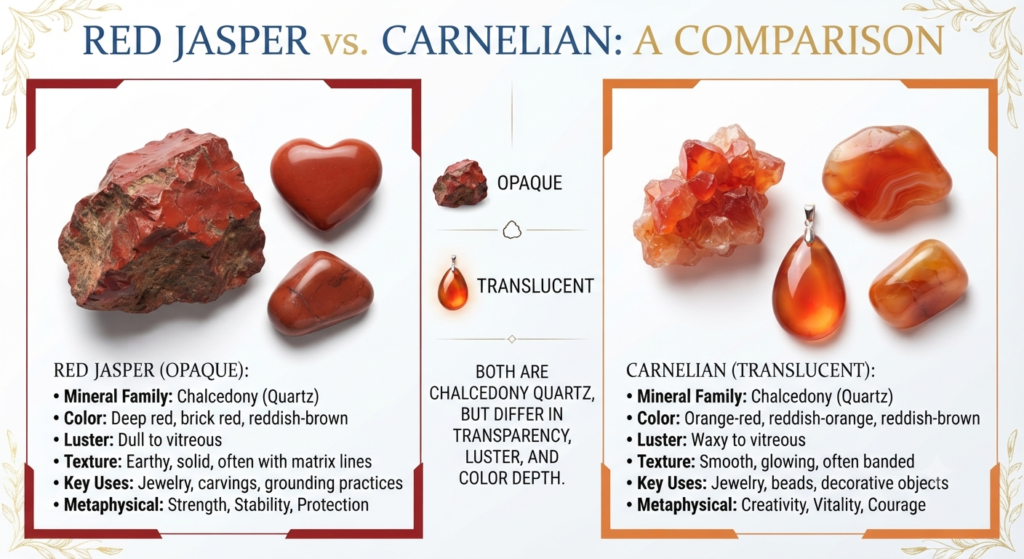
What Is Red Jasper?
Red Jasper is an opaque, microcrystalline variety of quartz belonging to the chalcedony family. Its rich red color comes primarily from iron oxide inclusions dispersed throughout the stone. Unlike translucent gemstones, red jasper has a completely opaque appearance, giving it a bold, earthy look.
For thousands of years, red jasper has been used in jewelry, carvings, seals, amulets, and decorative objects. It is appreciated for its durability, affordability, and attractive natural patterns.
Characteristics of Red Jasper
- Opaque gemstone
- Deep red to reddish-brown color
- Composed of silicon dioxide (SiO₂)
- Colored by iron oxide
- Mohs hardness of 6.5–7
- Smooth polished finish
- Earthy appearance
- Excellent durability
- Commonly used in cabochons
- Popular ornamental stone
What Is Carnelian?
Carnelian is a translucent to semi-transparent variety of chalcedony that ranges in color from pale orange to deep reddish-orange and reddish-brown. Its warm, glowing appearance results from finely dispersed iron oxide impurities.
Carnelian has been prized since ancient civilizations for making beads, rings, pendants, engraved seals, and ceremonial objects. Today, it remains one of the most popular semi-precious gemstones because of its vibrant color and excellent polish.
Characteristics of Carnelian
- Translucent to semi-transparent
- Orange-red to reddish-brown color
- Silicon dioxide (SiO₂)
- Colored by iron oxide
- Mohs hardness of 6.5–7
- Waxy to vitreous luster
- Bright glowing appearance
- Accepts excellent polish
- Frequently faceted or cabochon-cut
- Popular jewelry gemstone
Red Jasper vs. Carnelian: Key Differences
1. Mineral Classification
The primary difference between Red Jasper vs. Carnelian lies in their appearance rather than their mineral composition.
Red Jasper is an opaque variety of chalcedony, which is a microcrystalline form of quartz.
Carnelian is a translucent to semi-transparent variety of chalcedony that also belongs to the quartz family.
Although both gemstones have the same chemical composition, their internal structures produce different visual effects.
2. Chemical Composition
Chemically, both gemstones are nearly identical.
Red Jasper
- Chemical formula: SiO₂
- Composed primarily of silicon dioxide
- Colored by iron oxide inclusions
Carnelian
- Chemical formula: SiO₂
- Composed primarily of silicon dioxide
- Colored by finely dispersed iron oxide
The difference in color and transparency results from the distribution and concentration of iron impurities.
3. Color
Color is one of the easiest ways to distinguish Red Jasper vs. Carnelian.
Red Jasper typically displays:
- Deep red
- Brick red
- Dark reddish-brown
- Earthy red
Carnelian commonly occurs in:
- Orange-red
- Bright reddish-orange
- Honey orange
- Light reddish-brown
- Warm amber-red
Carnelian generally appears brighter and more vibrant than red jasper.
4. Transparency
Transparency is the most noticeable visual difference.
Red Jasper
- Completely opaque
- Does not transmit light
Carnelian
- Translucent to semi-transparent
- Light passes through thin edges
- Exhibits a glowing appearance when illuminated
This glowing quality makes carnelian especially popular in jewelry.
5. Luster
The surface appearance differs after polishing.
Red Jasper
- Dull to vitreous luster
- Earthy appearance
- Matte-looking finish in some specimens
Carnelian
- Waxy to vitreous luster
- Bright, glossy finish
- More reflective surface
Carnelian generally appears shinier than red jasper.
6. Hardness
Both gemstones have nearly identical hardness because they belong to the same mineral family.
Red Jasper
- Mohs hardness: 6.5–7
Carnelian
- Mohs hardness: 6.5–7
Both are durable enough for rings, pendants, bracelets, earrings, and everyday jewelry.
7. Internal Structure
The internal appearance varies considerably.
Red Jasper
- Dense and opaque
- Fine-grained texture
- Often contains mineral inclusions
- May display streaks or patterns
Carnelian
- More uniform texture
- Cleaner internal appearance
- Minimal visible inclusions
- Light penetrates the stone
Carnelian usually appears clearer and more luminous.
8. Common Uses
Although both stones are widely used, their preferred applications differ.
Red Jasper is commonly used for:
- Cabochon jewelry
- Sculptures
- Decorative carvings
- Paperweights
- Beads
- Ornamental objects
- Meditation stones
Carnelian is widely used for:
- Rings
- Necklaces
- Earrings
- Bracelets
- Pendants
- Beads
- Engraved gemstones
Carnelian is more frequently chosen for fine jewelry because of its transparency and brilliance.
9. Symbolism
Both gemstones have long histories in cultural and spiritual traditions.
Red Jasper is traditionally associated with:
- Strength
- Stability
- Protection
- Endurance
- Grounding
- Courage
Carnelian is traditionally associated with:
- Energy
- Creativity
- Confidence
- Motivation
- Passion
- Vitality
These symbolic meanings are based on cultural and historical beliefs rather than scientific evidence.
10. Availability
Both gemstones are relatively common and affordable.
Red Jasper
- Abundant worldwide
- Widely available
- Usually inexpensive
- Easy to source
Carnelian
- Common in gemstone markets
- Moderately abundant
- Slightly more valuable when displaying rich orange-red color
- High-quality specimens may command higher prices
Neither gemstone is considered rare.
11. Jewelry Durability
Both gemstones are suitable for everyday jewelry when cared for properly.
Red Jasper
- Highly resistant to scratches
- Excellent toughness
- Suitable for daily wear
- Less likely to show internal fractures
Carnelian
- Good durability
- Excellent polish retention
- Suitable for rings and pendants
- May require protection from sharp impacts
Both should be cleaned with mild soap and warm water rather than harsh chemicals.
12. Price
Price depends on color quality, size, polish, and craftsmanship.
Red Jasper
- Generally less expensive
- Affordable for most jewelry buyers
- Decorative pieces are widely available
Carnelian
- Usually slightly more expensive
- High-quality translucent specimens have greater value
- Fine jewelry-grade stones command premium prices
Overall, both gemstones offer excellent value, but carnelian typically costs more because of its brighter color and translucent appearance.
Similarities Between Red Jasper and Carnelian
Although Red Jasper vs. Carnelian differ in transparency, color intensity, and appearance, they also share many important characteristics. Both gemstones belong to the quartz family and have been used for jewelry and ornamental purposes for thousands of years.
Some major similarities include:
- Both are varieties of chalcedony.
- Both are composed primarily of silicon dioxide (SiO₂).
- Both belong to the quartz mineral family.
- Both derive their color from iron oxide impurities.
- Both have a Mohs hardness of 6.5–7.
- Both are durable gemstones suitable for everyday jewelry.
- Both are commonly cut into cabochons and beads.
- Both are widely available and affordable.
- Both accept a high-quality polish.
- Both have been used in jewelry and decorative carvings since ancient times.
Advantages of Red Jasper
Red Jasper is valued for its durability, earthy appearance, and versatility in decorative applications.
Major advantages include:
- Excellent durability for everyday wear.
- Rich, deep red color with natural patterns.
- Highly resistant to scratches.
- Easy to polish and shape.
- Affordable compared to many gemstones.
- Widely available worldwide.
- Suitable for carvings and sculptures.
- Popular for cabochon jewelry.
- Dense and less prone to internal fractures.
- Requires minimal maintenance.
Advantages of Carnelian
Carnelian is admired for its vibrant color and attractive transparency, making it one of the most popular semi-precious gemstones.
Major advantages include:
- Bright orange-red color.
- Attractive translucent appearance.
- Excellent polish and shine.
- Ideal for fine jewelry.
- Durable enough for daily wear.
- Available in various shades of orange and red.
- Lightweight and comfortable in jewelry.
- Affordable compared to precious gemstones.
- Easy to cut into different gemstone shapes.
- Highly popular among jewelry designers.
Which Is Better—Red Jasper or Carnelian?
Neither Red Jasper nor Carnelian is universally better because each gemstone has its own strengths and aesthetic appeal.
Red Jasper is an excellent choice for those who prefer an opaque gemstone with rich earthy colors and exceptional durability. It is widely used in carvings, cabochons, decorative items, and everyday jewelry.
Carnelian, on the other hand, is ideal for people who appreciate bright, glowing gemstones with translucent beauty. Its vibrant orange-red hues and glossy finish make it especially popular for rings, pendants, earrings, and bracelets.
In summary:
- Choose Red Jasper if you prefer a deep red, opaque, earthy-looking gemstone.
- Choose Carnelian if you want a bright, translucent gemstone with vibrant orange-red tones.
The best choice ultimately depends on your personal style, intended use, and color preference.
Conclusion
The comparison of Red Jasper vs. Carnelian shows that although both gemstones belong to the chalcedony family and share the same chemical composition, they differ significantly in transparency, color, luster, appearance, and typical uses. Red Jasper is an opaque gemstone with a deep earthy red color that is prized for its durability and natural patterns. Carnelian is a translucent gemstone known for its glowing orange-red hues, glossy finish, and popularity in fine jewelry.
Understanding Red Jasper vs. Carnelian helps gemstone enthusiasts, jewelry buyers, collectors, and students recognize their unique features and select the stone that best suits their preferences. Whether you prefer the bold appearance of Red Jasper or the luminous beauty of Carnelian, both gemstones offer lasting beauty and excellent value.
Frequently Asked Questions (FAQs)
The main difference between Red Jasper vs. Carnelian is that Red Jasper is opaque with a deep brick-red color, while Carnelian is translucent to semi-transparent and typically displays bright orange-red to reddish-brown hues.
No. Although both are varieties of chalcedony (microcrystalline quartz) and have the same chemical composition (SiO₂), they differ in transparency, color, and appearance.
Generally, Carnelian is slightly more valuable than Red Jasper, particularly when it has a rich, uniform orange-red color and good transparency. However, value also depends on size, quality, craftsmanship, and origin.
Both gemstones have a Mohs hardness of 6.5–7, making them similarly durable for everyday jewelry. Proper care helps maintain their appearance over time.
You can usually distinguish them by their appearance:
Red Jasper is opaque with a solid, earthy red color.
Carnelian is translucent to semi-transparent and often glows when held against a light source.
Reference:
1. “Red Jasper Meaning, Uses, and Healing Properties.” Kumi Oils.
2. “Carnelian.” Wikipedia. Wikipedia Foundation.
Read Next: